



Mount Sinai, known in Arabic as Jabal Musa, rises 2,285 meters above the granite heart of the Sinai Peninsula in Egypt. Sacred to Jews, Christians and Muslims as the mountain where Moses received the Ten Commandments, it draws pilgrims who climb through the night to watch sunrise. This guide explains where Mount Sinai is, its history in the Bible and Islam, how to climb it and when to visit today.

Geographical Location of Mount Sinai
Mount Sinai is in Egypt, in the mountains of the South Sinai Governorate, close to the small town of Saint Catherine. It stands at about 28.54°N, 33.97°E, roughly midway between the Gulf of Suez and the Gulf of Aqaba.
The mountain is made of red and gray granite and forms part of a high mountain massif that includes Mount Catherine, the highest peak in Egypt at about 2,629 meters. The surrounding landscape is an arid world of rocky valleys mountain peaks, sparse vegetation and small Bedouin gardens. Jabal Musa is one of the most visited Sinai attractions.
Mount Sinai Facts at a Glance
| Fact | Detail |
|---|---|
| Arabic name | Jabal Musa, meaning the Mountain of Moses |
| Other names | Mount Horeb in biblical tradition; al-Tur in the Quran |
| Height | About 2,285 meters (7,497 feet) |
| Location | South Sinai Governorate, Egypt |
| Nearest town | Saint Catherine, at the foot of the mountain |
| Main climbing routes | The Camel Path and the Steps of Repentance |
| Steps of Repentance | About 3,750 stone steps |
| Typical climbing time | About 2.5 to 3.5 hours up |
| Summit | Greek Orthodox chapel and a small mosque |
| UNESCO status | Part of the Saint Catherine Area World Heritage Site since 2002 |
Is Mount Sinai in Egypt or Israel?
Mount Sinai is in Egypt. It stands on the Sinai Peninsula, which is Egyptian territory and borders Israel and the Gaza Strip in the northeast.
Israel occupied the Sinai Peninsula after the 1967 Arab-Israeli War. Under the 1979 Egypt-Israel Peace Treaty, Sinai was returned to Egypt in stages, with most of the final withdrawal completed on April 25, 1982, now commemorated in Egypt as Sinai Liberation Day.
Where Is Mount Sinai Now?
The mountain traditionally identified as biblical Mount Sinai is Jabal Musa, beside Saint Catherine's Monastery in South Sinai.
Christian monks and pilgrims have associated this mountain with Moses since Late Antiquity. However, the biblical texts do not provide enough geographic detail to prove the identification archaeologically.
Other proposed locations include Jebel Serbal in southern Sinai, Har Karkom in the Negev and Jabal al-Lawz in northwest Saudi Arabia. None has been conclusively proven, while Jabal Musa remains the traditional pilgrimage site recognized by generations of Christian, Jewish and Muslim visitors.
How Can I Reach Sinai, Egypt?
By air, the nearest major international gateway is Sharm El Sheikh International Airport, around three hours away by road. Taba International Airport is another option, although it has fewer flights.
Mount Sinai is around two hours by road from Dahab and roughly two hours from Nuweiba. Organized sunrise trips normally leave these Red Sea destinations late in the evening.
From Cairo, the journey takes roughly six to seven hours by road through the Ahmed Hamdi Tunnel beneath the Suez Canal.
Bus and private-transfer schedules can change, so check them before traveling. Connections to Sinai are available from Cairo and other major Egyptian cities, while many pilgrimage tours travel overnight so visitors can begin the ascent before sunrise.
The Historical Journey of Mount Sinai
Mount Sinai holds a special place in Judaism, Christianity and Islam because religious tradition identifies it as the mountain where God spoke to Moses. Its story stretches from biblical tradition and early Christian pilgrimage to Islamic reverence and modern travelers.
Biblical Account
In the Book of Exodus, Moses leads the Israelites out of Egypt and through the wilderness to Mount Sinai. There, amid thunder, smoke and fire, he receives the Ten Commandments on tablets of stone, as described in Exodus 19 and 20.
The Sinai tradition is also connected with the Burning Bush, where Moses receives his calling in Exodus 3, and with the prophet Elijah, who journeys to the mountain of God in 1 Kings 19.
The Bible does not identify the pharaoh of the Exodus. Some modern writers have suggested Ramses II, but there is no archaeological evidence that proves which Egyptian ruler, if any, should be connected with the biblical account.
Early Christian Pilgrimage
As Christianity spread through Egypt, hermits and monks settled in the valleys around Mount Sinai for prayer and isolation.
Around AD 381–384, the pilgrim Egeria described climbing Mount Sinai and visiting places associated with Moses. Her travel account is one of the earliest surviving descriptions of Christian pilgrimage in the region.
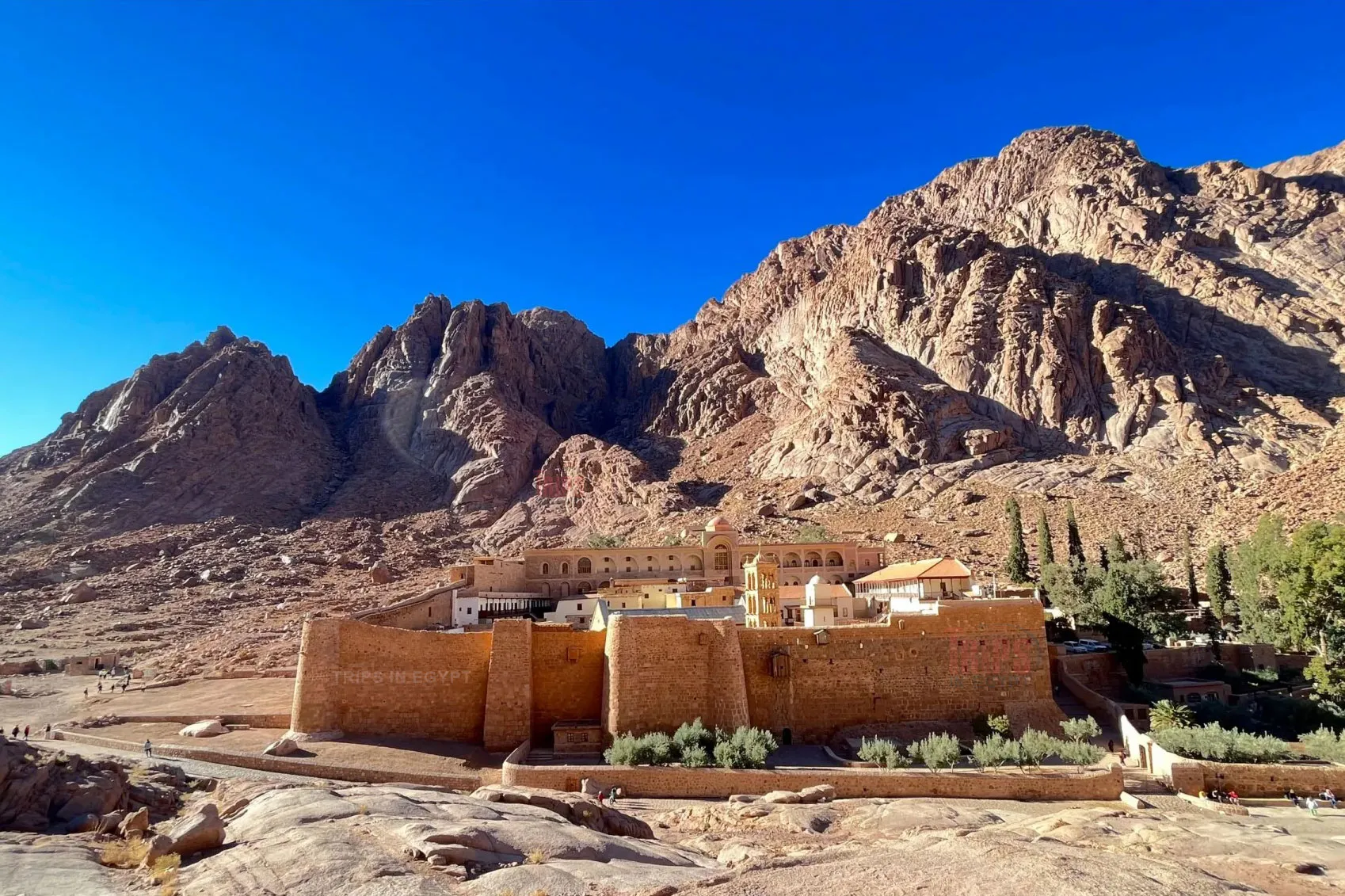
In the sixth century, Byzantine emperor Justinian I ordered the construction of a fortified monastery at the foot of the mountain. It later became known as Saint Catherine's Monastery and remains an active Greek Orthodox monastery.
Mount Sinai in Islam
In Islamic tradition, Mount Sinai is associated with al-Tur or Tur Sina and with the Prophet Musa, the Quranic Moses.
Moses is traditionally known as Kalim Allah, "the one who spoke with God", because the Quran describes God speaking directly to him.
Surah 95 begins with an oath by the fig, the olive and Mount Sinai, while Surah 52 is called At-Tur, "The Mount".
In Surah 7, Moses asks to see God. The Quran describes the mountain crumbling when God manifests His glory to it, after which Moses falls unconscious.
Surah 20 also refers to the sacred valley of Tuwa, where Moses sees the fire and receives his divine calling.
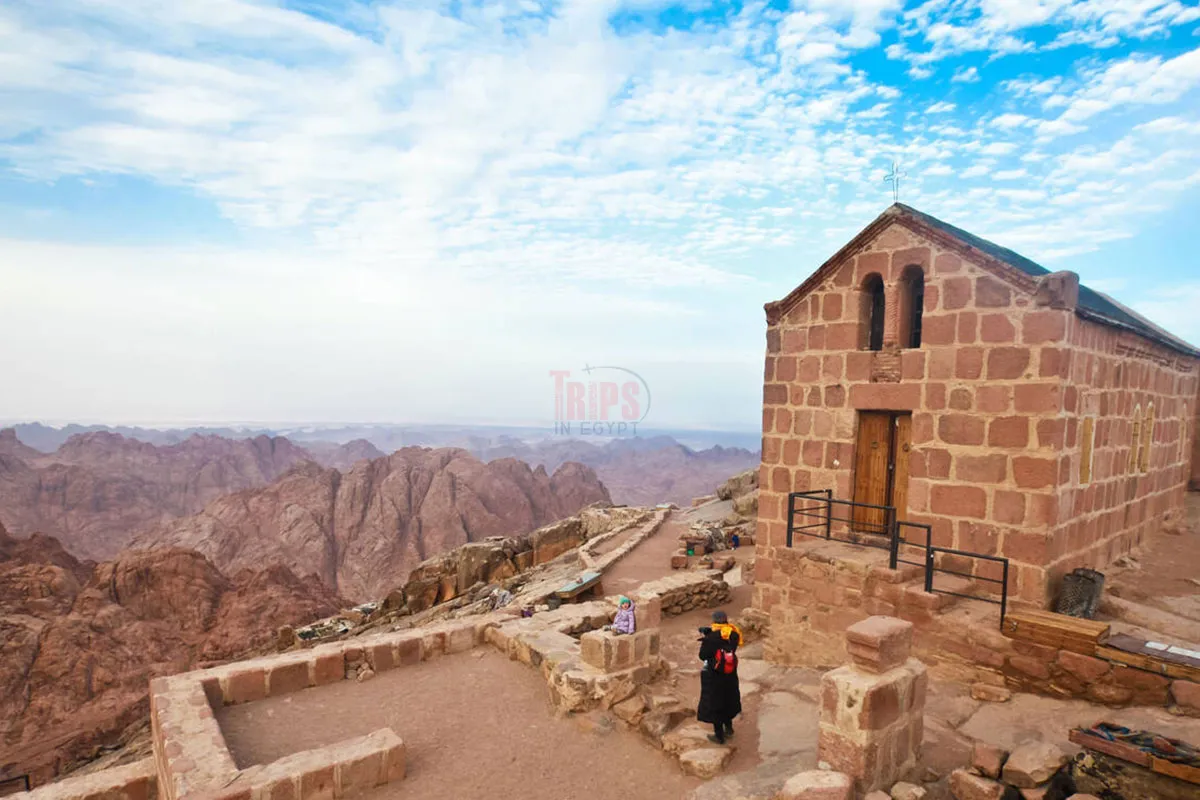
A small mosque stands on Mount Sinai's summit near the Christian chapel. Saint Catherine's Monastery also contains a historic mosque dating to the Fatimid period, around the early twelfth century.
Mount Sinai in Modern History
In the nineteenth century, European scholars traveled to Saint Catherine's Monastery searching for ancient manuscripts.
The monastery became particularly famous in connection with the Codex Sinaiticus, one of the oldest surviving manuscripts of the Christian Bible. Constantin von Tischendorf obtained portions of the manuscript from the monastery during visits culminating in 1859.
In 2002, UNESCO inscribed the Saint Catherine Area, including the monastery and surrounding sacred landscape, as a World Heritage Site.
Today, Mount Sinai remains one of Egypt's most important destinations for religious pilgrimage, cultural tourism and mountain hiking.
Why Is Mount Sinai So Famous?
Mount Sinai is famous above all for its traditional connection with Moses and the Ten Commandments, one of the most influential religious and moral traditions in world history.
Its importance crosses three faiths. Jews, Christians and Muslims all connect the wider Sinai tradition with Moses.
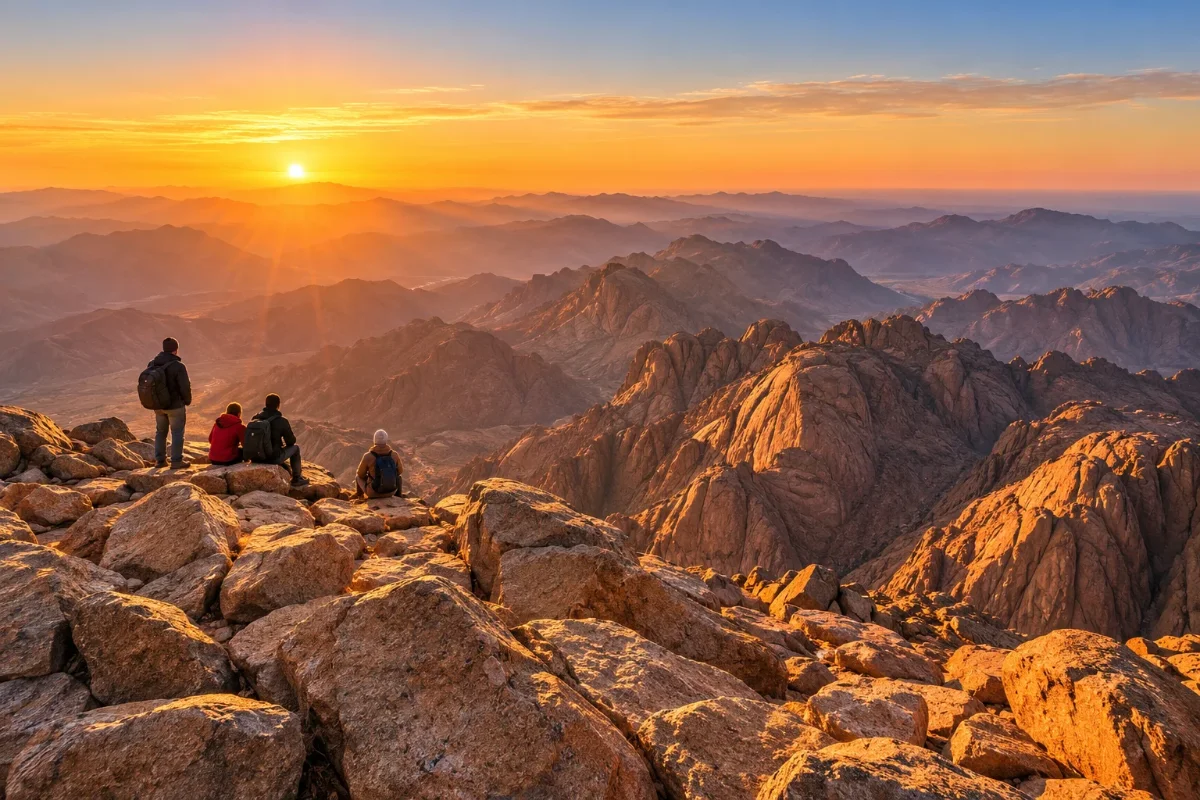
The mountain is also renowned for its sunrise. From the summit, visitors watch dawn spread across the jagged granite ranges of South Sinai, which has turned the night pilgrimage into one of Egypt's most memorable travel experiences.
The List of the Ten Commandments Given by Moses at Mount Sinai
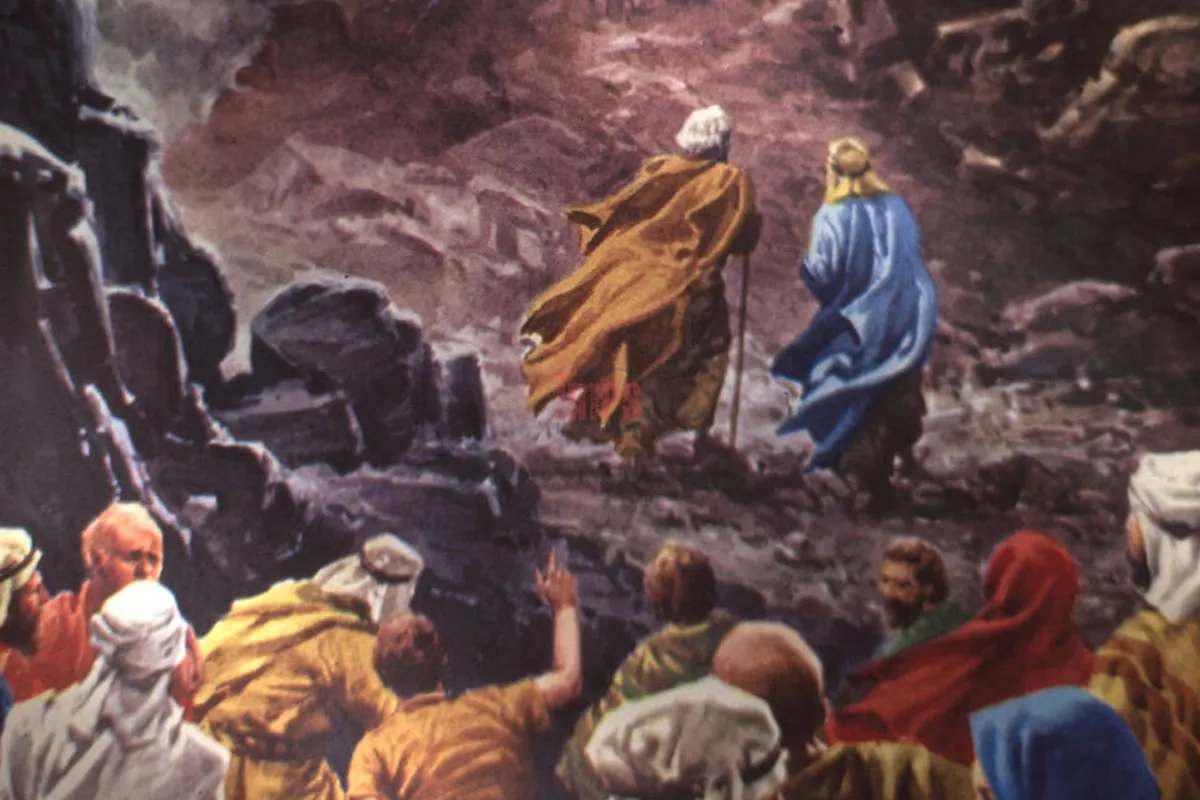
The Ten Commandments appear in Exodus 20 and again in Deuteronomy 5. Jewish, Catholic and Protestant traditions divide and number them somewhat differently, so the list below follows the ordering commonly used in Protestant Bibles.
The Ten Commandments in the Bible
-
You shall have no other gods before me — Exodus 20:3. Worship is directed to God alone.
-
You shall not make for yourself a graven image — Exodus 20:4. Idols must not be worshipped.
-
You shall not take the name of the Lord your God in vain — Exodus 20:7. God's name should not be misused or invoked falsely.
-
Remember the Sabbath day, to keep it holy — Exodus 20:8–10. In Judaism, the Sabbath extends from Friday evening to Saturday evening. Most Christian traditions observe Sunday as their principal day of worship.
-
Honor your father and your mother — Exodus 20:12. Children are commanded to respect their parents.
-
You shall not murder — Exodus 20:13. Human life must not be unlawfully taken.
-
You shall not commit adultery — Exodus 20:14. Marriage and marital faithfulness are protected.
-
You shall not steal — Exodus 20:15. The property of others must be respected.
-
You shall not bear false witness against your neighbor — Exodus 20:16. False testimony and harmful lies are forbidden.
-
You shall not covet — Exodus 20:17. The command warns against wrongful desire for another person's household or possessions.
Mount Sinai in the Quran & Bible
The Quran does not present the Ten Commandments as one numbered list identical to Exodus 20, but it contains many closely related commands, particularly in Surah 6:151–153 and Surah 17:22–39.
| Bible — Exodus 20 | Related Quranic Teaching |
|---|---|
| You shall have no other gods before me | Do not set up another god with God — 17:22 |
| You shall not make a graven image | Avoid the impurity of idols — 22:30 |
| Do not take God's name in vain | Do not make God's name an excuse in your oaths — 2:224 |
| Remember the Sabbath day | The Sabbath is associated with the Children of Israel — 4:154; Muslims gather for Friday prayer — 62:9 |
| Honor your father and mother | Treat your parents with kindness — 17:23 |
| You shall not murder | Do not kill the soul God has made sacred — 6:151 |
| You shall not commit adultery | Do not approach adultery — 17:32 |
| You shall not steal | Theft is prohibited — 5:38 |
| You shall not bear false witness | Avoid false speech — 22:30 |
| You shall not covet | Do not desire what God has given others above you — 4:32 |
The Significance of the Ten Commandments
For ancient Israel, the Ten Commandments formed a central part of the covenant between God and the Israelites and became foundational to Jewish religious and ethical teaching.
They also became central to Christianity and had a major influence on later European religious thought and moral traditions.
Islam has its own revealed law and religious framework, but the Quran contains many ethical teachings that parallel commands found in the Decalogue, reflecting the shared prophetic traditions surrounding Moses.
Things to Do in the Sinai Mount
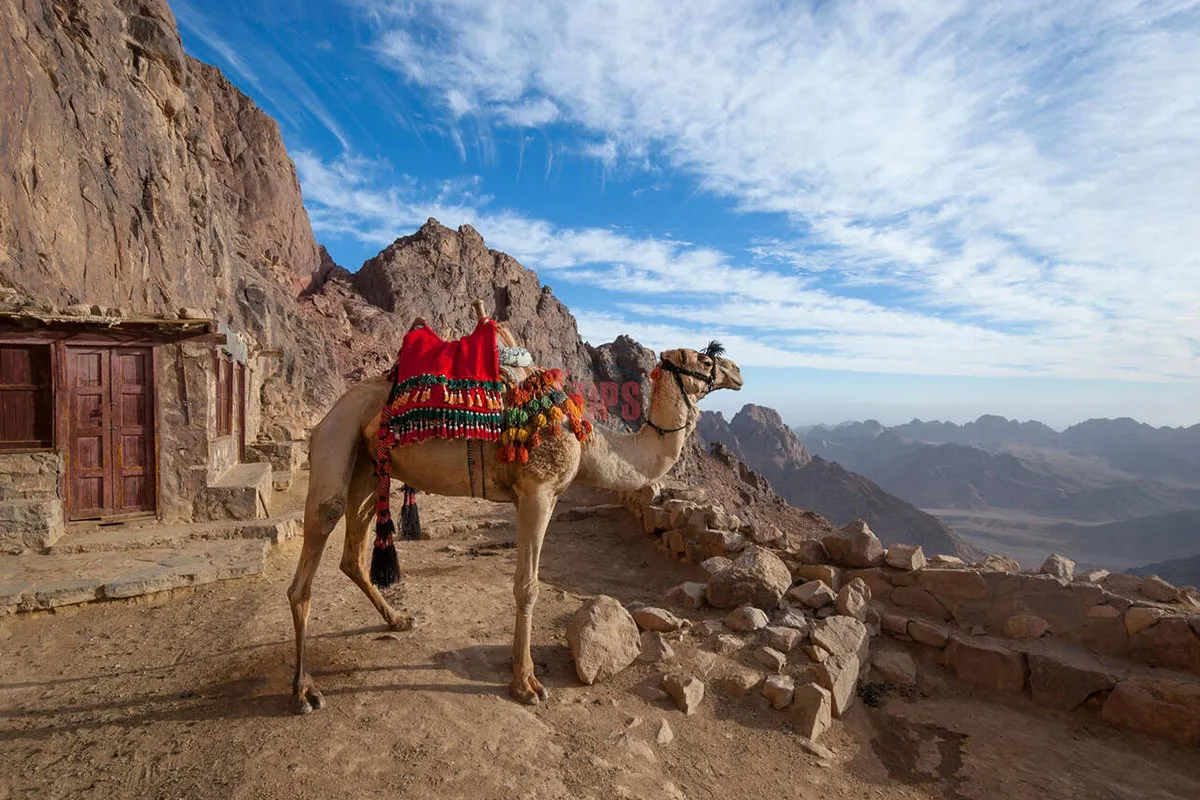
Mount Sinai is more than a climb. The surrounding Saint Catherine region combines sacred sites, mountain landscapes and Bedouin culture, making it worth spending more time here than the sunrise hike alone.
1. Hike to the Summit
The climb to the summit is the main reason many visitors come to Mount Sinai.
There are two traditional routes: the gentler Camel Path, followed by most visitors, and the much steeper Steps of Repentance, approximately 3,750 stone steps traditionally associated with monks.
Both routes meet near Elijah's Basin, also called the Plain or Basin of the Seventy Elders in local tradition, before the final ascent to the summit.
2. Explore St. Catherine's Monastery
At the foot of the mountain stands Saint Catherine's Monastery, one of the world's oldest continuously functioning Christian monasteries.
It is named after Catherine of Alexandria, a Christian martyr traditionally believed to have come from a noble family.
Within the monastery is the site traditionally identified with the Burning Bush, together with a remarkable collection of manuscripts, icons and religious objects.
3. Sunset at Mount Sinai
Not every traveler climbs for sunrise. An afternoon ascent allows you to watch the peaks of Sinai change from gold and orange to red and purple as the sun disappears.
Sunset hikes are usually quieter than the classic overnight pilgrimage. Carry a flashlight or headlamp because the descent continues after dark.
4. Stargazing Around Mount Sinai
The high altitude, dry climate and low levels of artificial light around Saint Catherine make the area excellent for stargazing.
On clear nights, especially when the moon is faint, stars can be exceptionally visible during the climb.
Several Bedouin camps in the region also offer evenings under the night sky with tea or dinner around a fire.
5. Experience the Bedouin Culture
The Jebeleya Bedouin have lived around Saint Catherine for centuries and remain closely connected with the mountain.
Many work as local guides and camel handlers, while Bedouin camps introduce visitors to traditional hospitality, sweet tea and foods such as zarb, meat and vegetables slow-cooked in an underground oven.
6. Experience Desert Safari
Visitors staying in Sharm El Sheikh or Dahab can combine their Mount Sinai experience with desert safaris.
Typical trips include quad-bike rides, camel rides, desert scenery, Bedouin meals and traditional evening entertainment.
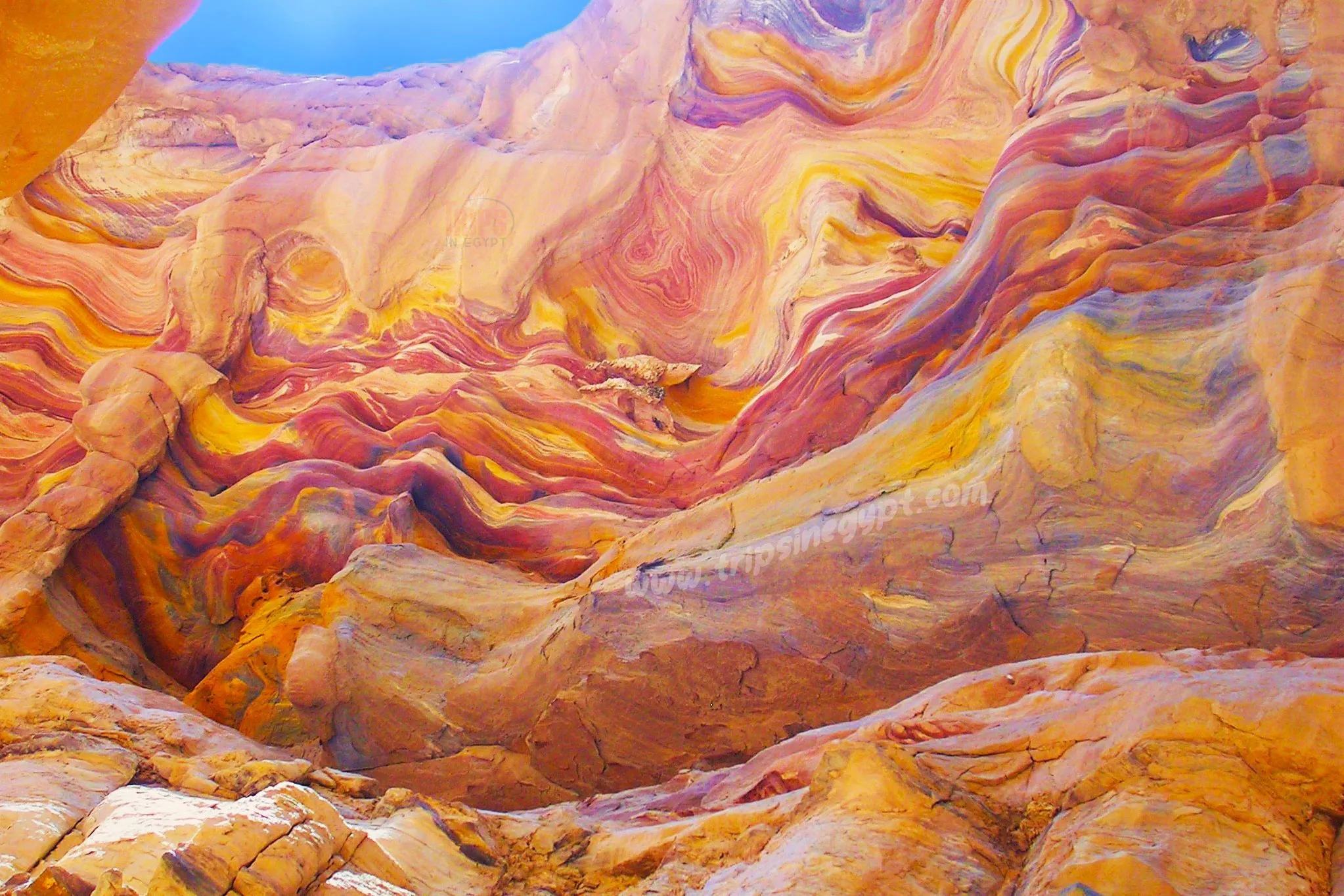
7. Discover the Colored Canyon
Near Nuweiba, the Colored Canyon is another of South Sinai's striking natural landscapes.
Its narrow sandstone walls reach up to around 40 meters in places and display bands of red, yellow, orange and purple produced by mineral-rich layers.
It is sometimes compared visually with Petra, but the Colored Canyon is a natural geological formation rather than a rock-cut archaeological city.
8. Photography
Mount Sinai offers some of the most dramatic mountain photography in Egypt.
The best moments include the blue hour before sunrise, the first rays of sunlight crossing the granite peaks and the softer late-afternoon light around Saint Catherine's Monastery.
Always ask before photographing Bedouin residents, and respect any photography restrictions inside the monastery.
Climbing Mount Sinai: The Pilgrimage Hike
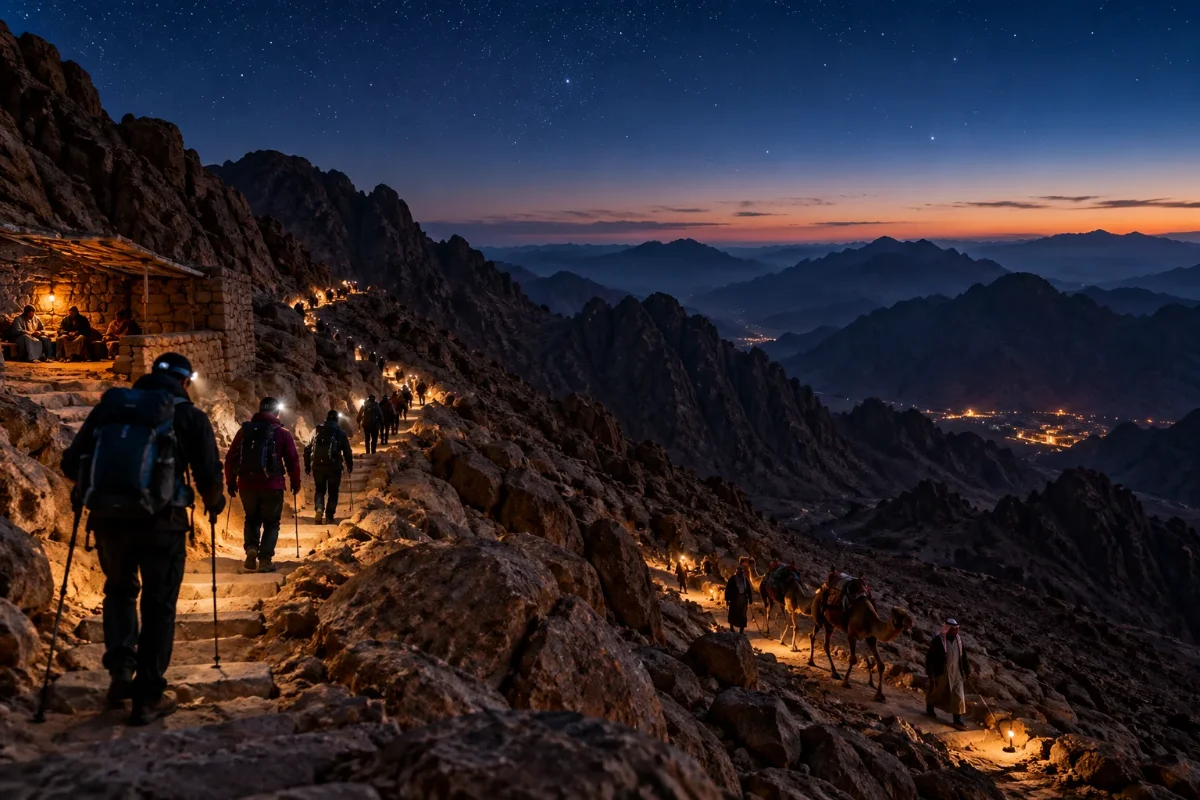
The Mount Sinai pilgrimage is commonly completed at night so hikers can reach the summit before sunrise. It is physically demanding in places but manageable for many travelers with reasonable fitness.
The Camel Path and the Steps of Repentance
Most sunrise climbers begin the ascent during the night.
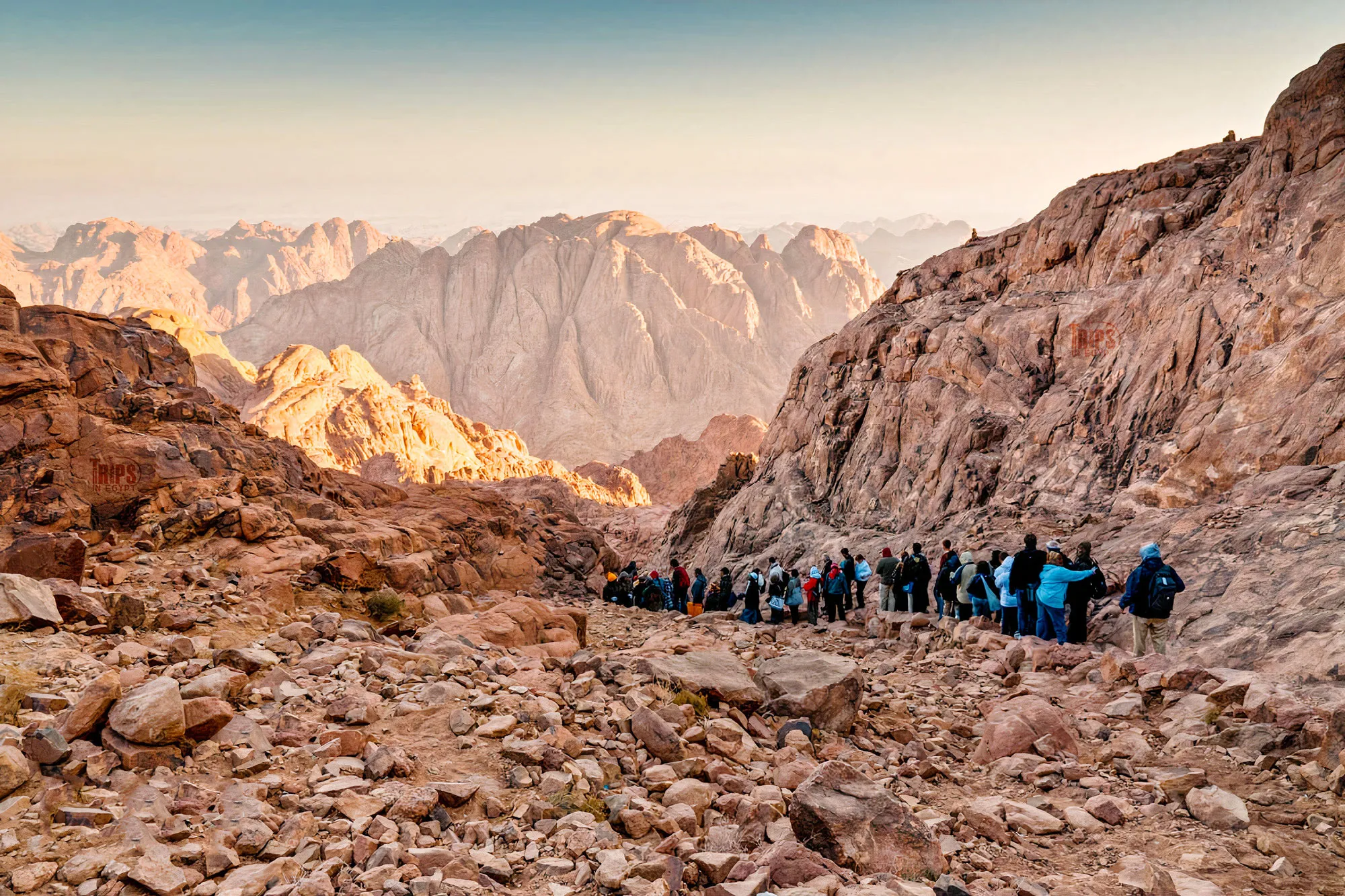
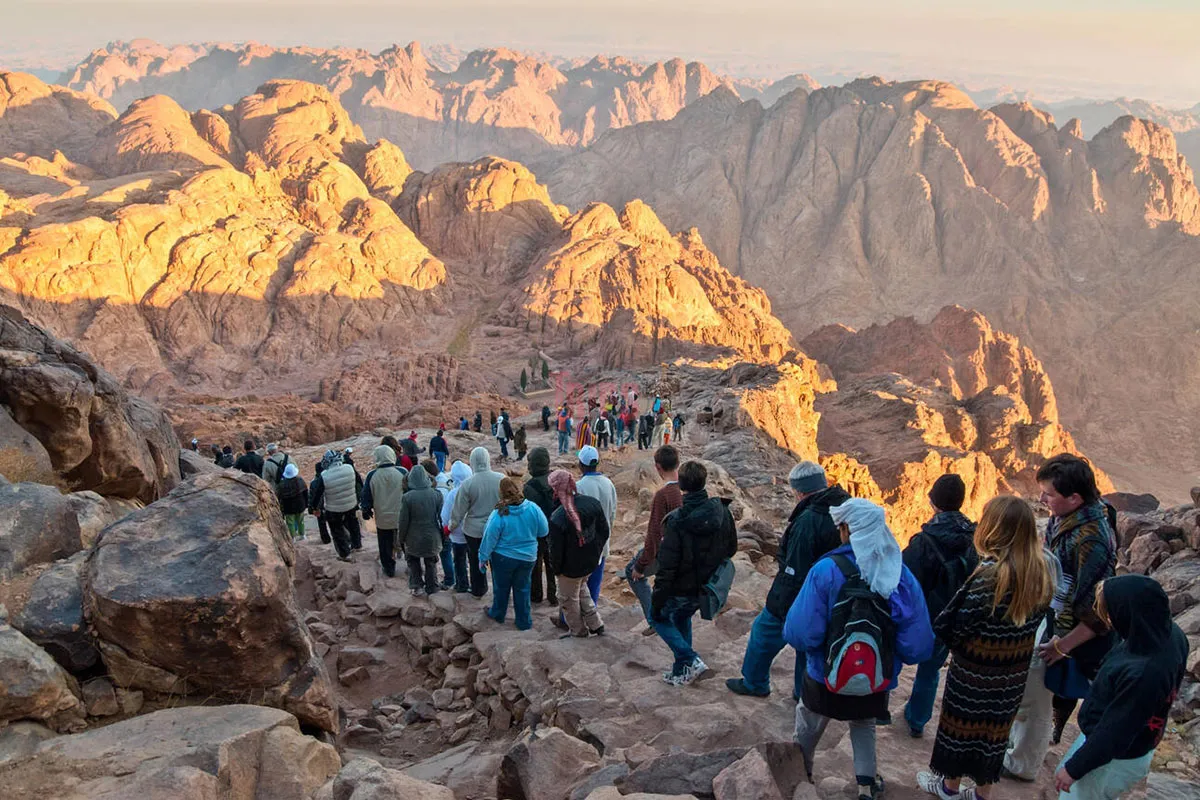
The Camel Path follows a gradual zigzagging route up the mountain and normally takes around 2.5 to 3.5 hours depending on fitness, crowds and stops.
Camels can carry visitors along much of this route for an additional fee, but they cannot complete the final climb to the summit.
The second route is the Steps of Repentance, also called the Steps of Penitence. Approximately 3,750 uneven stone steps climb steeply behind the monastery.
The route is shorter but significantly more strenuous, particularly for the knees.
Near Elijah's Basin, the routes converge before the last section of roughly 750 steps leading toward the summit.
Sunrise at the Summit
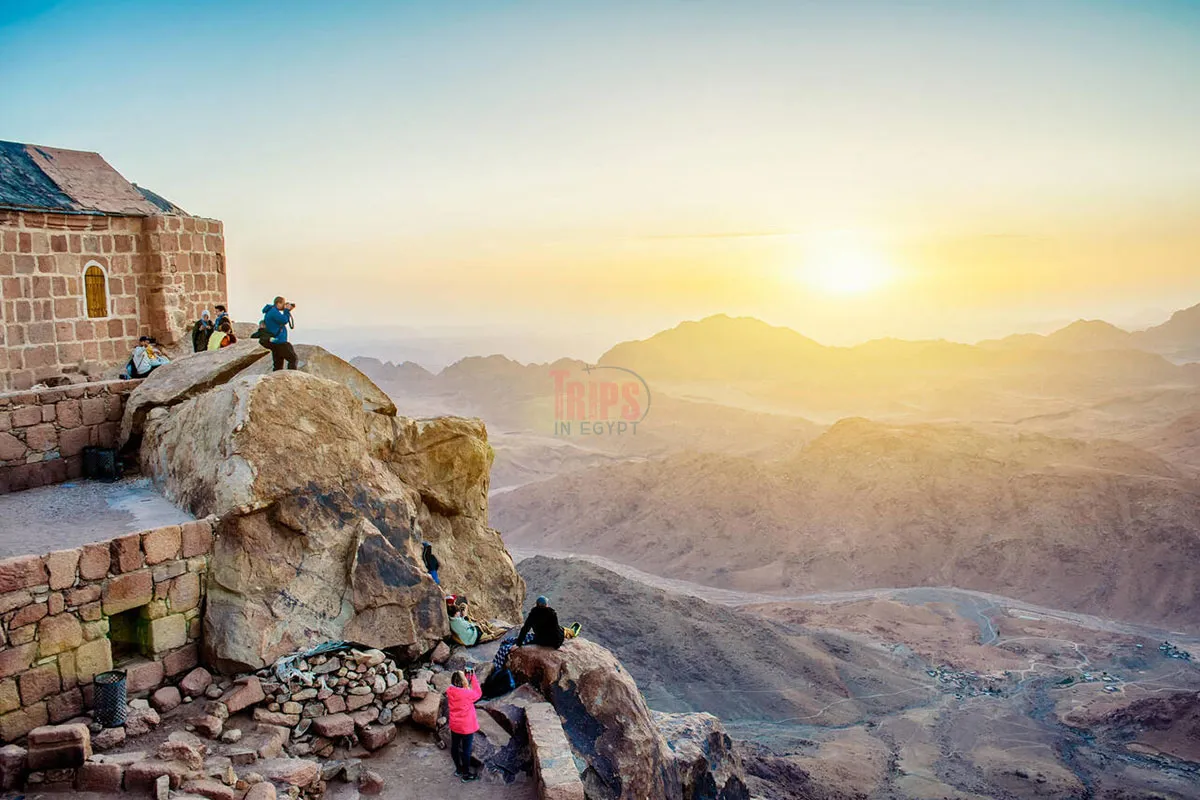
At the summit stands the Chapel of the Holy Trinity, built in 1934 on the site of earlier Christian structures, alongside a small mosque.
Before sunrise, pilgrims and hikers gather around the summit rocks while the surrounding mountains remain almost completely dark.
As the sun rises, the granite peaks gradually turn orange and gold. The atmosphere can include quiet prayer, hymns in different languages and travelers simply watching the landscape.
Small stalls along the upper route may sell tea and offer blankets during busy periods.
Guides, Rules and What to Bring
Visitors commonly make the climb with a local Bedouin guide arranged in Saint Catherine or included with an organized excursion.
Bring:
-
A flashlight or headlamp.
-
Warm layers, especially for the summit.
-
A hat and gloves in colder months.
-
Comfortable walking or hiking shoes with good grip.
-
Water and light snacks.
-
Egyptian pounds for drinks, camels or other small expenses.
-
Your passport for security checkpoints on Sinai roads.
How Hard Is the Climb?
The Mount Sinai hike involves several hours of uphill walking on rocky and uneven paths.
The Camel Path is relatively gradual, but the final stone steps become much steeper. The Steps of Repentance route is considerably more challenging.
Cold can be as difficult as the physical climb. During winter, temperatures around the summit before dawn can fall below freezing, and snowfall occasionally occurs in the high Saint Catherine mountains.
Visiting Mount Sinai: Best Time and Tours
Mount Sinai can be visited from Saint Catherine, Dahab, Sharm El Sheikh or Cairo. The right season and itinerary make a major difference because temperatures change sharply between the mountain summit and the surrounding Red Sea resorts.
The Best Time to Visit Mount Sinai
The most comfortable periods are generally spring and autumn, particularly from March to May and September to November.
Daytime temperatures around Saint Catherine can be mild during these seasons, while the summit remains much colder before sunrise.
Winter from December to February brings clear mountain air but cold conditions. Daytime temperatures around Saint Catherine can be around 10°C to 15°C, while nights and early mornings may approach or fall below freezing.
Summer days are warmer, although overnight climbs avoid much of the daytime heat.
For the monastery, plan carefully around its limited visitor schedule and religious calendar.
Best Tour Itinerary to Mount Sinai
Our Overnight Trip to Mount Sinai and St. Catherine Monastery from Cairo, From $180, follows this general plan:
Day One: Pickup from your hotel in Cairo followed by an approximately six-hour drive in a private air-conditioned vehicle to Saint Catherine. After arrival, check in to your hotel, have dinner and rest before the climb.
Day Two: Transfer very early to the foot of Mount Sinai and begin the ascent with a local guide. Watch the sunrise from the summit, descend the mountain and visit Saint Catherine's Monastery. Afterward, return by road to Cairo.
Explore Sinai's Treasures, One Tour at a Time
If you are staying beside the Red Sea, Mount Sinai is a popular overnight excursion from Sharm El Sheikh.
The drive is around three hours each way, depending on road and checkpoint conditions. Our guide to the best places to visit from Sharm El Sheikh covers more experiences around South Sinai.
The 6 Days Cairo and Sharm El Sheikh Luxury Holiday, From $1,350, combines Cairo's landmarks with free time beside the Red Sea, where a Mount Sinai trip can be added.
Trips in Egypt also offers Egypt vacation packages that can include the Sinai Peninsula and its sacred landscapes.
Mount Sinai is among the places where history, faith and nature meet. According to tradition, Moses climbed it to receive the Ten Commandments, monks have prayed at its foot for fifteen centuries, and travelers still climb through the night to greet the sun. Whether you come as a pilgrim or a hiker, dawn over the granite peaks of Sinai is a sight that stays with you long after the descent.
5 Days Cairo And Hurghada Trip
Amazing 4 Nights Cairo and Hurghada Trip Itinerary 5 Days Cairo and Hurghada trip wil...
- Duration 5 Days / 4 Nights
- Location Cairo & Hurghada
- Type Historical & Recreational Tour
From$690/per person
View Tour
6 Days Cairo, Alexandria & Faiyum Tour
Unforgettable Cairo, Alexandria & Faiyum Adventure in Six Days 6 Days Cairo, Alex...
- Duration 6 Days / 5 Nights
- Location Cairo - Alexandria - Fayum
- Type Historical Tour
From$720/per person
View Tour
10 Days Cairo, Faiyum & Nile Cruise Holiday
Breathtaking 10 Days Journey of A Lifetime in Egypt 10 Days Cairo, Faiyum & Nile...
- Duration 10 Days / 9 Nights
- Location Cairo, Luxor, Aswan & Faiyum
- Type Classic Tour
From$1350/per person
View Tour SOLD OUT
Ultimate 7-Day Egypt Solar Eclipse Experience with Hurghada 2027
Enjoy a 7-Day Egypt Solar Eclipse Tour with Hurghada 2027 6 Nights Egypt Solar Ecli...
- Duration 7 Days / 6 Nights
- Location Cairo / Giza / Luxor / Hurghada
- Type Astronomical Tour
Sold Out
View Details