



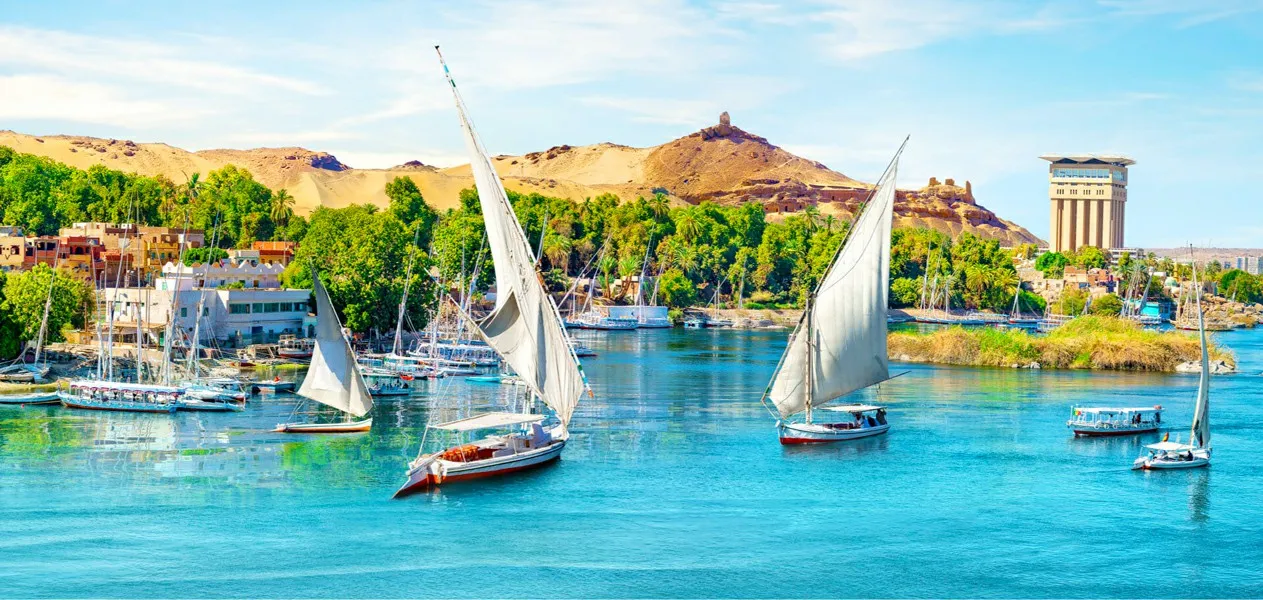
The Nile River has shaped Egypt for thousands of years. Flowing about 6,650 kilometers north through eleven countries, it turned a desert into the cradle of one of history's greatest civilizations, feeding farms, carrying stone for the pyramids and inspiring powerful myths. This guide traces the history of the Nile River, its importance in ancient Egypt, essential Nile River facts, the annual flood and the best ways to experience it today.

Nile River in Ancient Egypt
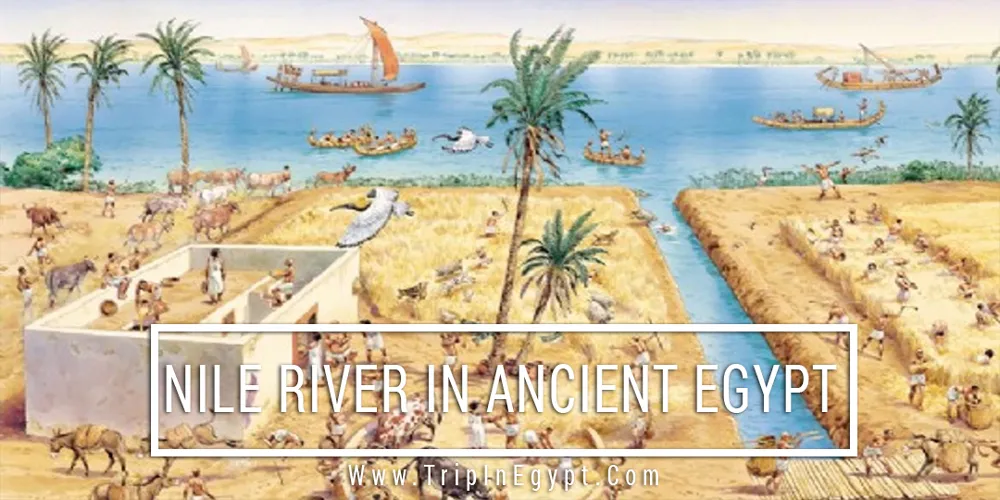
Ancient Egyptians worshipped many gods and goddesses, but no natural force influenced everyday life more than the Nile. They called it Iteru, meaning "the river", and organized agriculture, transport, religion and the calendar around its yearly rhythm. Settlements, temples and royal cemeteries developed in relation to the river, while boats connected communities across a kingdom stretching almost 1,000 kilometers from south to north.
The Story Behind the Nile River
The story of the Nile River began millions of years before the rise of ancient Egypt. Geologists believe an earlier river system, sometimes called the Eonile, carved a deep canyon toward the Mediterranean about six million years ago when the sea level fell dramatically.
Research published in 2019 suggested that geological forces deep beneath northeast Africa may have helped keep the Nile on a broadly similar course for roughly 30 million years. As the Sahara became increasingly dry after about 5000 BC, human communities concentrated around the river, where reliable water and fertile soil allowed farming settlements to grow into the civilization of ancient Egypt.
Nile River History Timeline
The history of the Nile River in Egypt can be followed through several major stages. Farming communities expanded along its banks after about 5000 BC, and around 3100 BC Upper and Lower Egypt were united under one ruler. During the Old Kingdom, from about 2686 to 2181 BC, the river became essential for transporting stone, workers and supplies connected with the great pyramid-building projects.
The Nile remained central under the Ptolemies and Romans, when Egypt became a major supplier of grain to the Mediterranean world. The famous Nilometer on Roda Island was built in 861 AD, the first Aswan Dam was completed in 1902, and the Aswan High Dam was finished in 1970. Each development changed the way Egyptians controlled, measured and depended on the river.
What Was the Importance of the Nile River in Ancient Egypt
The Nile River was important to ancient Egypt because it supplied water, fertile soil, food, transportation and the seasonal rhythm that organized economic life. Its annual flood deposited dark silt across the valley, helping farmers grow reliable crops in a landscape otherwise surrounded by desert.
The Egyptians called their fertile homeland Kemet, or "the Black Land", in contrast with Deshret, the "Red Land" of the surrounding desert. Boats carried grain, livestock, stone and people along the river, while the current helped ships move north and prevailing winds allowed sailing south. Taxes, agricultural work and much of daily life in ancient Egypt followed the Nile's seasonal cycle.
How Close Was the Nile to the Pyramids
When the pyramids were constructed, branches of the Nile ran much closer to the desert edge than they do today. A 2024 study mapped a buried waterway known as the Ahramat Branch, stretching for roughly 64 kilometers beside pyramid fields from the Giza region toward Lisht.
The discovery helps explain why so many pyramid complexes were built along the same desert strip. Papyri discovered at Wadi al-Jarf, including the diary of an official called Merer, also describe limestone being transported by boat and canal to the Giza Pyramids Complex, showing how waterways supported the enormous construction projects.
The Economic Importance of the Nile River in Egypt
The Nile remains the economic backbone of Egypt. The overwhelming majority of the country's population lives within the narrow Nile Valley and Delta even though these areas represent only a small fraction of Egypt's total land. The river supplies most of the country's freshwater, irrigates agricultural land, supports electricity generation and sustains a large tourism economy centered on Cairo, Luxor and Aswan.
Farming on the Nile's Black Land
The fertile soil of the Nile Valley allowed ancient farmers to grow wheat, which became a staple for bread, and barley, which was widely used for beer. Egyptians also cultivated papyrus for writing material, baskets and sandals, while flax supplied the linen used for clothing and funerary wrappings.
Farmers developed basin irrigation systems that held floodwater inside earth-walled fields and later used devices such as the shaduf to raise water from the river. These technologies contributed to Egypt's agricultural success and appear among the developments discussed in our guide to ancient Egyptian inventions.
The Aswan High Dam and Lake Nasser
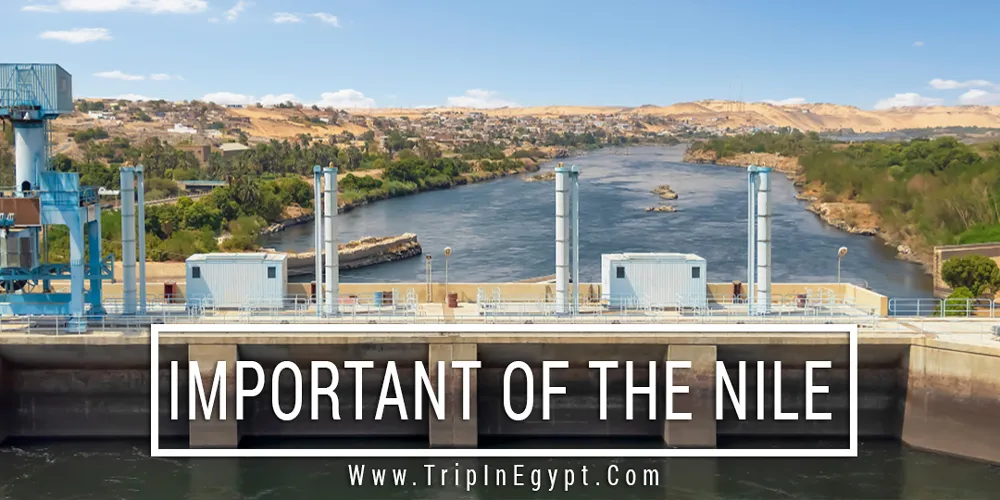
The Aswan High Dam transformed the relationship between Egypt and the Nile. Constructed between 1960 and 1970, the dam is about 3.8 kilometers long and 111 meters high, and its hydroelectric plant has a generating capacity of roughly 2,100 megawatts.
Behind the dam lies Lake Nasser, one of the world's largest artificial lakes, extending approximately 500 kilometers south into Sudan. The dam provides flood control, water storage and electricity, but its construction also required the relocation of tens of thousands of Nubians and the rescue or relocation of major archaeological sites threatened by rising water.
The Toshka Project and the Nile's Future
The Toshka Project, also called the New Valley Project, was launched in 1997 to move water from Lake Nasser into Egypt's Western Desert and create new agricultural land. Development has continued in stages, supported by large pumping and irrigation systems intended to expand farmland beyond the traditional Nile Valley.
Egypt's future water security also depends on developments upstream. The Grand Ethiopian Renaissance Dam on the Blue Nile became another major factor in regional water discussions, with Egypt continuing to seek agreements concerning the operation of the dam, particularly during prolonged droughts.
Egypt Nile River Facts
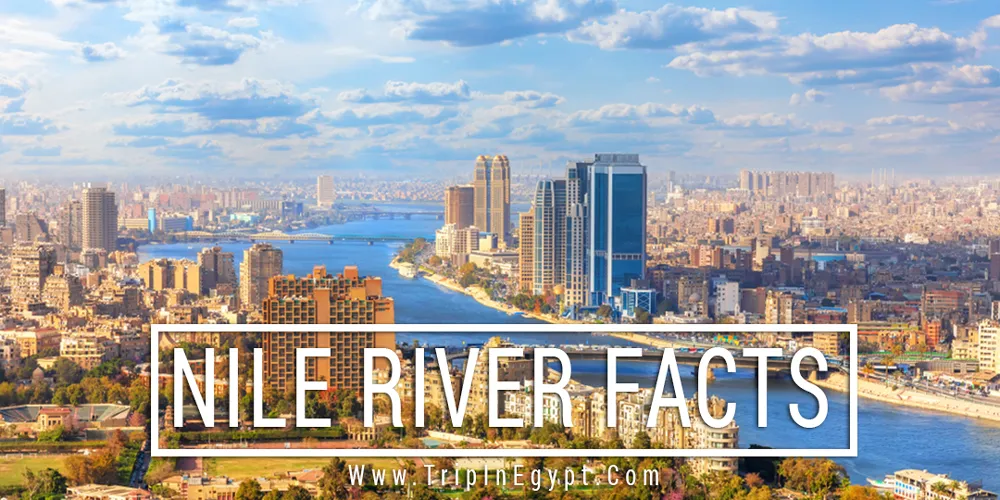
When people search for the river of Egypt, they are usually referring to the Nile, the country's only permanent river. Egypt lies near the end of the Nile's long journey, receiving water that begins thousands of kilometers away in East and Central Africa. Cairo, Luxor, Aswan and many other major Egyptian cities developed along its banks, making the river inseparable from the country's geography and history.
Where Does the Nile River Start
The Nile has two major branches. The White Nile is the longer branch and is commonly treated as the main headwater, flowing from Lake Victoria in Uganda, although its most distant feeder streams originate farther south in Rwanda and Burundi.
The Blue Nile begins at Lake Tana in the Ethiopian highlands and supplies much of the water and sediment that historically reached Egypt during the flood season. The White and Blue Nile meet at Khartoum in Sudan, while the Atbara River joins farther north before the combined Nile continues through the Sahara toward Egypt.
Nile River Map, the Countries and the Route
On a Nile River map, the river flows from south to north, which is why Upper Egypt lies in the south and Lower Egypt lies toward the Mediterranean. The Nile basin covers roughly 3.4 million square kilometers and touches eleven countries across eastern and central Africa.
These countries are Tanzania, Uganda, Rwanda, Burundi, the Democratic Republic of the Congo, Kenya, Ethiopia, Eritrea, South Sudan, Sudan and Egypt. Once inside Egypt, the river passes Aswan, the Nubian city, Luxor and Cairo before dividing into the Rosetta and Damietta branches of the Nile Delta and reaching the Mediterranean Sea.
Is the Nile the Longest River in the World
The Nile is generally listed as the longest river in the world at approximately 6,650 kilometers, or around 4,130 miles. Measuring the length of a river is complicated because the result depends on how researchers define its most distant source and exact endpoint.
Some studies have proposed that the Amazon River may be slightly longer under different measurement methods. Most standard references still place the Nile first in length, while the Amazon is unquestionably the world's largest river by water volume.
10 Facts About the Nile River
The following Nile River facts summarize its geography, history and importance to Egypt.
|
Nile River Fact |
Detail |
|
Length |
About 6,650 km and generally listed as the world's longest river |
|
Direction |
Flows north toward the Mediterranean |
|
Countries |
The Nile basin touches 11 countries |
|
Main branches |
White Nile and Blue Nile |
|
Meeting point |
The two main branches meet at Khartoum |
|
Main floodwater source |
Summer rainfall in the Ethiopian highlands |
|
Ancient name |
Iteru, meaning "the river" |
|
Historic flood |
Flooded Egypt every summer before regulation by the High Dam |
|
Delta branches |
Rosetta and Damietta |
|
Wildlife |
Includes Nile crocodiles, Nile perch and many water birds |
The Relationship Between the Nile River and the Osiris Myth
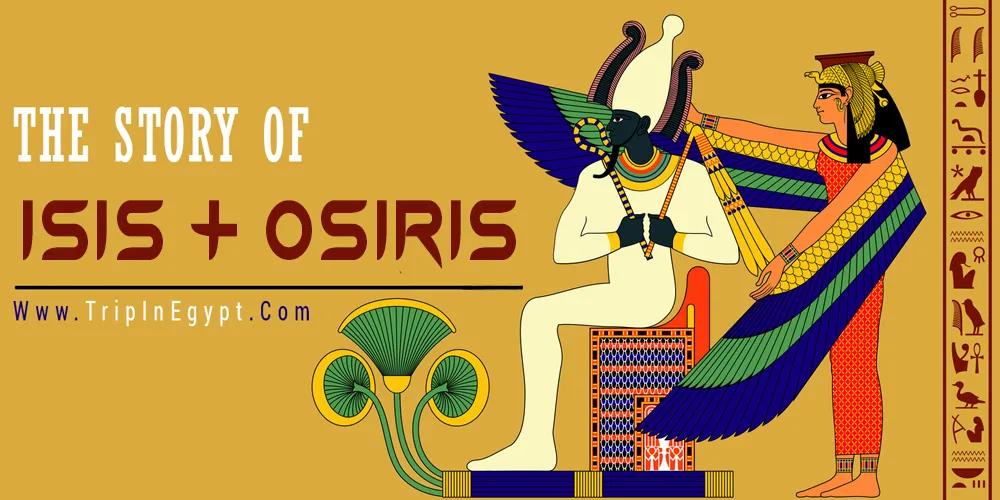
For ancient Egyptians, the Nile was more than a physical waterway. Its annual return represented fertility, renewal and divine order, ideas that became deeply connected with the story of Osiris, the god who died and returned to life, and his wife Isis. The cycle of flood, growth and harvest echoed the larger Egyptian belief that death could be followed by rebirth.
The Story of Osiris, Isis and the Nile
According to the myth, Set became jealous of his brother Osiris and tricked him into entering a beautifully made coffin. Set sealed the coffin and cast it into the Nile, forcing Isis to search for her husband's body. In later accounts, children who saw the coffin floating helped Isis discover where it had traveled.
Set eventually found the body again, dismembered it and scattered the pieces across Egypt. Isis recovered the remains and restored Osiris, who became ruler of the afterlife, while their son Horus eventually challenged Set for the throne of Egypt. The complete version appears in the story of Osiris and Isis.
The association between Osiris and fertility helped connect him symbolically with the river and agricultural renewal. Later traditions also linked Isis's grief with the rising Nile, reinforcing the idea that the yearly flood represented the return of life to the land.
Hapi, Sobek and Khnum, Gods of the Nile
Several ancient Egyptian gods were closely associated with the Nile. Hapi represented the annual inundation and was depicted with symbols of abundance, including papyrus and lotus plants.
Sobek, the crocodile god, reflected both the danger and fertility of the river and was especially important at Kom Ombo and in the Faiyum. Khnum, the ram-headed creator god worshipped at Elephantine Island, was connected with the Nile's southern source and the life-giving flood. Offerings and rituals dedicated to these gods expressed hopes for a flood high enough to nourish the land without becoming destructive.
Why Did the Nile River Flood?
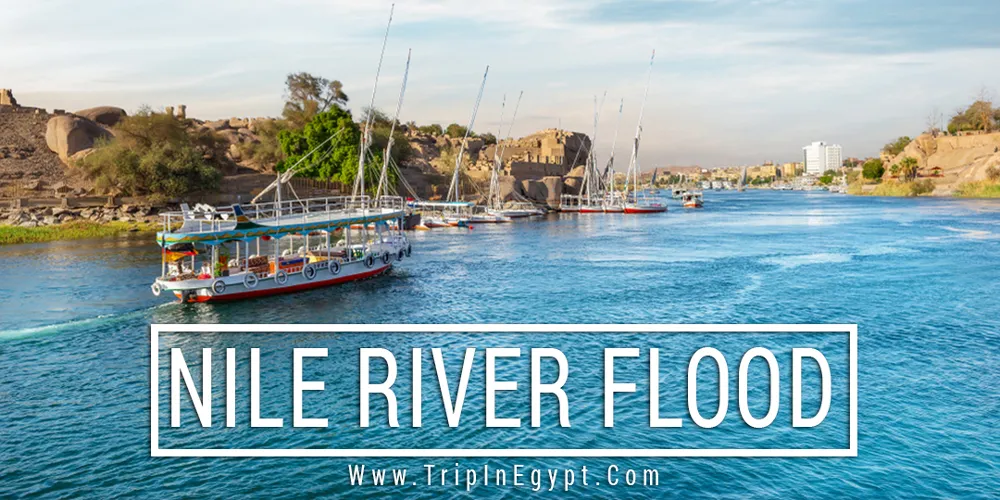
For thousands of years, the Nile rose every summer and covered the fields of Egypt with water and fertile sediment. The real cause lay far upstream in the Ethiopian highlands, where heavy seasonal rains between June and September dramatically increased the flow of the Blue Nile and Atbara River.
The White Nile provided a steadier year-round flow from equatorial Africa. Together, these waters reached Egypt during summer and peaked before falling again in autumn. The completion of the Aswan High Dam in 1970 ended this natural annual inundation inside Egypt.
The Three Seasons of the Nile Year
Ancient Egyptians divided the year into three seasons based on the behavior of the Nile. Akhet was the inundation season, when water covered agricultural land and farming activity slowed. Peret followed as the flood receded and farmers planted crops in the moist soil.
The final season, Shemu, was the harvest period before the next flood cycle began. The return of the inundation approximately coincided with the heliacal rising of the star Sirius, helping Egyptians organize a civil calendar of twelve 30-day months plus five additional days.
Nilometers and Measuring the Flood
Because the height of the flood directly affected harvests and taxation, Egyptians developed Nilometers to monitor the river level. These structures took the form of marked wells, staircases or columns positioned beside or connected to the Nile.
A low flood could mean poor harvests and famine, while an exceptionally high flood could damage houses and farmland. Important Nilometers survive at Elephantine Island, Kom Ombo and Roda Island in Cairo. Travelers can see the Elephantine example during a Day Tour to Elephantine Island & Aga Khan Mausoleum.
Wafaa El Nil and the Bride of the Nile
Celebrations of the river's annual rise survived into later Egyptian history and continue in the tradition known as Wafaa El Nil, or the Nile Flood Festival. The festival celebrates the river and its enduring importance to Egyptian life.
A famous story claims that ancient Egyptians sacrificed a young woman known as the Bride of the Nile to make the river rise. However, the story appears in a medieval Arabic source written long after the pharaonic period, and there is no reliable evidence that ancient Egyptians practiced such human sacrifice. Modern celebrations use symbolic objects such as flowers instead.
Things to Do on the Nile River
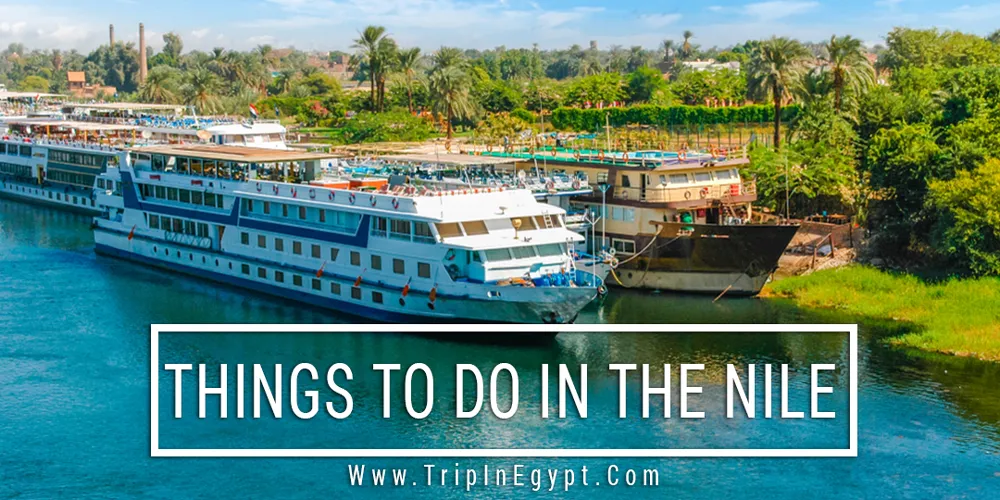
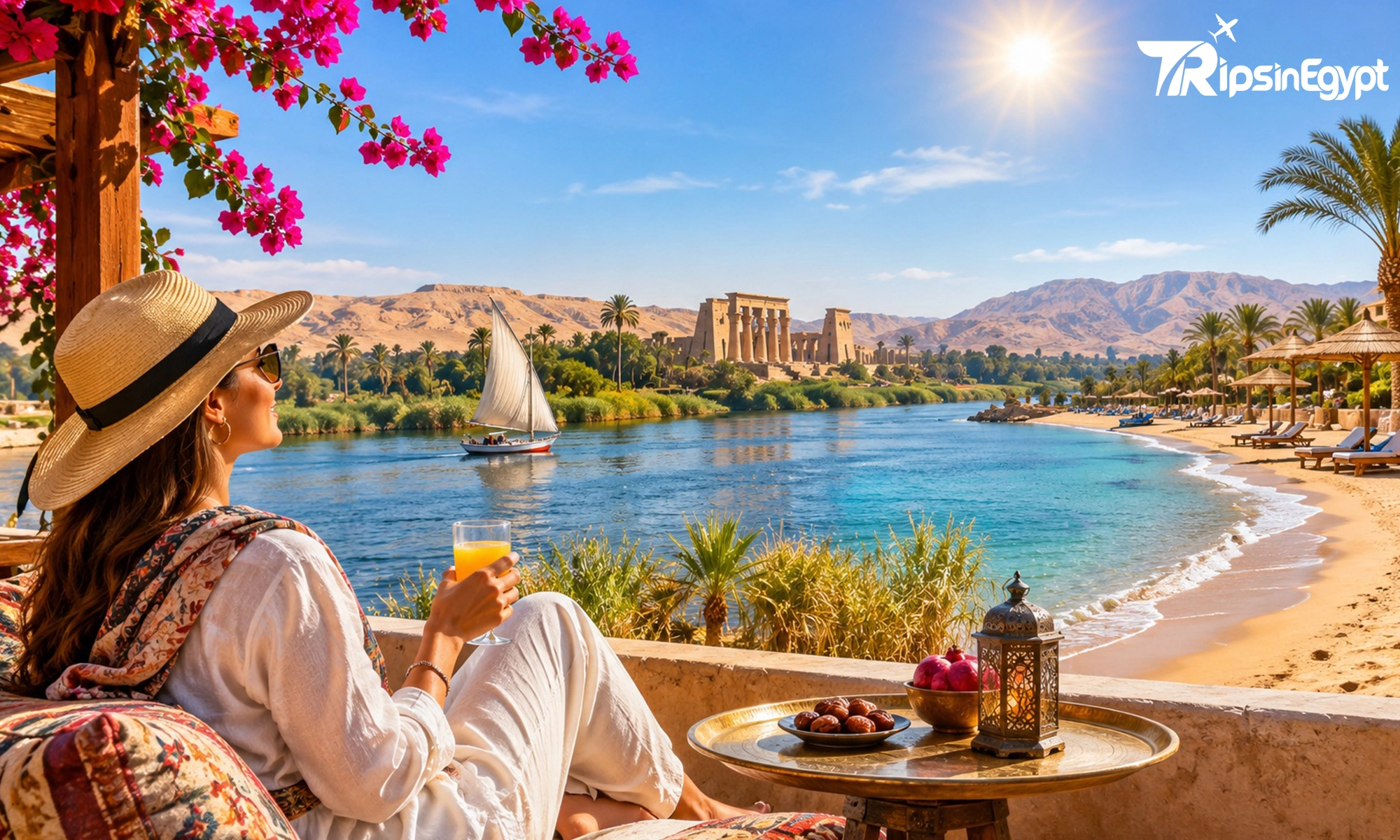
The best way to appreciate the Nile is to travel on it, just as Egyptians have done for thousands of years. A cruise between Luxor and Aswan connects many of Upper Egypt's greatest temples, while a traditional felucca offers a quieter experience close to the water. In Cairo, evening dinner cruises provide a completely different view of the capital and its illuminated riverfront.
Nile Cruises Between Luxor and Aswan
A Nile cruise is the classic way to explore Upper Egypt, and our Egypt Nile cruise packages operate in both directions between Luxor and Aswan. Most itineraries include stops at Edfu and Kom Ombo as well as guided sightseeing in both cities.
The most comfortable sailing season is generally from October to April, when temperatures are better suited to temple visits. Cruise ships normally provide private cabins, restaurants, sun decks and guided shore excursions.
A Nile Cruise from Aswan to Luxor typically combines Philae Temple and Aswan's major attractions with Kom Ombo, Edfu and the monuments of Luxor. The itinerary runs for 4 days and 3 nights and starts From $400, making it suitable for travelers who want to see the main Upper Egypt highlights within a shorter schedule.
A longer Nile Cruise from Luxor to Aswan gives travelers more time at Karnak, Luxor Temple, the West Bank, Edfu, Kom Ombo and Aswan. The 8-day round-trip itinerary starts From $730 and offers more time to relax on deck between archaeological visits.
Felucca Rides and Dinner Cruises
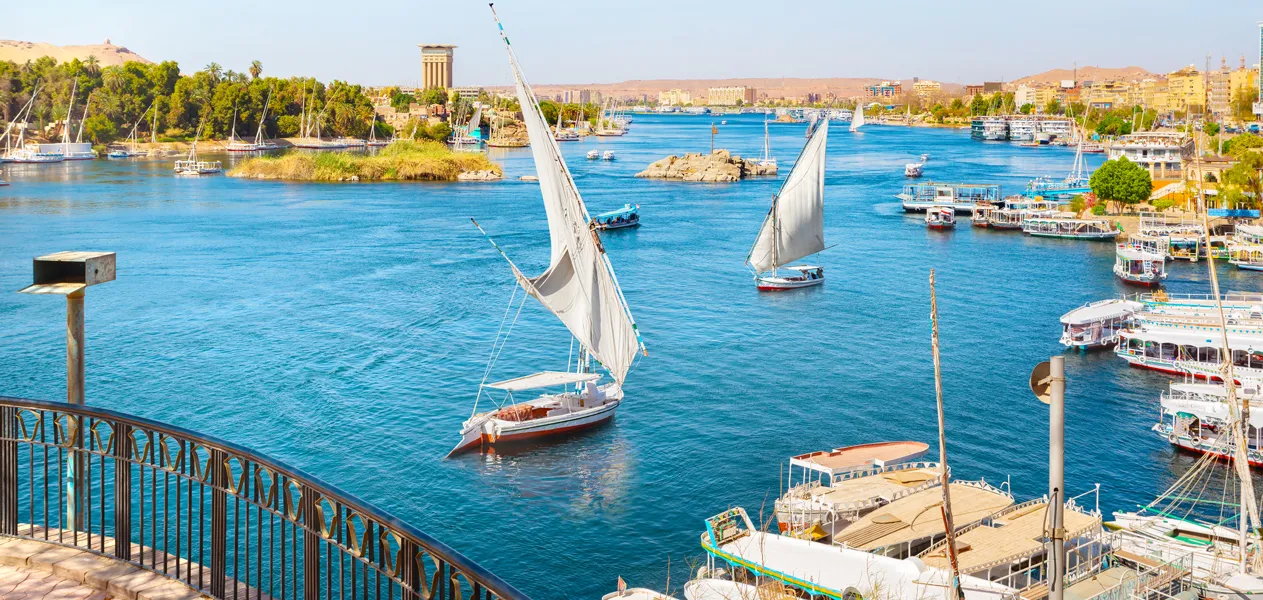
A felucca is a traditional wooden sailing boat that provides a simpler and quieter way to experience the Nile. These rides are especially popular around Aswan, where boats weave between granite islands and Nubian villages, and around Luxor, where sunset sails offer views of the green West Bank.
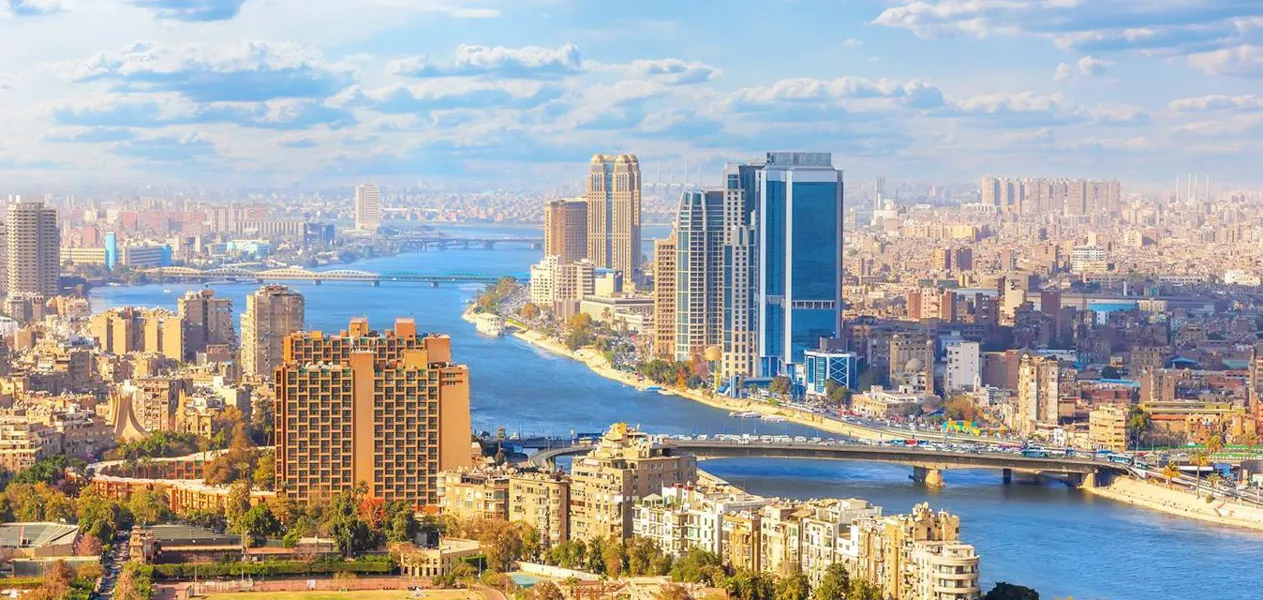
Cairo offers a different experience through evening dinner cruises, combining city views with food and live entertainment. These shorter activities work particularly well for travelers who want to spend time on the river without committing to a multi-day cruise.
Enjoy Tours on the Nile
The tours below offer several ways to experience the Nile, from a short evening in Cairo to a longer journey through Upper Egypt.
Cairo Dinner Nile Cruise includes a two-hour evening cruise with dinner, entertainment and hotel transfers in Cairo or Giza. From $45.
Private Felucca Ride and Banana Island Tour from Luxor combines a private felucca sail, Banana Island, lunch, an Egyptologist guide and hotel transfers. From $35.
10 Days Cairo, Faiyum & Nile Cruise Holiday combines Cairo and Faiyum with a Nile cruise through Upper Egypt and major archaeological sites. From $1,350.
5 Days Cairo And Hurghada Trip combines Cairo's historical attractions with snorkeling and desert activities in Hurghada. From $690.
6 Days Cairo, Alexandria & Faiyum Tour combines Cairo, Alexandria and the landscapes of the Faiyum Oasis. From $720.
The history of the Nile River is inseparable from the history of Egypt. For thousands of years, it fed the fields, carried materials for monuments, inspired the Osiris myth and shaped the Egyptian calendar. Today it still supplies water and supports millions of people. Sail between Luxor and Aswan or drift across the river by felucca, and the reason Egypt grew around the Nile becomes immediately clear.

5 Days Cairo And Hurghada Trip
Amazing 4 Nights Cairo and Hurghada Trip Itinerary 5 Days Cairo and Hurghada trip wil...
- Duration 5 Days / 4 Nights
- Location Cairo & Hurghada
- Type Historical & Recreational Tour
From$690/per person
View Tour
6 Days Cairo, Alexandria & Faiyum Tour
Unforgettable Cairo, Alexandria & Faiyum Adventure in Six Days 6 Days Cairo, Alex...
- Duration 6 Days / 5 Nights
- Location Cairo - Alexandria - Fayum
- Type Historical Tour
From$720/per person
View Tour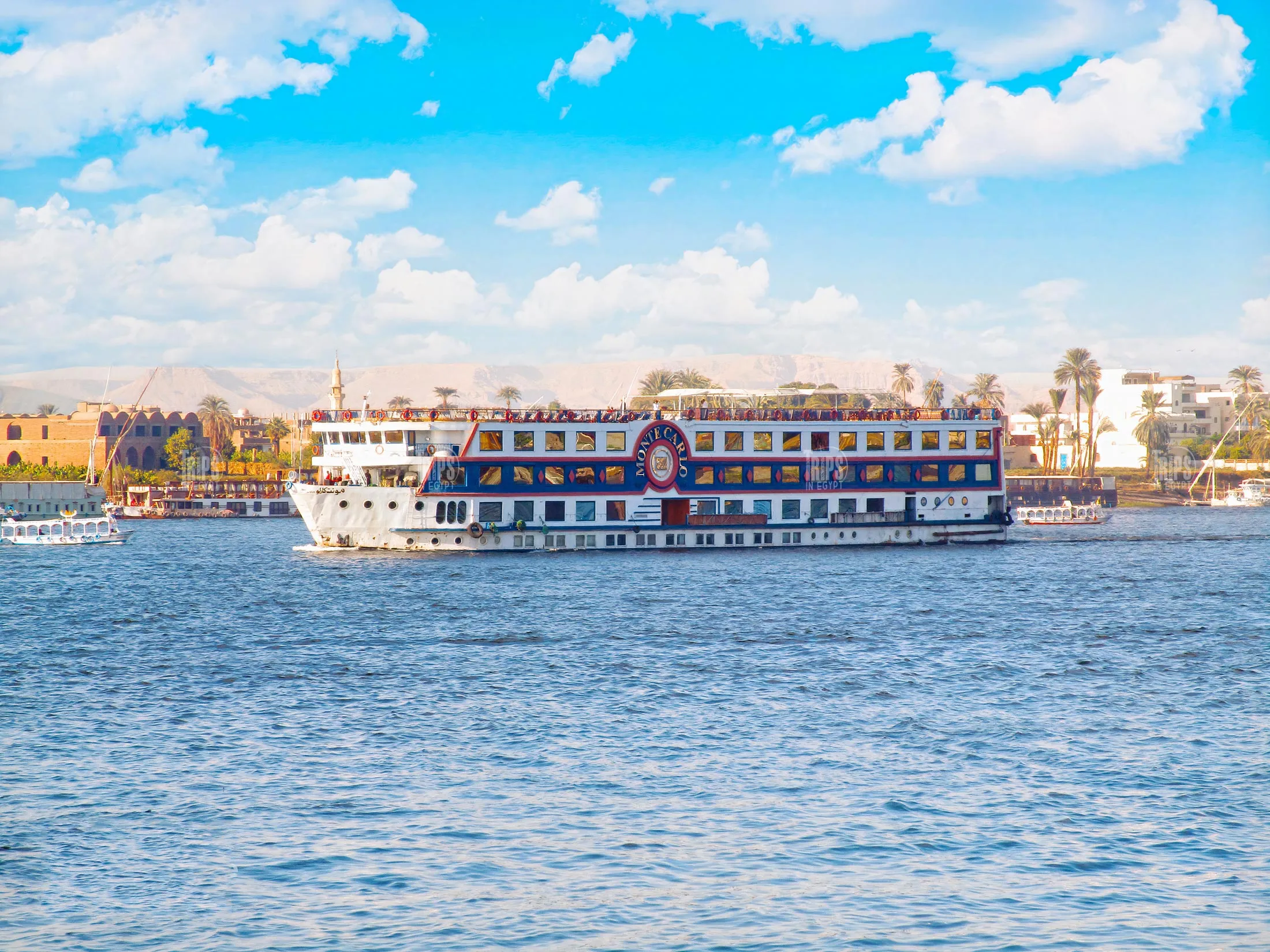
10 Days Cairo, Faiyum & Nile Cruise Holiday
Breathtaking 10 Days Journey of A Lifetime in Egypt 10 Days Cairo, Faiyum & Nile...
- Duration 10 Days / 9 Nights
- Location Cairo, Luxor, Aswan & Faiyum
- Type Classic Tour
From$1350/per person
View Tour SOLD OUT
Ultimate 7-Day Egypt Solar Eclipse Experience with Hurghada 2027
Enjoy a 7-Day Egypt Solar Eclipse Tour with Hurghada 2027 6 Nights Egypt Solar Ecli...
- Duration 7 Days / 6 Nights
- Location Cairo / Giza / Luxor / Hurghada
- Type Astronomical Tour
Sold Out
View Details