



Love, murder, magic and a son's revenge: the story of Osiris and Isis is the greatest myth of ancient Egypt. Osiris, the good king, is killed by his jealous brother Seth, and his devoted wife Isis brings him back to life. Their son Horus then wins back the throne. This guide tells the full story, explains their family and the moral of the myth, and shows where to see it.

The Story of Osiris and Isis in Brief
The story of Osiris and Isis explains how death entered the world, how the dead live again, and why every pharaoh ruled as Horus. Before the full myth, here is the short version and where it comes from.
Isis and Osiris Story Summary
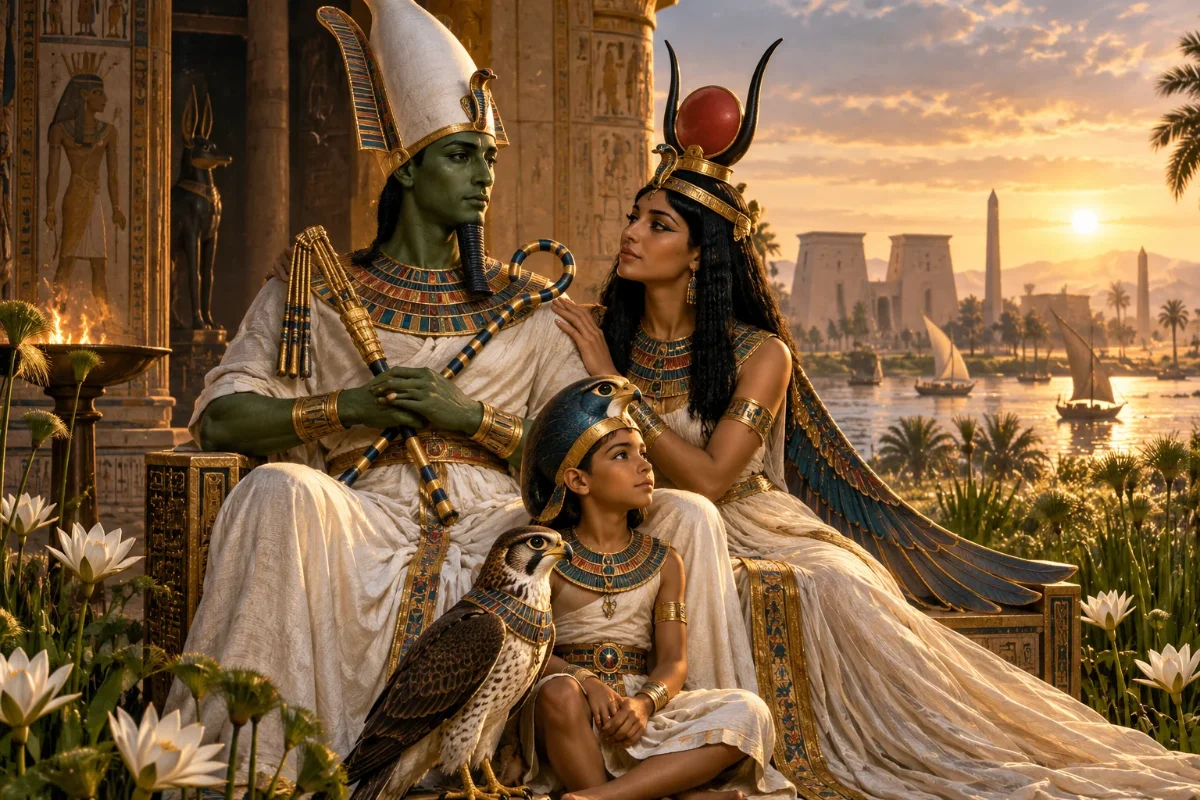
Osiris was the first king of Egypt, and he ruled with his sister and wife, Isis. Their brother Seth envied him, tricked him into a chest and threw it into the Nile. Isis found the body, but Seth tore it to pieces and scattered them across Egypt.
Isis searched the land, gathered the pieces and, with the help of Nephthys, Anubis and Thoth, made Osiris whole again as the first mummy. Through her magic, she conceived their son Horus. Osiris could not return to the living, so he became king of the underworld.
Isis hid the baby Horus in the marshes of the Delta. When he grew up, Horus fought Seth for the throne, lost an eye in the struggle, and was finally crowned king of Egypt by the gods.
Where the Osiris Myth Comes From
No single ancient Egyptian text tells the whole story from start to finish. The Egyptians knew it so well that they usually only hinted at it in hymns, spells and temple scenes.
The oldest references appear in the Pyramid Texts, carved around 2350 BC inside the pyramid of King Unas at Saqqara. The trial of Horus and Seth is told in a papyrus known as The Contendings of Horus and Seth, written around 1160 BC under Ramesses V.
The fullest version is a Greek one. The writer Plutarch set out the Osiris myth full story in his work On Isis and Osiris, around AD 100, and many details below, such as the 14 pieces and the city of Byblos, come from him. The tale is part of the wider body of ancient Egyptian mythology.
Who Were Osiris and Isis?
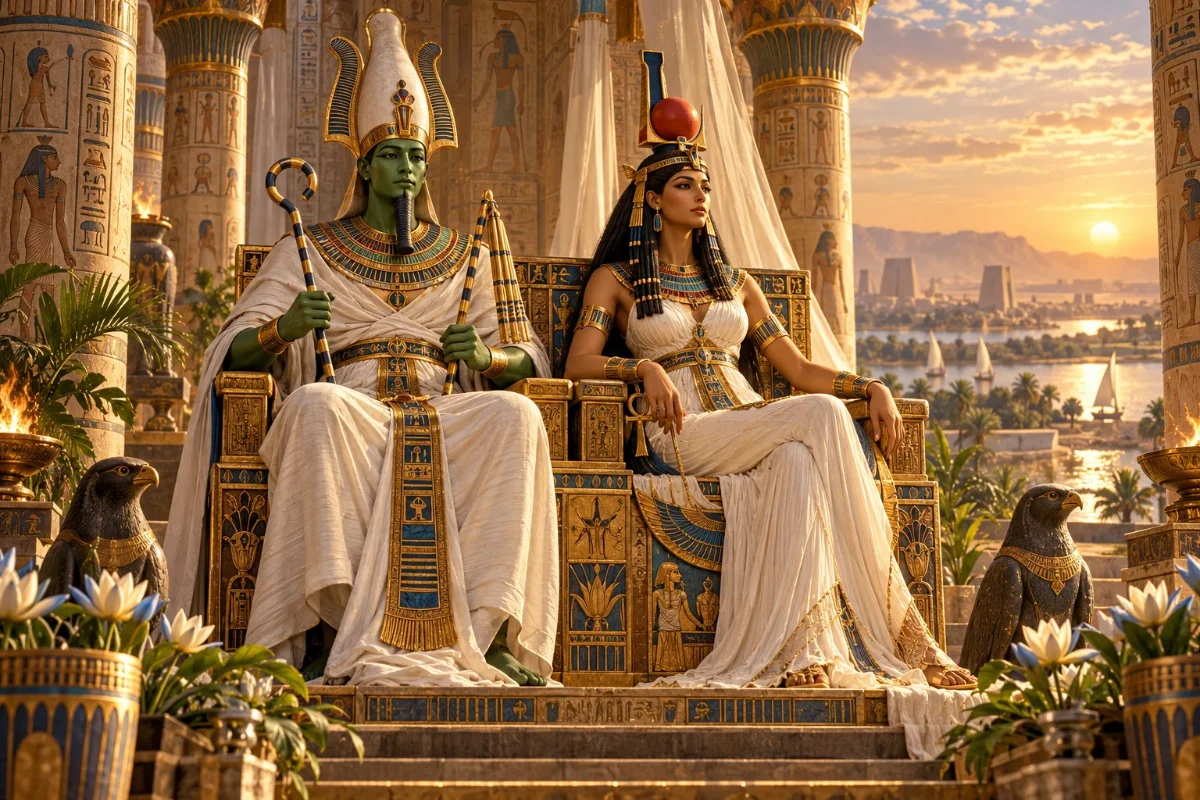
Osiris and Isis were two of the most important gods in Egypt, a royal couple whose story shaped ideas of kingship, love and life after death. Their relationship began long before they married.
Osiris, the First King of Egypt
In the myth, Osiris ruled Egypt as its first king on earth. He was responsible for laws, religion, culture and farming, and he taught people to grow grain and make bread and beer.
He ruled according to Maat, the divine order of truth, justice and balance. Plutarch adds that he traveled the world to teach other peoples, while Isis governed Egypt in his place.
Isis, the Great of Magic
Isis was the goddess of motherhood, healing and magic. Her Egyptian name, Aset, means "throne", and her headdress is the sign of a royal seat. The king was seen as her child, sitting on her lap like Horus.
Her worship outlasted almost every other Egyptian cult. It spread across the Roman Empire, with temples at Pompeii and in Rome, and continued at her temple on Philae until the sixth century AD.
What Is the Isis Origin Story?
Isis was born to Geb, the earth god, and Nut, the sky goddess, in the family of gods known as the Ennead of Heliopolis. Her family began with the creator Atum, whose children Shu and Tefnut became the parents of Geb and Nut, as told in the ancient Egyptian creation myth.
According to Plutarch, the sun god Ra forbade Nut to give birth on any day of the year. Thoth won extra light from the moon in a game and made five new days outside the 360-day year. On these days, Nut gave birth to Osiris, Horus the Elder, Seth, Isis and Nephthys.
Another myth explains how Isis became so powerful. She shaped a snake from earth and Ra's saliva, and it bit the aging sun god. Isis healed him only after he told her his secret name, and from then on her magic was greater than that of any other god.
Were Isis and Osiris Siblings?
Yes. Isis and Osiris were brother and sister, both children of Geb and Nut. Their other siblings were Seth and Nephthys, who also married each other.
The four gods formed two couples with opposite natures. Osiris and Isis stood for the fertile Nile valley and order, while Seth stood for the desert, storms and chaos.
Why Did Osiris Marry His Sister?
In the myth, the first gods had no one else to marry, so divine couples were made of brothers and sisters. Plutarch even says that Isis and Osiris fell in love in their mother's womb.
The marriage also made a royal model. A brother and sister on the throne kept power inside the divine family, and some royal families, above all the later Ptolemies, copied it. Ordinary Egyptians rarely married their siblings, and in love poems the words "brother" and "sister" simply meant "beloved".
Isis and Osiris Pronunciation
In English, Osiris is said "oh-SY-ris" and Isis "EYE-sis". These are the Greek forms of their names.
The ancient Egyptians called them Wesir (or Usir) and Aset (or Iset). Hieroglyphs record no vowels, so the exact ancient pronunciation is uncertain.
How Osiris and Isis Are Depicted
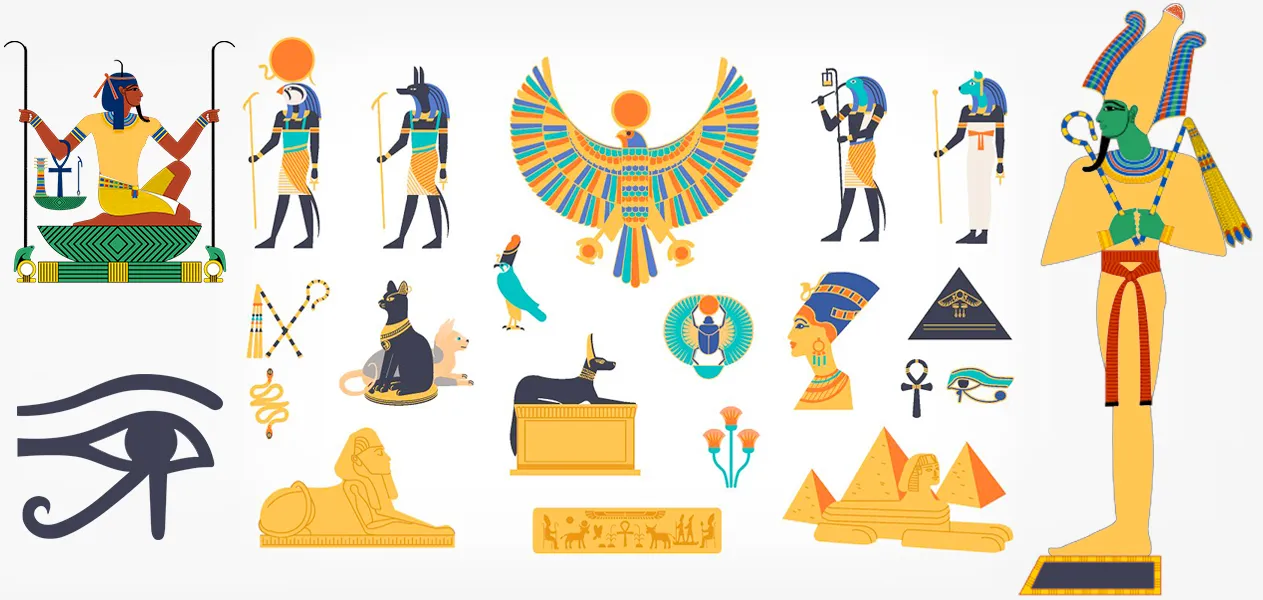
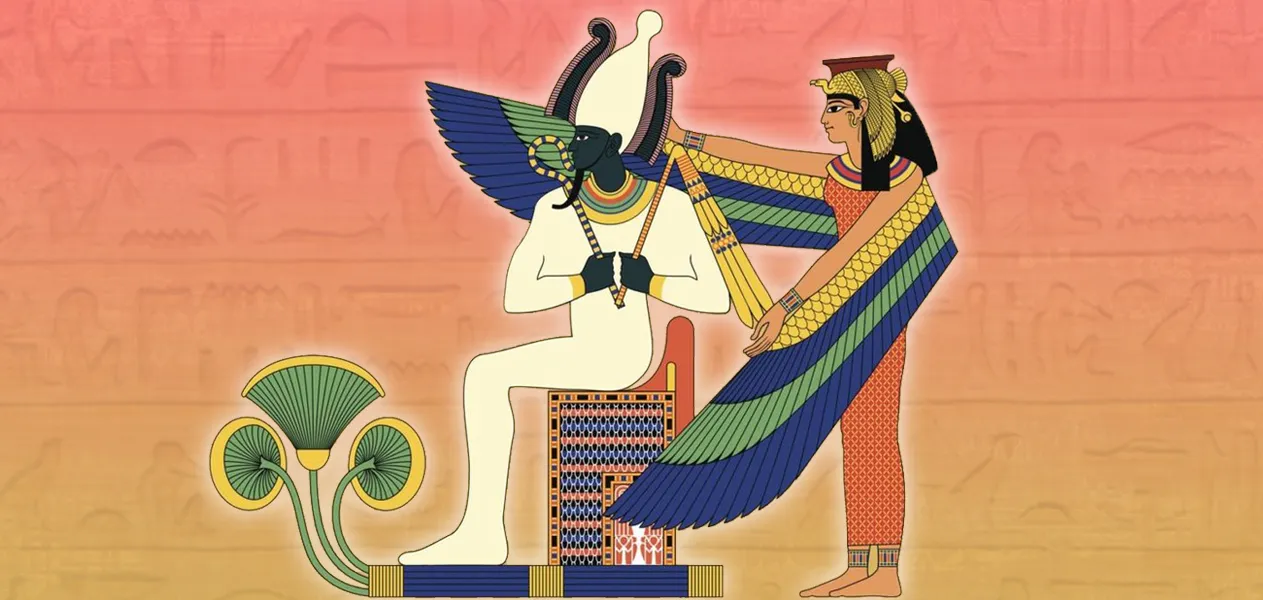
In images, Osiris is shown as a mummy wrapped in white, holding the crook and flail of kingship. He wears the atef crown, the tall white crown with two ostrich feathers. His skin is often green or black, the colors of new plants and the fertile Nile mud.
Isis usually wears the throne sign on her head, or later the cow horns and sun disk she shared with Hathor. She is often shown with outstretched wings protecting Osiris, or nursing the baby Horus on her lap. Her tyet knot, the "knot of Isis", was a popular amulet among the ancient Egyptian symbols.
Osiris's Demise at the Hands of His Evil Brother Seth
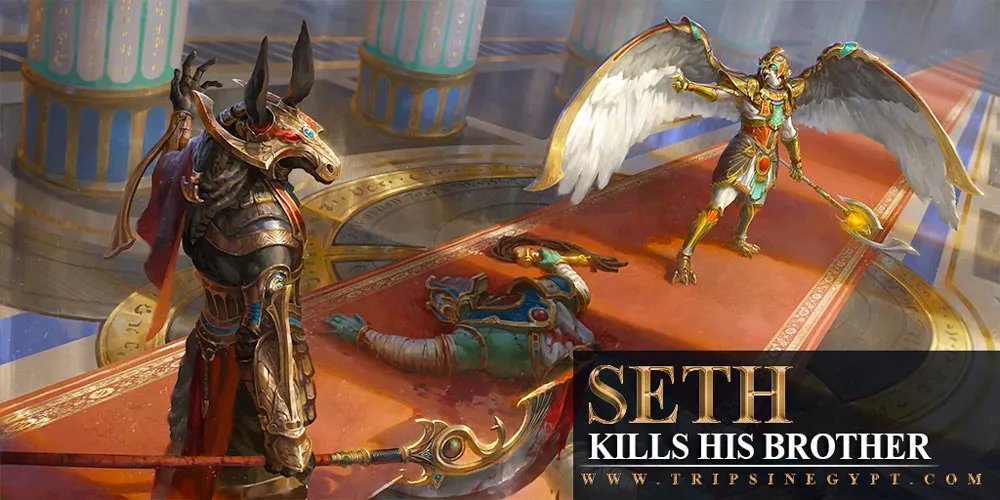
The heart of the Osiris story is a murder. Seth, the god of the desert and storms, grew jealous of his brother's power and the love the people had for him.
Seth's Jealousy and the Chest
Seth secretly measured Osiris's body and had a beautiful chest made to fit it exactly. Plutarch says he plotted with 72 companions and an Ethiopian queen named Aso.
At a great feast, Seth promised the chest to any guest who fit inside it. Each guest tried and failed. When Osiris lay down in it, Seth and his men slammed the lid shut, sealed it with lead and threw it into the Nile.
Osiris died inside the chest. Seth took the throne of Egypt, and chaos and darkness followed in place of the order Osiris had kept.
Isis Searches for Osiris
Isis cut her hair, put on mourning clothes and wandered Egypt in search of her husband. The chest floated down the Nile and out to sea, until it washed ashore at Byblos, in modern Lebanon.
There, a tamarisk tree grew around the chest and hid it inside its trunk. The king of Byblos cut down the tree and used it as a pillar in his palace. Isis came to the city, served as nurse to the queen's son, and finally asked for the pillar and took the body home.
Seth Tears Osiris Apart
Isis hid the body in the marshes of the Delta, but Seth found it while hunting by moonlight. In his rage, he tore Osiris into 14 pieces and scattered them across Egypt and the Nile.
Egyptian sources give different numbers. Some count 16 parts, and others 42, one for each province of Egypt. Many towns later claimed to hold a part of Osiris, which explains why the god had shrines and "tombs" all over the country.
Isis Brings Osiris Back to Life
Isis and her sister Nephthys took the form of kites, birds of prey, and searched for every piece, crying out in grief. Their laments became the songs of mourning sung at Egyptian funerals.
Isis found every part except the phallus, which Plutarch says was eaten by fish, so she shaped a new one. With the help of Anubis, the god of embalming, the pieces were joined and wrapped in linen. Osiris became the first mummy, the model for ancient Egyptian mummification.
Isis then spread her wings and fanned the breath of life into him. Osiris woke long enough for the couple to conceive a child.
Osiris Becomes Lord of the Underworld
Because his body had been broken, Osiris could not return to rule the living. He went instead to the Duat, the underworld, where he became king and judge of the dead.
Every Egyptian hoped to join him there. In the Hall of Two Truths, the heart of the dead person was weighed against the feather of Maat before Osiris, as told in the Judgement of the Dead.
The Revenge of Horus Upon His Evil Uncle Seth
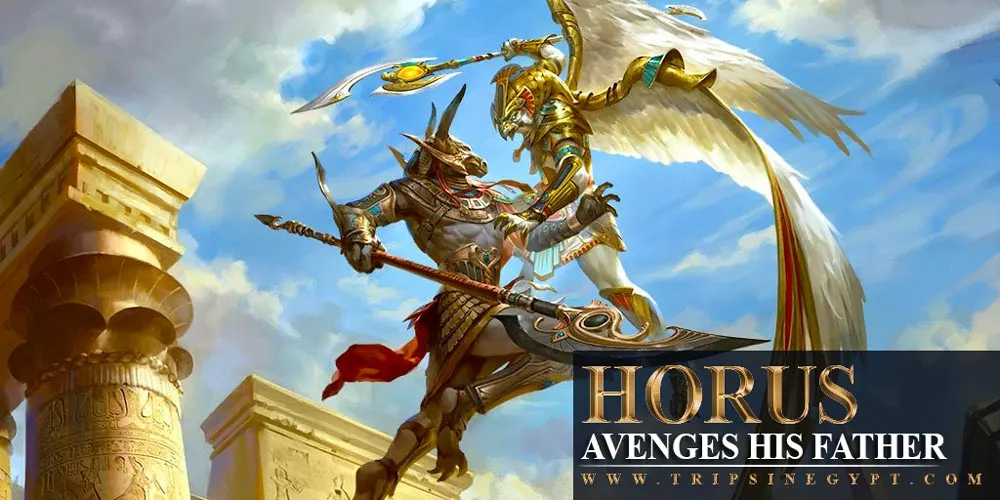
The second half of the myth belongs to Horus, the son of Osiris and Isis. It is the story of how the rightful heir won back his father's throne.
Did Osiris and Isis Have a Child?
Yes. Osiris and Isis had a son, Horus, conceived through Isis's magic after Osiris was brought back to life. He is often called Horus son of Isis to set him apart from Horus the Elder, the brother of Osiris.
In Plutarch's version, Osiris also had a son, Anubis, with Nephthys. Nephthys hid the baby out of fear of Seth, and Isis found him and raised him as her own.
Horus Hidden in the Marshes
Isis gave birth to Horus at Khemmis, a hidden place among the papyrus marshes of the Delta. She raised him in secret, because Seth wanted to kill the heir to the throne.
The young Horus faced many dangers. In one tale, carved on the Metternich Stela of the Thirtieth Dynasty, he is stung by a scorpion. Isis cried out to Ra, who stopped the sun boat in the sky until Thoth came down and healed the child.
The Contendings of Horus and Seth
As an adult, Horus claimed his father's throne. The case came before a court of the gods, and according to The Contendings of Horus and Seth, the dispute lasted 80 years.
Seth challenged Horus to many contests, including a race in stone boats and a fight in which both turned into hippopotamuses. In one battle, Seth tore out Horus's eye. The eye was healed and became the wedjat, the famous Eye of Horus, a symbol of healing and protection.
The temple tradition at Edfu tells the fight as a great war, with Horus spearing Seth in the shape of a hippopotamus. The reliefs of this story still cover the walls of Edfu Temple.
Horus Becomes King
In the end, the gods judged Horus to be the rightful heir. Seth was defeated and sent to rule the desert and the storms, or, in some versions, to carry Ra's sun boat and fight the serpent Apophis each night.
Horus was crowned king of Egypt, and an era of peace and prosperity followed. From then on, every living pharaoh ruled as Horus, and every dead pharaoh became Osiris.
What Is the Moral of the Story of Osiris and Isis?
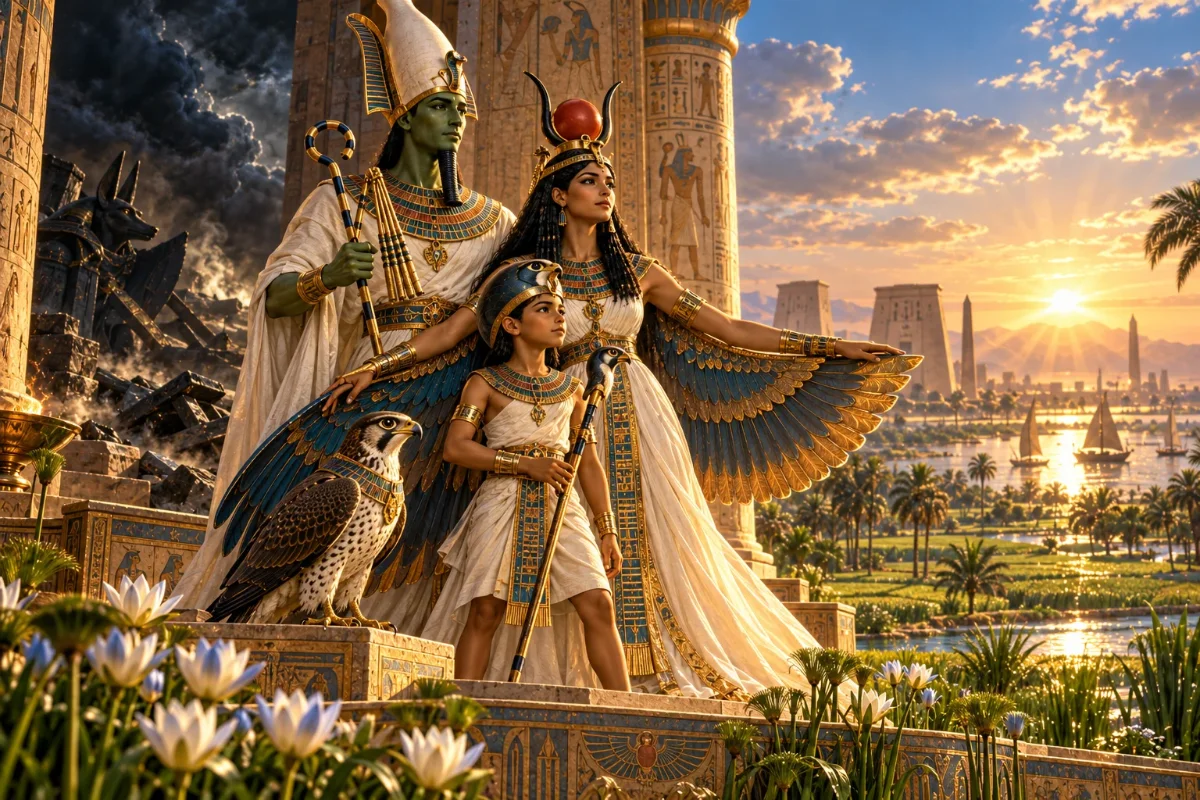
The moral of the story of Isis and Osiris is that order and goodness survive even after evil seems to win. The myth carries several lessons that the Egyptians lived by.
Order Will Overcome Chaos
Seth's murder brought chaos, but Isis, Horus and the gods restored Maat. For the Egyptians, the world was a constant struggle between order and chaos, and every king's duty was to keep order in place, as Horus did.
Love and Loyalty Are Stronger Than Death
Isis never gave up on her husband. Her search, her grief and her magic made her the model of the loyal wife and devoted mother, and Egyptians prayed to her for protection, healing and help in childbirth.
Death Is Not the End
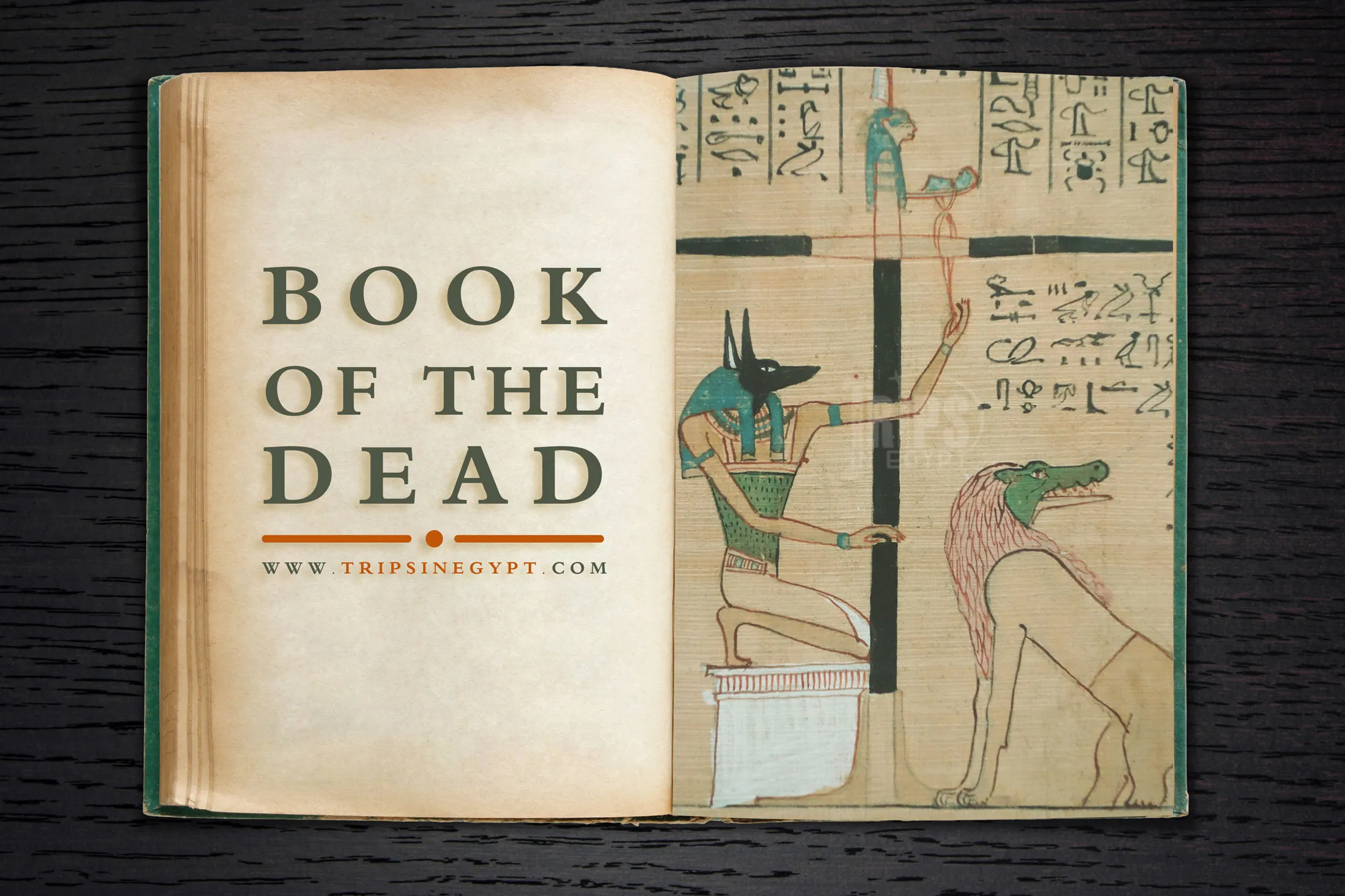
The resurrection of Osiris promised life after death to everyone. From the Middle Kingdom onward, ordinary people hoped to become "an Osiris" after death, and the spells that helped them were gathered in the Egyptian Book of the Dead.
The Rightful Heir Takes the Throne
The trial of Horus and Seth showed that power must pass from father to son by right, not by force. It justified the succession of each new pharaoh as the heir of Osiris.
The Symbolism of Osiris, Isis and Horus
Osiris represents justice, resurrection, kingship and the yearly rebirth of the land after the Nile flood. Isis represents love, compassion, magic and motherhood. Horus represents victory, kingship and the triumph of the rightful heir.
The myth was also tied to nature. The flood was sometimes seen as the tears of Isis, and the grain that sprouted from the soil was the reborn Osiris, a cycle that the ancient Egyptian gods were believed to renew each year.
Discover All the Beautiful Hidden Tales Found Around Egypt
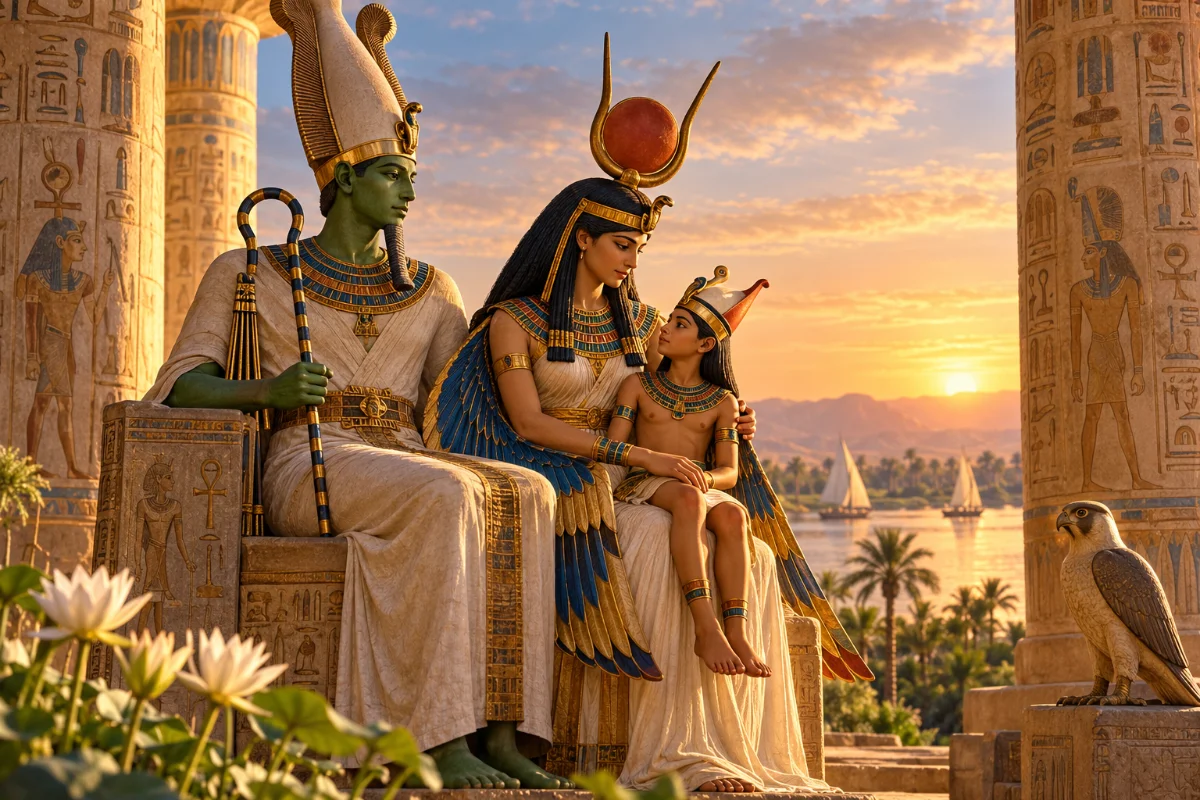
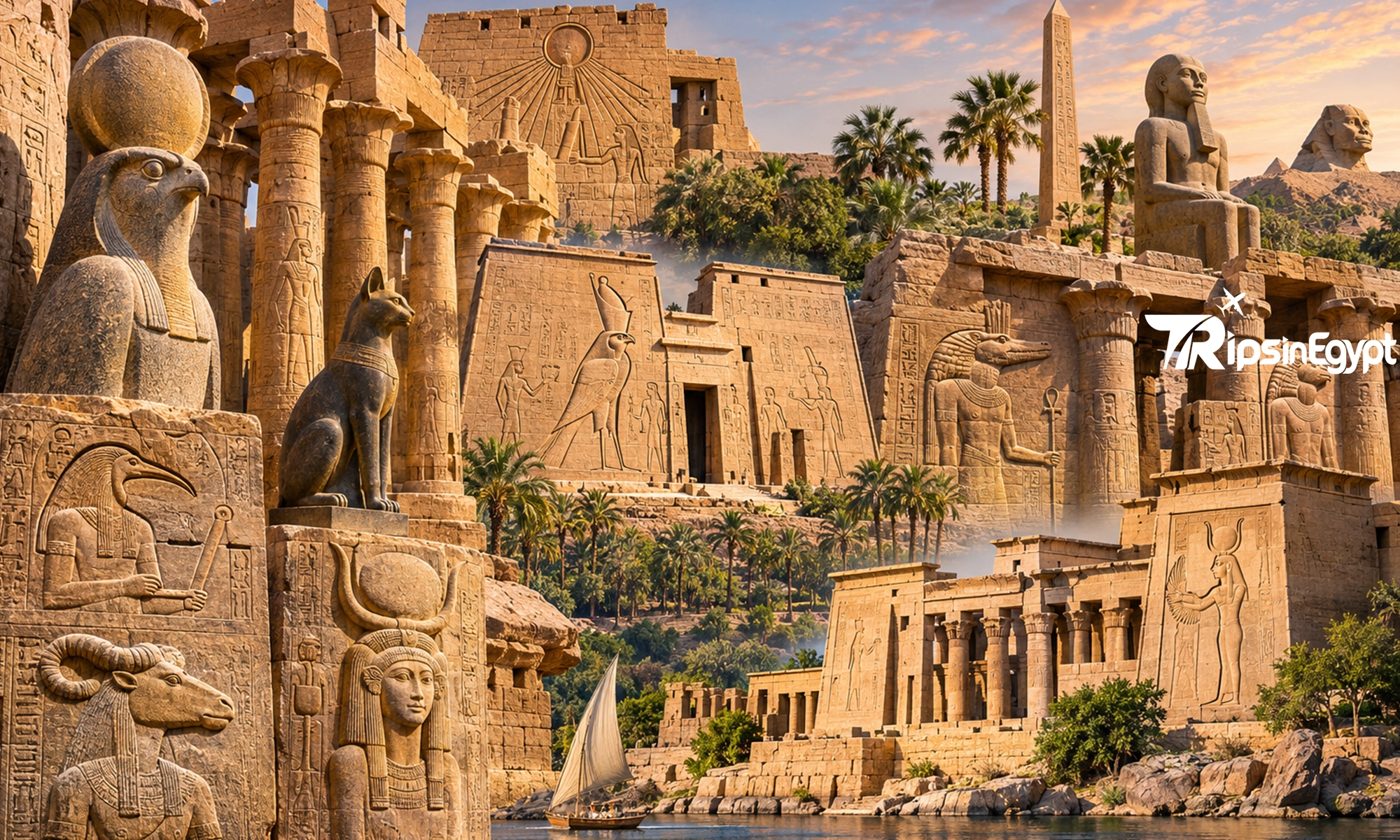
The story of Osiris and Isis is still carved on temple walls along the Nile. These are the best places to see it.
Abydos: The Home of Osiris
Abydos was the most sacred place of Osiris. In the Middle Kingdom, the tomb of the early king Djer was believed to be the tomb of Osiris, and pilgrims left offerings there for centuries.
Each year, priests staged the Mysteries of Osiris at Abydos, a sacred play of his death and rebirth. Similar rites of the Khoiak month appear among the ancient Egyptian festivals.
The Temple of Seti I at Abydos, built around 1290 BC, has seven chapels, with chapels to Osiris, Isis and Horus among them. Behind it lies the Osireion, a cenotaph of Osiris built of huge granite blocks.
Philae: The Temple of Isis
The Philae Temple near Aswan was the greatest temple of Isis. Most of it was built under the Ptolemies, and it was one of the last ancient temples still in use, until about AD 537.
Between 1977 and 1980, UNESCO moved the temple to Agilkia Island to save it from the waters behind the Aswan dams. Nearby Biggeh Island was believed to hold a tomb of Osiris.
Dendera and Edfu
On the roof of Dendera Temple, small Osiris chapels show the god's rebirth and Isis as a kite conceiving Horus. The Dendera zodiac once decorated one of these chapels, as explained in our Dendera Temple facts.
At Edfu, the walls of the Temple of Horus show his victory over Seth as a sacred drama, carved under the Ptolemies between 237 and 57 BC.
Tours to the Temples of Osiris and Isis
You can visit Abydos and Dendera together on the Day Tour to Dendera and Abydos from Luxor, which takes you to the Osiris chapels and the Temple of Seti I.
For Edfu, the Esna, Edfu and Kom Ombo Tour from Luxor, From $90, includes the Temple of Horus in one day.
A Nile cruise between Luxor and Aswan stops at Edfu and Kom Ombo and often includes Philae.
For a longer journey, you can browse our Egypt tour packages, with expert guides who tell these myths beside the carvings themselves.
The enduring myth of Osiris and Isis remains the beating heart of ancient Egyptian civilization, shaping profound beliefs in resurrection, divine order, and eternal love. From the majestic temples of Philae to the sacred halls of Abydos, this timeless tale of triumph over chaos continues to captivate modern travelers. Explore these sacred monuments along the Nile with Trips in Egypt and immerse yourself in the living legacy of the pharaohs.

5 Days Cairo And Hurghada Trip
Amazing 4 Nights Cairo and Hurghada Trip Itinerary 5 Days Cairo and Hurghada trip wil...
- Duration 5 Days / 4 Nights
- Location Cairo & Hurghada
- Type Historical & Recreational Tour
From$690/per person
View Tour
6 Days Cairo, Alexandria & Faiyum Tour
Unforgettable Cairo, Alexandria & Faiyum Adventure in Six Days 6 Days Cairo, Alex...
- Duration 6 Days / 5 Nights
- Location Cairo - Alexandria - Fayum
- Type Historical Tour
From$720/per person
View Tour
10 Days Cairo, Faiyum & Nile Cruise Holiday
Breathtaking 10 Days Journey of A Lifetime in Egypt 10 Days Cairo, Faiyum & Nile...
- Duration 10 Days / 9 Nights
- Location Cairo, Luxor, Aswan & Faiyum
- Type Classic Tour
From$1350/per person
View Tour SOLD OUT
Ultimate 7-Day Egypt Solar Eclipse Experience with Hurghada 2027
Enjoy a 7-Day Egypt Solar Eclipse Tour with Hurghada 2027 6 Nights Egypt Solar Ecli...
- Duration 7 Days / 6 Nights
- Location Cairo / Giza / Luxor / Hurghada
- Type Astronomical Tour
Sold Out
View Details