



Edfu Temple, the Temple of Horus, is one of the best-preserved temples of ancient Egypt, standing almost complete on the west bank of the Nile between Luxor and Aswan. Built by the Ptolemies over 180 years, it still keeps its roof, pylon and walls of hieroglyphs. This guide covers its history, key facts, a walk through the temple inside, its inscriptions, and everything you need to plan your own visit.

What Is the Temple of Edfu?
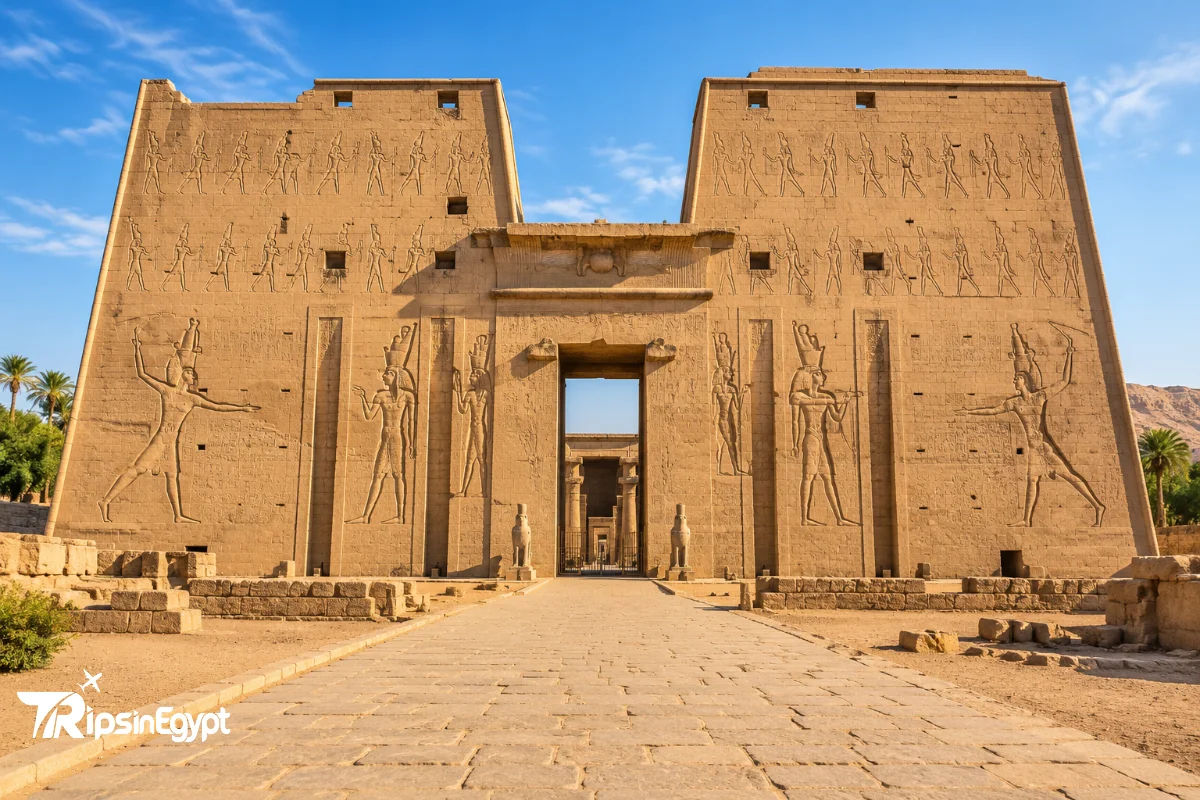
The Temple of Edfu is a sandstone temple dedicated to Horus, the falcon-headed god of kingship, built between 237 and 57 BC by the Ptolemaic kings of Egypt. It is often described as the second-largest temple in Egypt after Karnak and one of the most complete because its roof, walls and sanctuary survive almost intact. The questions below explain its names, location and importance among the ancient Egyptian temples.
Is the Temple of Edfu the Same as the Temple of Horus?
Yes. Edfu Temple and the Temple of Horus are the same building, and both names are correct. Ancient Egyptians called the town Behdet, and the god worshipped here was Horus of Behdet, often shown as a falcon or winged sun disk.
The Eye of Horus appears throughout the temple's religious imagery. Greek settlers later identified Horus with Apollo and called the city Apollonopolis Magna, meaning the great city of Apollo.
The modern name Edfu comes through the Coptic form Atbo, itself derived from the ancient Egyptian Djeba. The temple honored a divine triad made up of Horus, Hathor of Dendera and their son Harsomtus.
Where Is Edfu Temple?
Edfu Temple stands in the town of Edfu on the west bank of the Nile River in Aswan Governorate, Upper Egypt. It lies roughly between Luxor and Aswan, around 110 kilometers south of Luxor and about 105 kilometers north of Aswan by road.
Most travelers reach the temple during a Nile cruise between Luxor and Aswan because Edfu is a standard stop on many cruise itineraries. From the river, visitors usually continue through town by vehicle or horse-drawn carriage before the enormous temple pylon rises above the surrounding buildings.
Why Is the Temple of Edfu Important?
Edfu Temple is important because it preserves one of the clearest examples of how an ancient Egyptian temple was organized and used. Visitors can still follow the progression from the monumental pylon and open court to increasingly smaller and darker halls before reaching the sanctuary.
Its walls also preserve an enormous body of religious inscriptions describing rituals, festivals, myths and temple construction. The texts are particularly valuable for understanding the story of Horus and Seth and the role of kingship in Egyptian religion.
The History of Edfu Temple
The history of Edfu Temple began long before the Ptolemaic period. Edfu was the capital of the second nome of Upper Egypt and an important center for the worship of Horus. Evidence shows that earlier sanctuaries existed on the site, while remains connected with Ramesses I, Seti I and Ramesses II survive nearby. The present temple was created during the Ptolemaic era and preserves traces of both earlier Egyptian traditions and later Greek rule.
When Was the Temple of Edfu Built?
Construction of the present temple began on 23 August 237 BC under Ptolemy III Euergetes. Work continued across several reigns and the final decoration was completed in 57 BC under Ptolemy XII Auletes, the father of Cleopatra.
The temple's own building inscriptions record the long construction process. The main sanctuary and inner areas were completed before the monumental court and pylon, while work was interrupted during periods of political unrest in Upper Egypt.
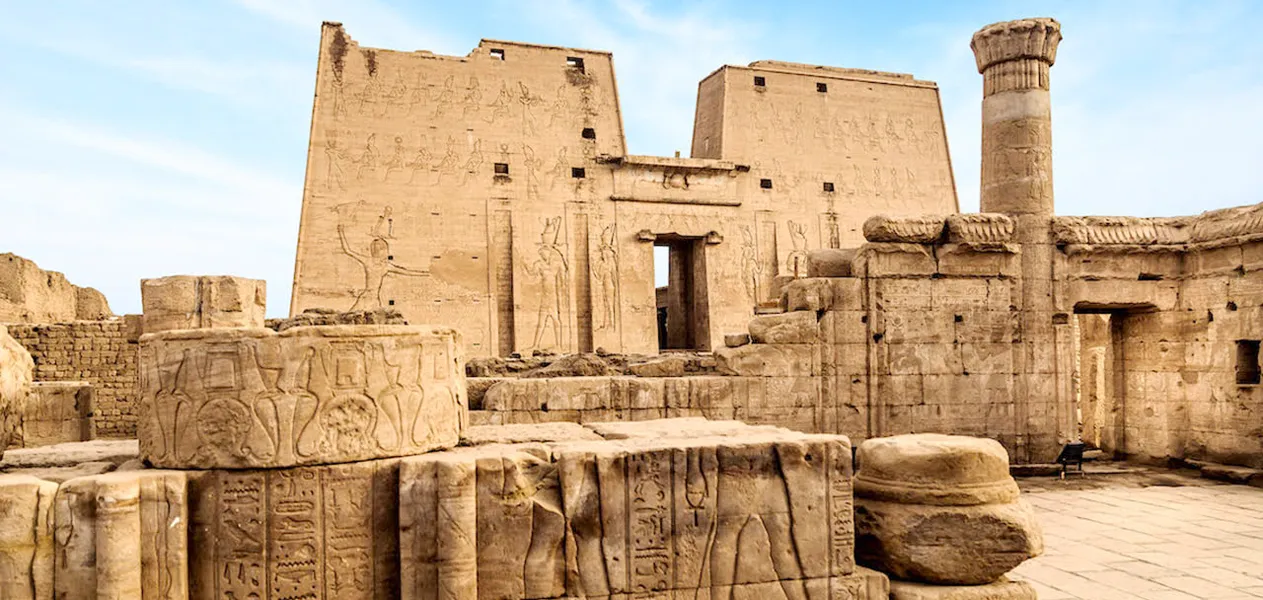
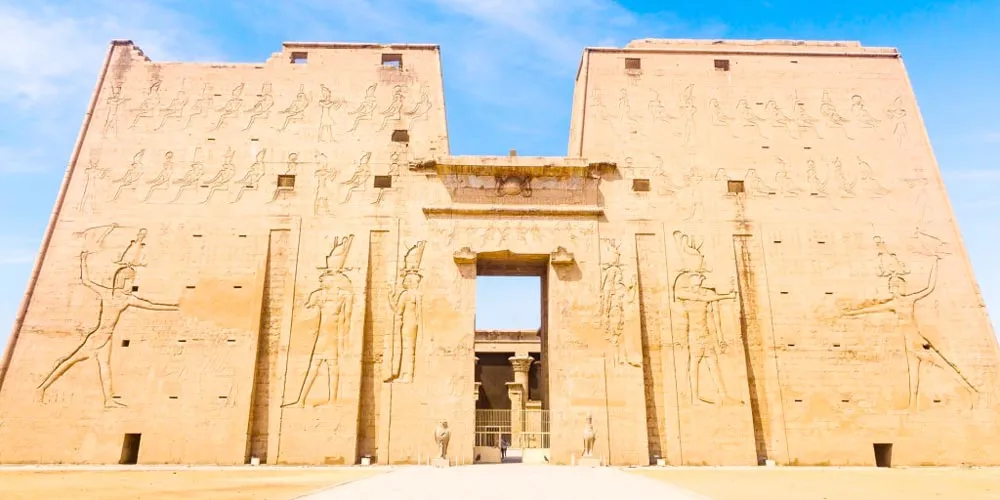
The great pylon eventually became one of the temple's most imposing features, with reliefs showing Ptolemy XII striking enemies in the traditional pose of Egyptian kingship.
Buried and Rediscovered
After the temple stopped functioning, sand and Nile silt slowly accumulated around it, eventually burying much of the structure beneath several meters of debris. Houses were later built over parts of the site, while some reliefs were damaged during the early Christian centuries.
By the time scholars of the French expedition reached Edfu in 1798, only the upper parts of the pylons were clearly visible.
In 1860, French Egyptologist Auguste Mariette began clearing the site. The removal of the accumulated village and debris exposed one of the most complete surviving temple complexes in Egypt. Its long burial helped protect much of the architecture and decoration from destruction.
Interesting Facts About Edfu Temple
Edfu Temple facts are among the most searched details about the site, and the following ten explain why it remains one of Egypt's most remarkable temples. Its history stretches across several Ptolemaic reigns, its walls record the building process itself, and its architecture preserves details that have disappeared from older Egyptian temples.
10 Edfu Temple Facts
-
It took about 180 years to build. Construction lasted from 237 to 57 BC under several Ptolemaic rulers.
-
It is one of Egypt's largest surviving temples. The building stretches roughly 137 meters from the pylon to the rear wall.
-
Its pylon rises about 36 meters. The massive towers dominate the entrance and carry monumental royal reliefs.
-
The sanctuary contains an older shrine. A granite naos associated with Nectanebo II predates much of the Ptolemaic temple.
-
The temple follows a highly unified plan. Unlike Karnak, which expanded over many centuries, Edfu follows a more consistent architectural scheme.
-
Its walls document construction. Inscriptions preserve measurements, room names and building phases.
-
It contains a Nilometer. The structure helped monitor the Nile's water level.
-
It celebrated the marriage of Horus and Hathor. Hathor's sacred image traveled from Dendera to Edfu during the Festival of the Beautiful Meeting.
-
It was buried for centuries. Sand and silt helped protect much of the temple until archaeological clearance began in the nineteenth century.
-
Its architecture influenced buildings outside Egypt. Egyptian Revival architecture in Europe drew inspiration from temple facades such as Edfu.
The Description of Edfu Temple
Walking through Edfu Temple from the pylon to the sanctuary is one of the best ways to understand how an Egyptian temple worked. The architecture becomes progressively smaller, darker and more restricted as visitors move inward, leading from the public court toward the sacred spaces reserved for priests and the divine image.
The Pylon and the Falcon Statues
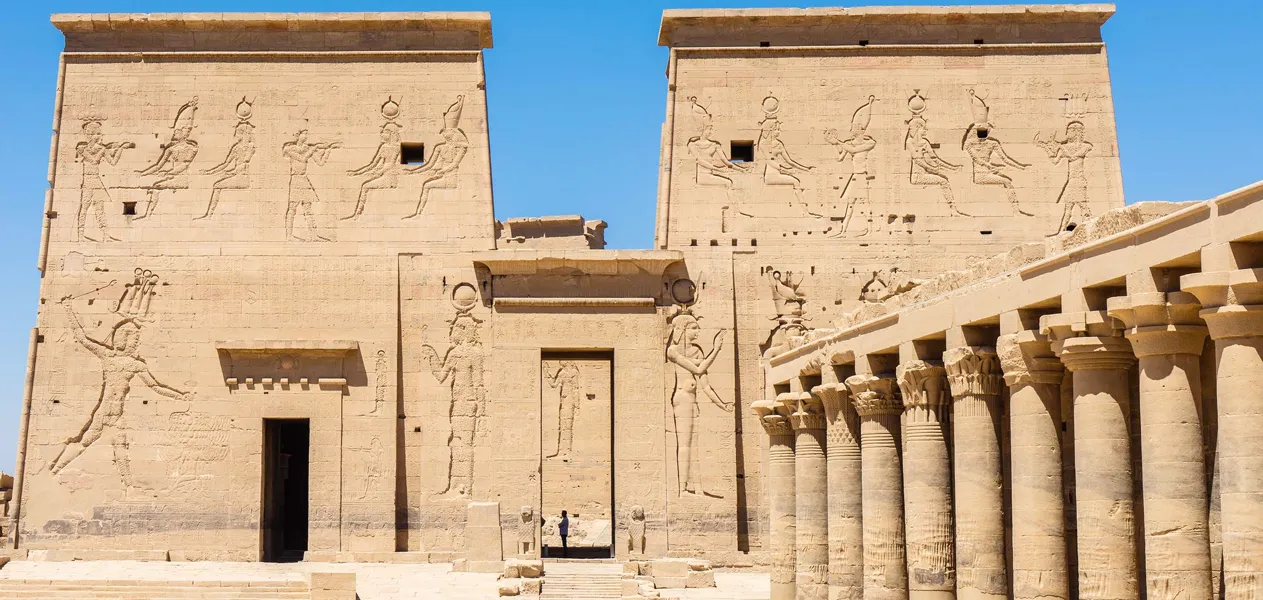
The temple faces south, and its monumental pylon forms the first major architectural feature. Reliefs on the towers show Ptolemy XII holding defeated enemies while Horus and Hathor stand nearby.
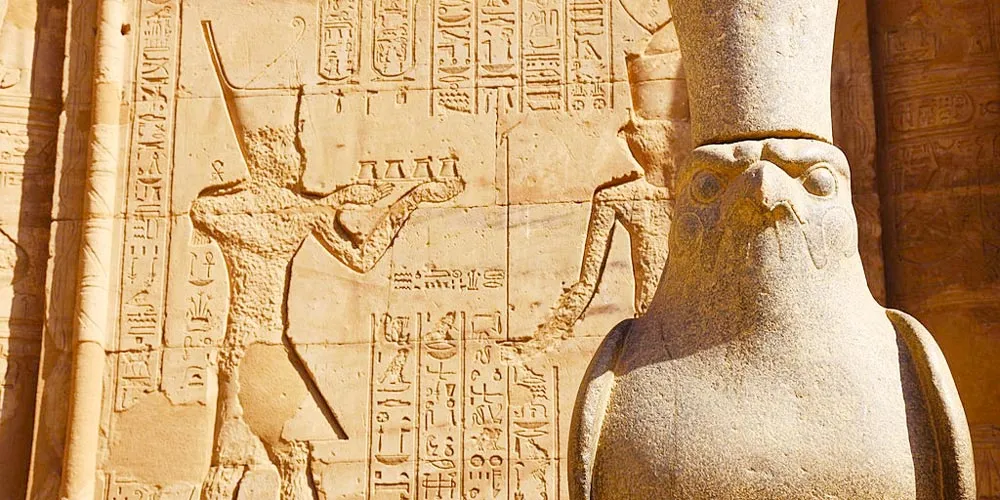
Grooves in the pylon once supported large ceremonial flagpoles. Granite statues of Horus in falcon form guard the gateway, creating one of the most recognizable views in the temple.
The original entrance would once have been closed by enormous wooden doors, which no longer survive.
The Court of Offerings and the Hypostyle Halls
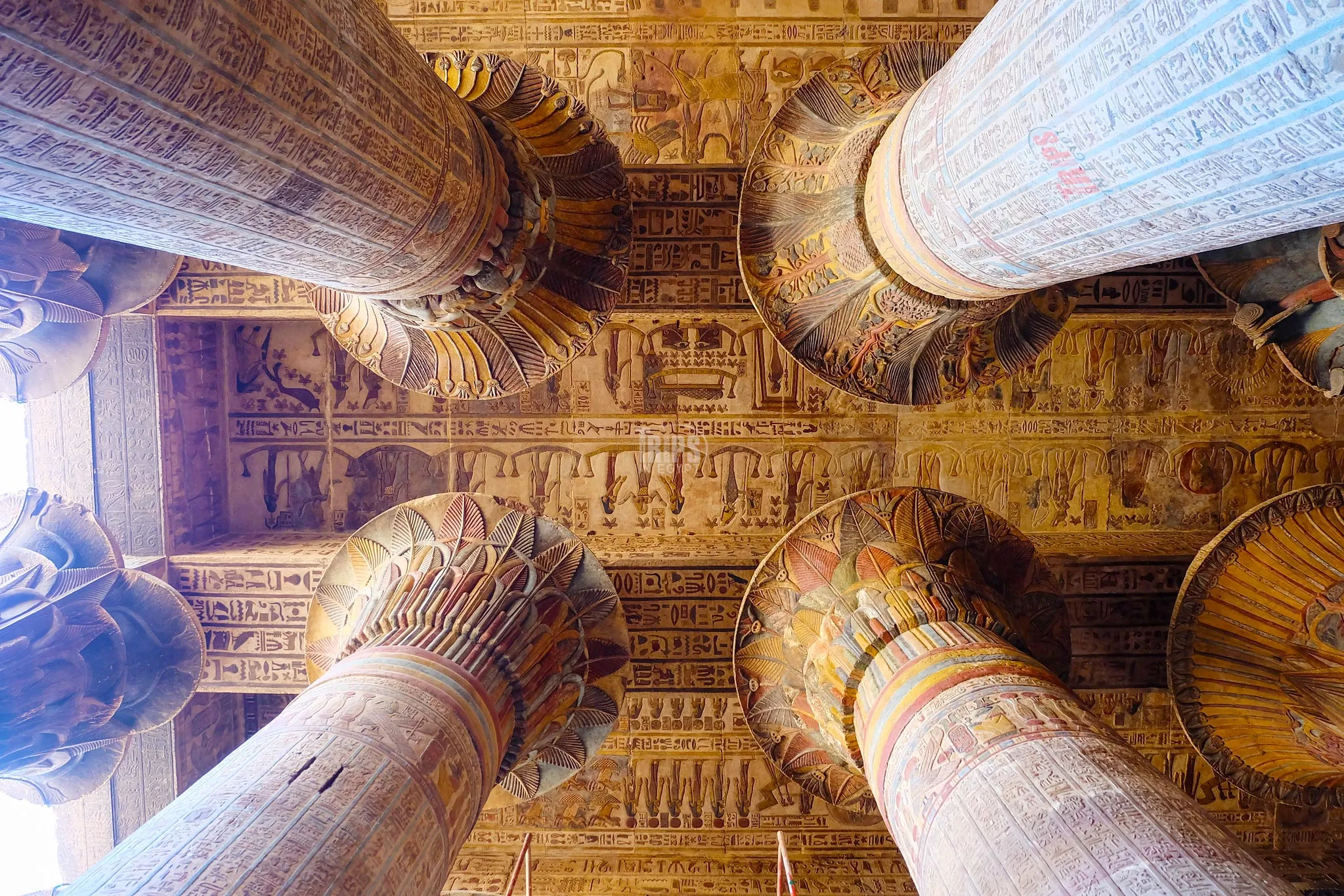
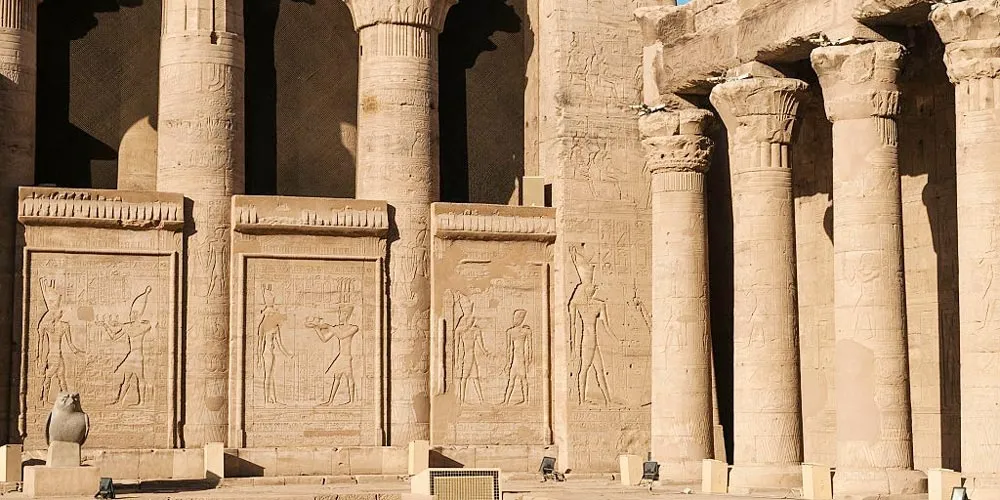
Beyond the pylon lies the Court of Offerings, an open courtyard surrounded by columns with varied floral capitals. This area was used during public religious festivals and ceremonies.
The famous granite falcon statue stands near the entrance to the temple's inner halls.
The outer hypostyle hall contains 18 columns and includes smaller rooms associated with temple functions such as the sacred library and robing rituals.
Behind it, the inner hypostyle hall contains 12 columns and side chambers used to store ritual supplies including incense, oils and offerings.
The Sanctuary and the Chapels
The temple's inner sequence continues through the Offering Hall and the Hall of the Ennead before reaching the sanctuary, the most sacred space in the complex.
Inside the sanctuary stands the granite shrine associated with Nectanebo II, which once housed the cult statue of Horus. A modern replica of the sacred barque represents the ceremonial boat used to carry the god during religious processions.
A corridor of smaller chapels surrounds the sanctuary. These rooms were dedicated to various deities and religious purposes and stored sacred objects used during temple rituals.
The Roof Chapels, the Nilometer and the Mammisi
Temple stairways decorated with processional scenes once led priests toward the roof during important ceremonies, including rituals linked to the New Year.
The Wabet, or pure place, was used during purification and preparation rituals and includes astronomical decoration associated with the sky goddess Nut.
The temple's enclosure also contains a Nilometer, while the Mammisi, or birth house, stands near the main temple and preserves scenes connected with the divine birth of Harsomtus, the child of Horus and Hathor.
Edfu Temple Layout at a Glance
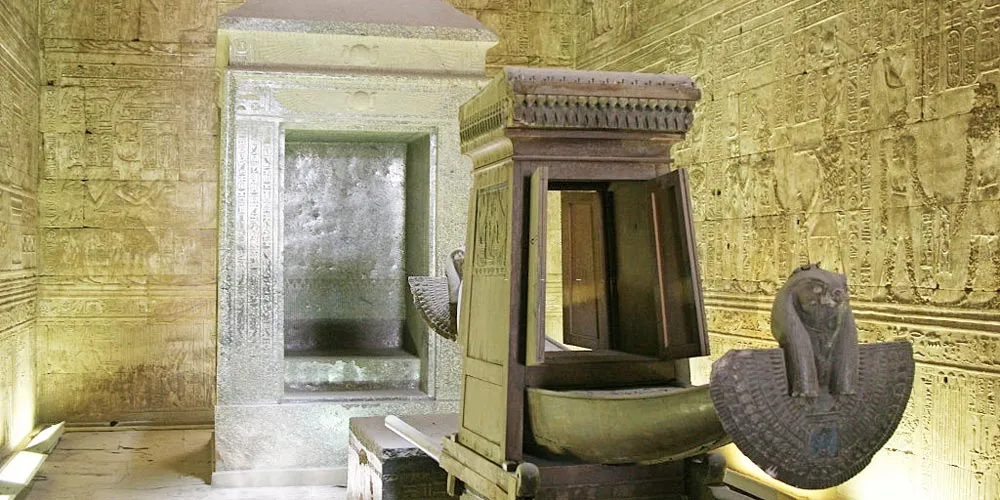
The layout below shows the principal elements of Edfu Temple in the order visitors encounter them.
|
Order |
Element |
What You Will See |
|
1 |
Pylon |
Two monumental towers, falcon statues and royal victory reliefs |
|
2 |
Court of Offerings |
Large open courtyard surrounded by columns |
|
3 |
Outer Hypostyle Hall |
18 columns, library and ritual rooms |
|
4 |
Inner Hypostyle Hall |
12 columns and storage chambers |
|
5 |
Offering Hall and Hall of the Ennead |
Transitional ritual spaces before the sanctuary |
|
6 |
Sanctuary |
Granite shrine and sacred barque |
|
7 |
Chapels and Corridor |
Sacred rooms, wall reliefs and access to the Nilometer |
|
8 |
Mammisi |
Birth house associated with Harsomtus |
The Hieroglyphs and Reliefs of Edfu Temple
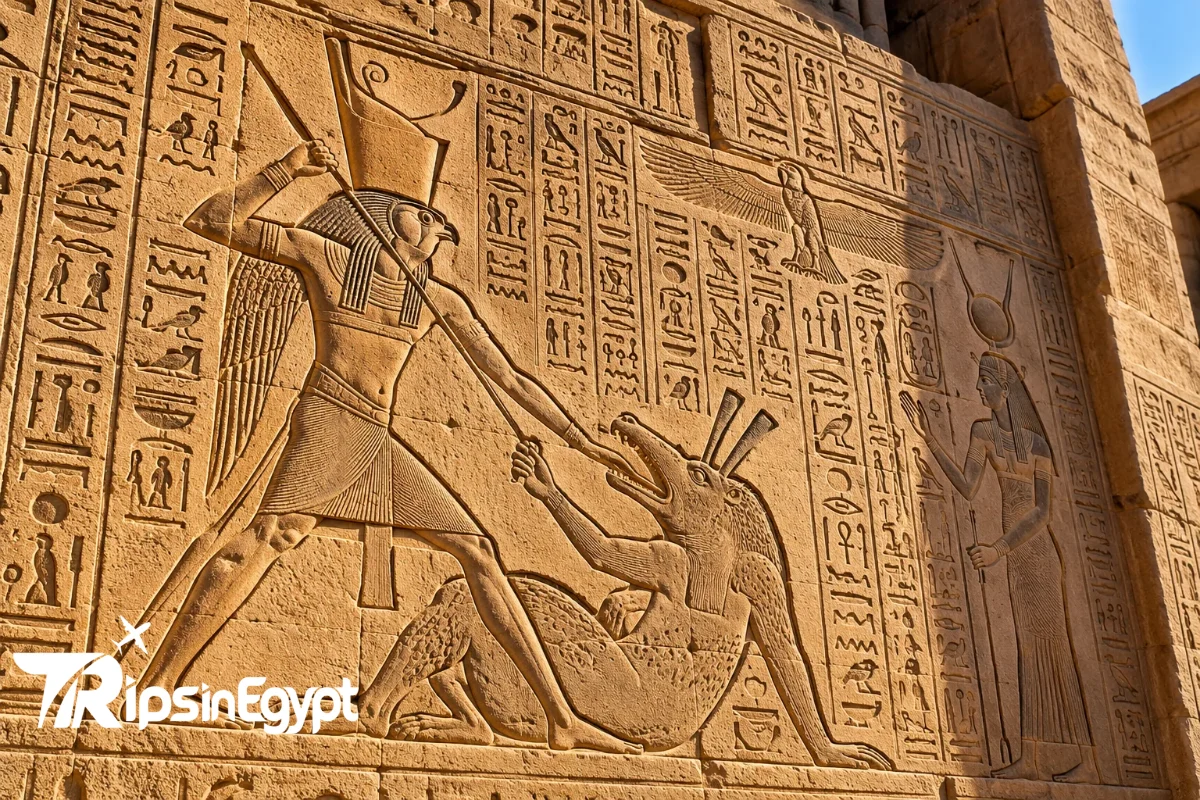
The hieroglyphs of Edfu Temple cover almost every wall and form one of the richest surviving collections of religious inscriptions from ancient Egypt. Modern scholars, including researchers associated with the Edfu Project, have spent decades documenting and translating them. The texts explain rituals, festivals, myths and the construction of the temple itself, making Edfu an essential source for understanding Egyptian religion during the Ptolemaic period.
The Triumph of Horus over Seth
Among the most famous scenes are reliefs showing the Triumph of Horus over Seth. Horus is shown hunting Seth, often represented as a hippopotamus, while Isis and the king participate in the ritual drama.
These scenes reflect the wider myth in which Horus avenges his father Osiris and defeats Seth in the struggle for the throne of Egypt. The story became one of the foundations of royal ideology because every reigning king could be associated symbolically with Horus.
You can explore the wider mythology in our guide to the story of Osiris and Isis.
Festivals Recorded on the Walls
Edfu's inscriptions also preserve detailed records of religious festivals.
One of the most important was the Festival of the Beautiful Meeting, when the statue of Hathor traveled from Dendera Temple to Edfu by boat. The sacred images of Horus and Hathor were brought together in ceremonies involving offerings, music and processions.
Other inscriptions describe rituals connected with the coronation of the sacred falcon and ceremonies marking the foundation of the temple, including symbolic measurements carried out with the goddess Seshat.
Visiting Edfu Temple
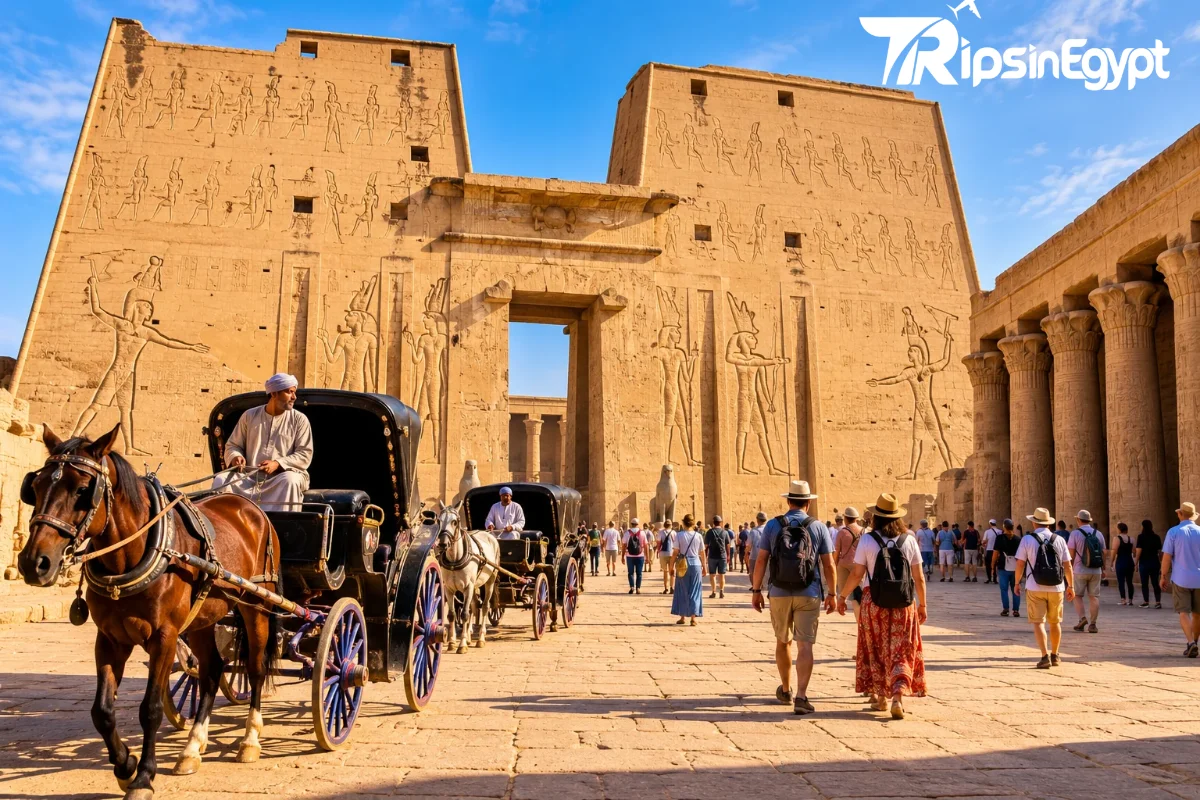
Edfu Temple is one of the easiest major temples to include in an Upper Egypt itinerary because it lies directly on the main Nile cruise route between Luxor and Aswan. Many travelers visit in the morning when cruise ships dock nearby, while others arrive by road on a private day tour. A typical visit takes about 90 minutes to two hours.
Is Edfu Temple Worth Visiting?
Yes. Edfu Temple is worth visiting because few Egyptian temples preserve such a complete architectural sequence from entrance to sanctuary.
The roof, halls, sanctuary and enclosure walls survive well enough to help visitors understand how an ancient temple functioned, which can make older sites such as Karnak easier to interpret afterward.
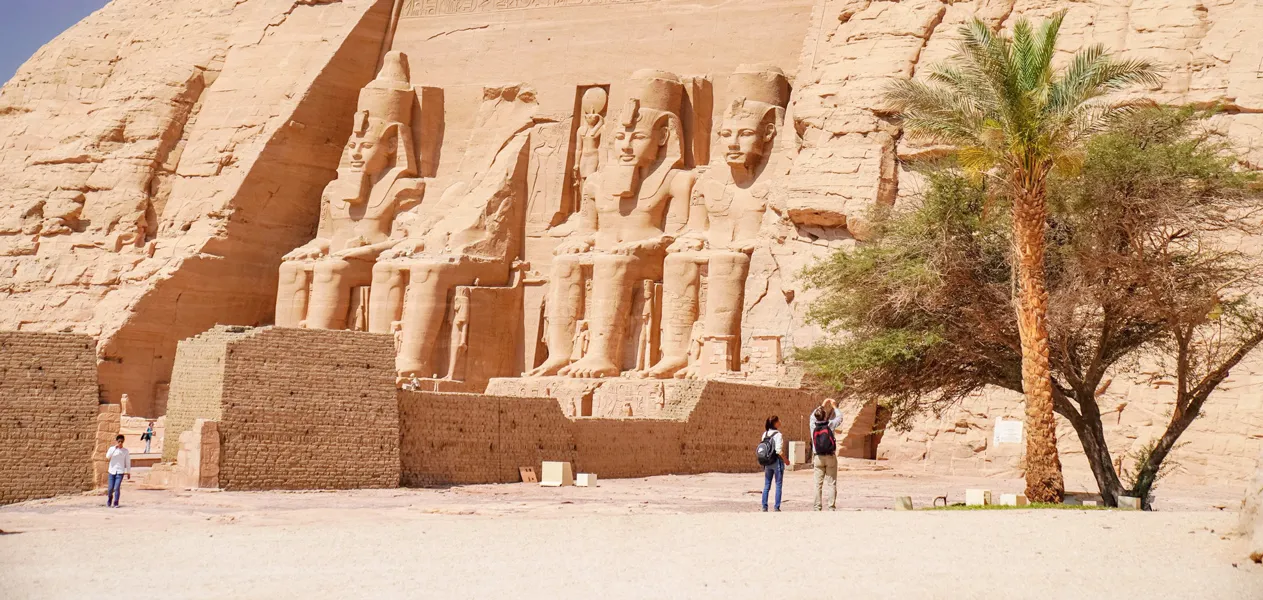
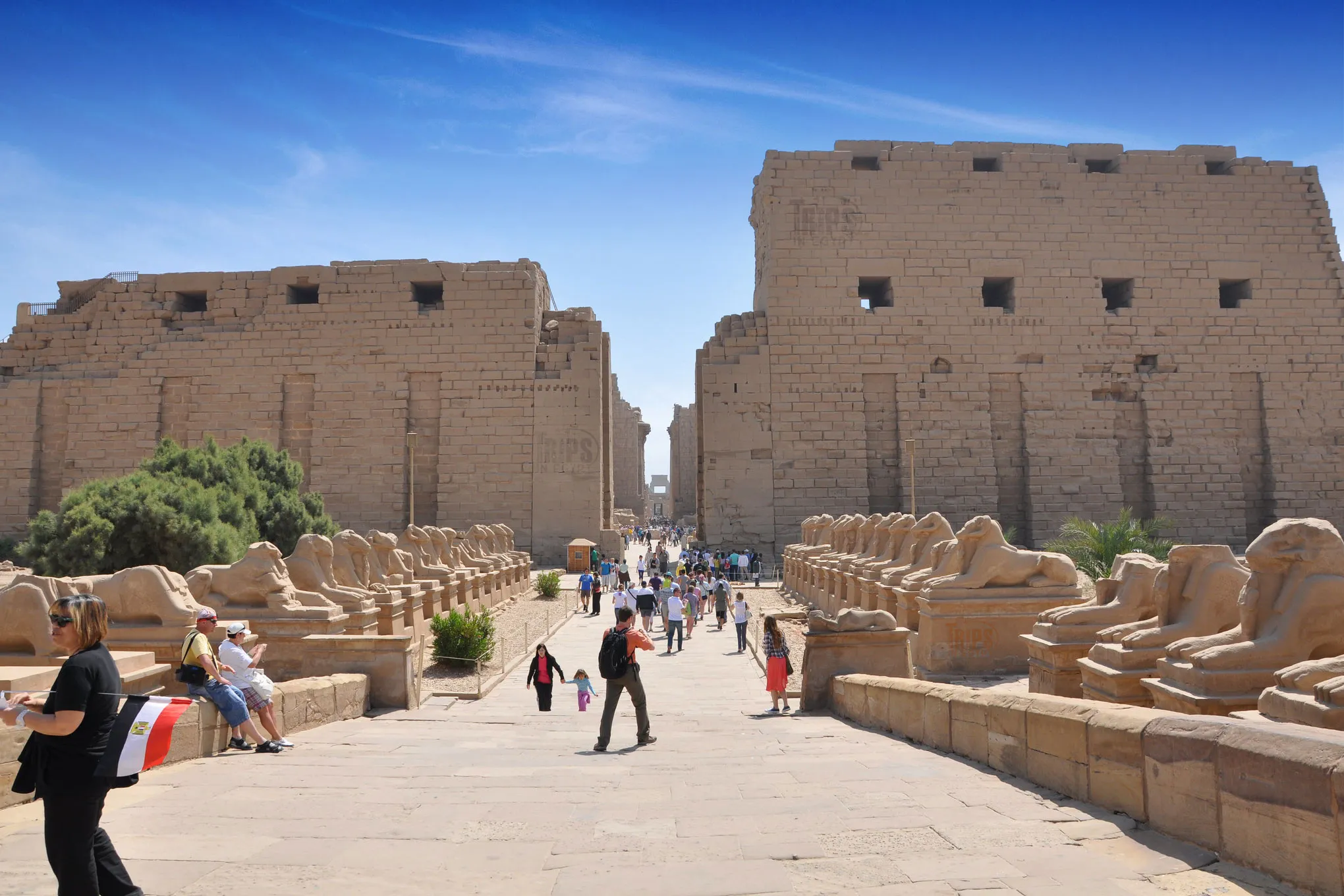
Travelers often compare Edfu with Abu Simbel, Karnak and Philae Temple. Edfu is especially impressive for its completeness and atmosphere rather than simply its size.
Tickets, Opening Hours and Photo Tips
At the time of writing, the ticket listed for foreign visitors is EGP 550 for adults and EGP 275 for students, while opening hours are generally around 7:00 am to 5:00 pm.
Ticket prices and schedules can change, so travelers should check official information shortly before visiting.
Early morning is usually the best time for photography and sightseeing because temperatures are cooler and cruise groups may be smaller.
Popular photo locations include the granite falcon statue, the pylon viewed from the courtyard and the narrow enclosure corridor where side lighting highlights the reliefs.
Edfu Temple Tours
Many visitors see Edfu as part of Nile cruises packages traveling between Luxor and Aswan. Cruise itineraries commonly combine Edfu with Esna or Kom Ombo.
Travelers staying in hotels rather than on a cruise can also visit by road.
Day Tour from Aswan to Edfu and Kom Ombo: Visit Edfu Temple and Kom Ombo from Aswan with private transport and an Egyptologist guide. From $80.
Esna, Edfu, Kom Ombo Tour from Luxor: Travel south from Luxor to explore Esna, Edfu and Kom Ombo in one full day. From $90.
10 Days Cairo, Faiyum & Nile Cruise Holiday: Combine Cairo and Faiyum with a Nile cruise between Luxor and Aswan that includes Edfu. From $1,350.
For longer itineraries, browse our Egypt tour packages to combine Edfu with Cairo, Luxor, Aswan and the Red Sea.
Edfu Temple and the Temple of Horus offer one of the clearest journeys into ancient Egyptian religion, architecture and mythology. Built over 180 years and protected beneath sand for centuries, the temple preserves monumental pylons, dark sanctuaries, sacred festivals and thousands of hieroglyphs. Whether you arrive by Nile cruise or day tour, allow enough time to walk slowly through its halls and experience one of Egypt's most complete ancient temples.

5 Days Cairo And Hurghada Trip
Amazing 4 Nights Cairo and Hurghada Trip Itinerary 5 Days Cairo and Hurghada trip wil...
- Duration 5 Days / 4 Nights
- Location Cairo & Hurghada
- Type Historical & Recreational Tour
From$690/per person
View Tour
6 Days Cairo, Alexandria & Faiyum Tour
Unforgettable Cairo, Alexandria & Faiyum Adventure in Six Days 6 Days Cairo, Alex...
- Duration 6 Days / 5 Nights
- Location Cairo - Alexandria - Fayum
- Type Historical Tour
From$720/per person
View Tour
10 Days Cairo, Faiyum & Nile Cruise Holiday
Breathtaking 10 Days Journey of A Lifetime in Egypt 10 Days Cairo, Faiyum & Nile...
- Duration 10 Days / 9 Nights
- Location Cairo, Luxor, Aswan & Faiyum
- Type Classic Tour
From$1350/per person
View Tour SOLD OUT
Ultimate 7-Day Egypt Solar Eclipse Experience with Hurghada 2027
Enjoy a 7-Day Egypt Solar Eclipse Tour with Hurghada 2027 6 Nights Egypt Solar Ecli...
- Duration 7 Days / 6 Nights
- Location Cairo / Giza / Luxor / Hurghada
- Type Astronomical Tour
Sold Out
View Details