



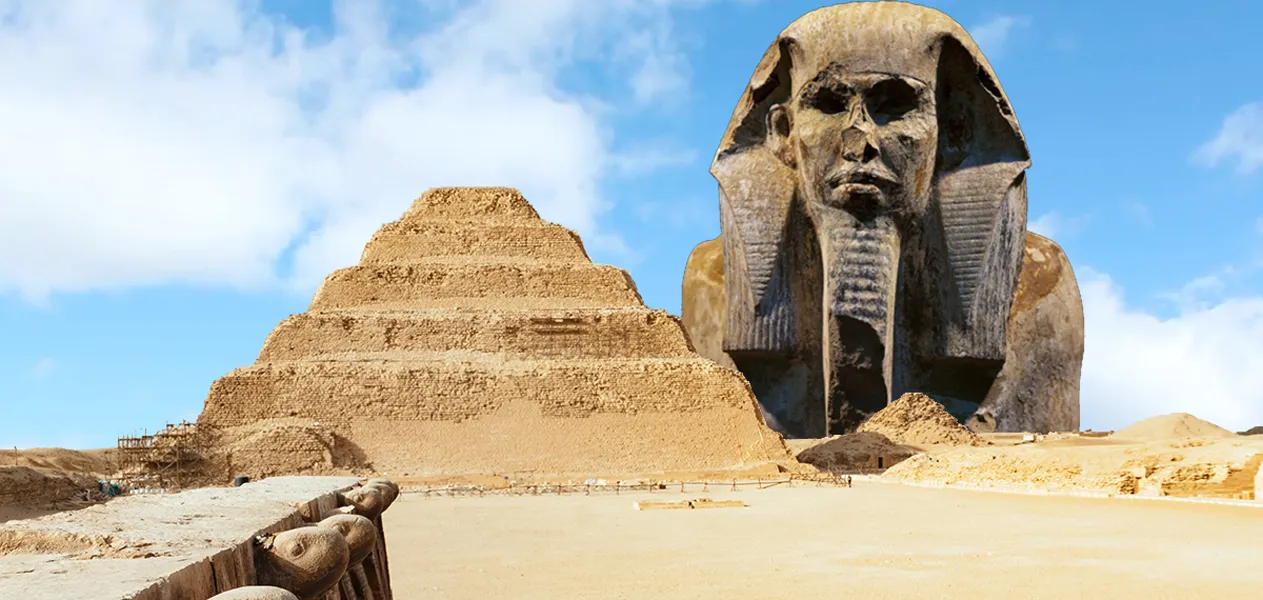
Long before Giza, one king decided that eternity should be built in stone. King Djoser ruled Egypt around 2667 to 2648 BC, at the start of the Third Dynasty, and his reign produced the first pyramid in human history.
This guide covers who Djoser was, the key facts about his life and his greatest achievements. It goes through his family and his death, the Step Pyramid of Saqqara, his tomb and mummy, and the partnership with his architect Imhotep. It also covers the legend of the Famine Stele and how you can visit his monument today.

Who Is King Djoser?
Who was Djoser? Djoser was an ancient Egyptian pharaoh of the Third Dynasty who ruled from around 2667 to 2648 BC. He is best known for the Step Pyramid at Saqqara, the first pyramid ever built and the oldest monumental stone building in Egypt.
His reign opens the Old Kingdom of ancient Egypt, the age of the great pyramids. The Ministry of Tourism and Antiquities uses the same dates as most modern chronologies.
Saqqara was the necropolis of the ancient capital Memphis, and the Step Pyramid became the model that every later pyramid improved on. Djoser was the son of King Khasekhemwy, the last ruler of the Second Dynasty, and Queen Nimaathap. His reign lasted roughly two decades: the Turin King List gives 19 years, and the Greek historian Manetho gives 29.
King Djoser Identity & Facts
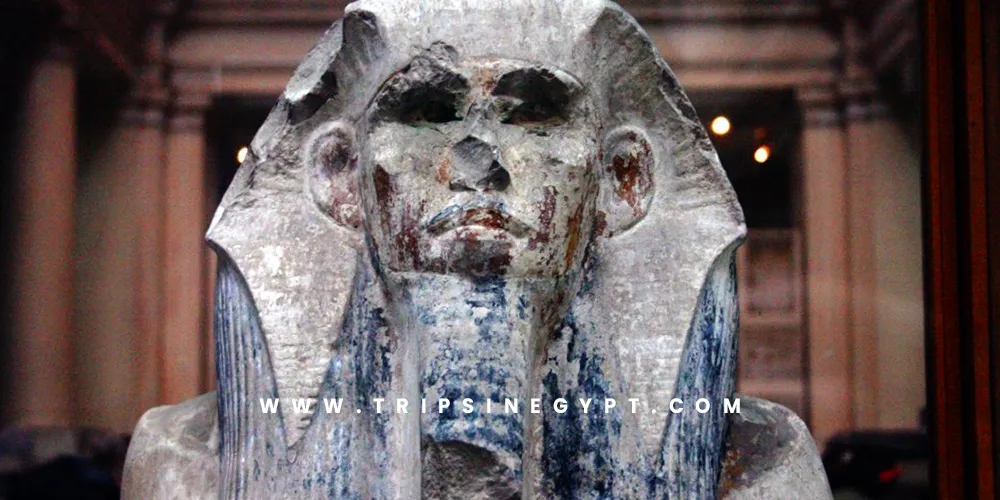
Netjerikhet or Djoser?
In his own lifetime, the king never used the name "Djoser" on his monuments. His contemporary inscriptions use his Horus name, Netjerikhet, which means "divine of body." The name Djoser appears in much later records, such as the New Kingdom king lists of Abydos and Turin, compiled more than a thousand years after his death.
The Greek form of his name in Manetho's history is Tosorthros. In older English books, you will also find him spelled Zoser. All of these names refer to the same king.
Djoser Pharaoh Facts at a Glance
These are the key King Djoser facts in one place.
|
Fact |
Detail |
|
Dynasty |
Third Dynasty, Old Kingdom |
|
Reign |
c. 2667 to 2648 BC, about 19 years (Turin King List) |
|
Horus name |
Netjerikhet ("divine of body") |
|
Parents |
Khasekhemwy and Nimaathap |
|
Capital |
Memphis |
|
Architect |
Imhotep |
|
Known for |
The Step Pyramid of Saqqara, the first pyramid |
|
Death |
c. 2648 BC; cause and age unknown |
|
Tomb |
Granite burial chamber beneath the Step Pyramid |
|
Statue |
Painted limestone seated statue, Egyptian Museum, Cairo |
10 Fun Facts About Djoser
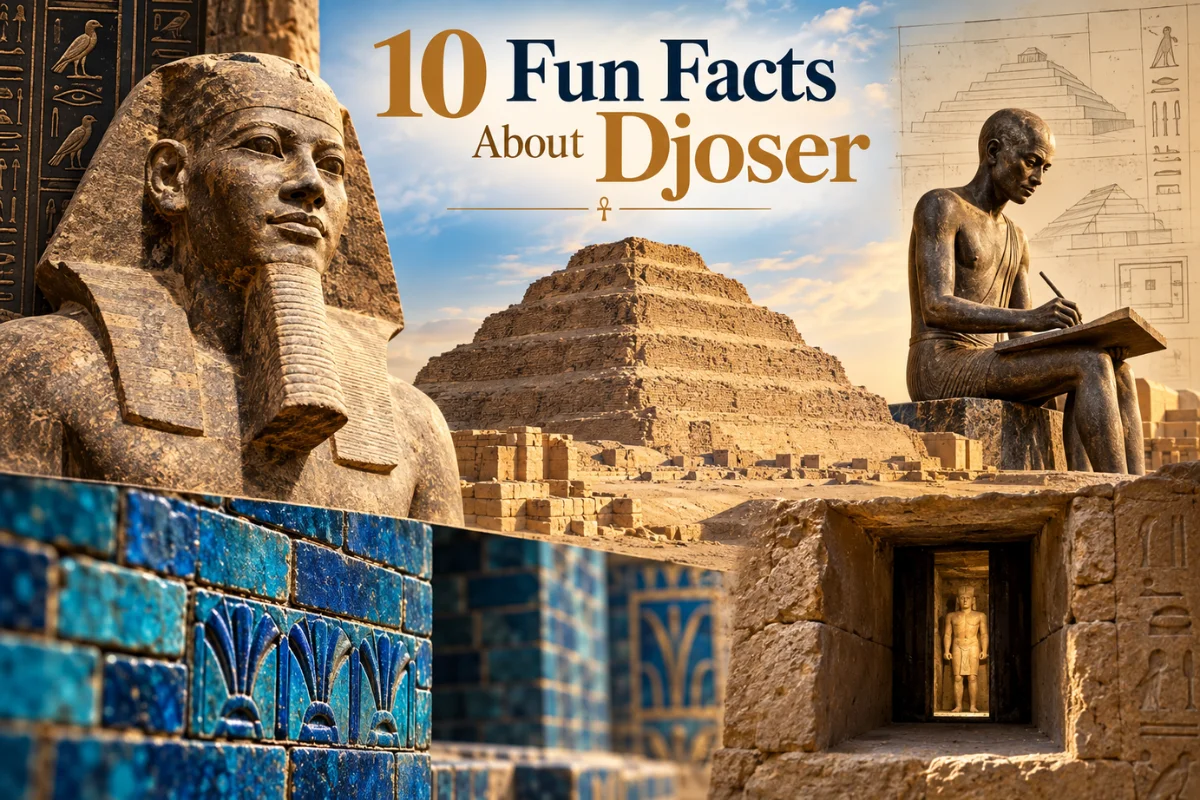
Some facts about Djoser surprise even visitors who know Egypt well. Here are ten.
-
He built the world's first pyramid. The Step Pyramid at Saqqara rose to 62.5 m in six steps, roughly a century before the Great Pyramid of Giza.
-
"Djoser" was not the name he used. His own monuments call him Netjerikhet. The name Djoser only appears in records written more than a thousand years later.
-
His pyramid started life as a flat tomb. It began as a square stone mastaba and was enlarged in stages until it became a six-step pyramid.
-
His architect became a god. Imhotep, who designed the pyramid, was worshipped as a god of healing two thousand years later, and the Greeks linked him with Asclepius.
-
His statue had eyeholes to look through. His seated statue was sealed in a stone chamber with two small holes at eye level, so his spirit could watch the offerings.
-
There is a maze under his pyramid. Nearly 6 km of tunnels and chambers run beneath it, some lined with blue faience tiles that imitate reed matting.
-
Only one of the 15 doors is real. The enclosure wall has fifteen doorways, but fourteen are solid stone false doors.
-
He has two tombs. Besides the burial chamber under the pyramid, the complex contains a second, symbolic "South Tomb".
-
More than 40,000 stone vessels were buried with him. Many of them carry the names of earlier First and Second Dynasty kings.
-
His most famous story was written about 2,400 years after his death. The Famine Stele, which tells of a seven-year drought in his reign, was carved under the Ptolemies.
How He Came to the Throne
Who ruled immediately before Djoser is still debated. Seal impressions naming Djoser were found in the tomb of Khasekhemwy at Abydos. This suggests Djoser oversaw his father's burial and succeeded him directly. However, the Ramesside king lists place a king called Nebka before him, so some scholars argue that Nebka ruled first.
The Statue of King Djoser
One of the most famous images of any pharaoh is the King Djoser statue, a seated figure in painted limestone. It is about 1.4 m tall and was found in 1924 to 1925 by the Egyptian Antiquities Service in the serdab, a sealed statue chamber on the north side of the pyramid. Two holes in the serdab wall let the statue "look out" at the offerings made for the king's spirit.
It is one of the oldest known life-size royal statues from Egypt. The original is displayed in the Egyptian Museum in Tahrir Square. A replica sits in the serdab at Saqqara, where visitors can see it through the same eye holes.
King Djoser Family Tree
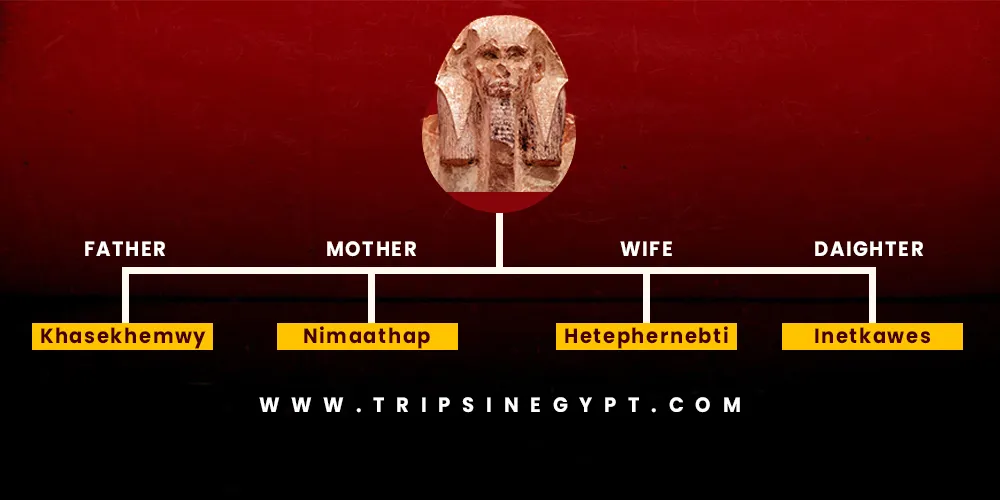
Much of what we know about Djoser's family comes from two sources. The first is fragments of a limestone shrine he built at Heliopolis, now in the Egyptian Museum of Turin. The second is the dozens of small boundary stelae found inside the Step Pyramid enclosure.
-
Father: Khasekhemwy, the last king of the Second Dynasty.
-
Mother: Queen Nimaathap, who held the title "Mother of the King's Children."
-
Wife: Queen Hetephernebti, whose titles include "she who sees Horus," "great of sceptre," and "King's Daughter." The last title suggests that she was also a daughter of Khasekhemwy, and therefore possibly Djoser's half-sister.
-
Daughter: Princess Inetkawes, the only child known by name. She appears with her mother on the Heliopolis reliefs and the boundary stelae.
The Death of King Djoser
No surviving record describes the death of King Djoser, so the cause of King Djoser's death remains unknown. His reign ended around 2648 BC, and his age at death is not known either. If the Turin King List's 19 years are correct, he died roughly two decades after taking the throne.
His successor was probably Sekhemkhet, who began his own step pyramid at Saqqara but died before it was finished. The exact relationship between the two kings is unknown. Djoser was buried beneath his own pyramid, in Lower Egypt, as the next section explains.
King Djoser's Accomplishments and Achievements
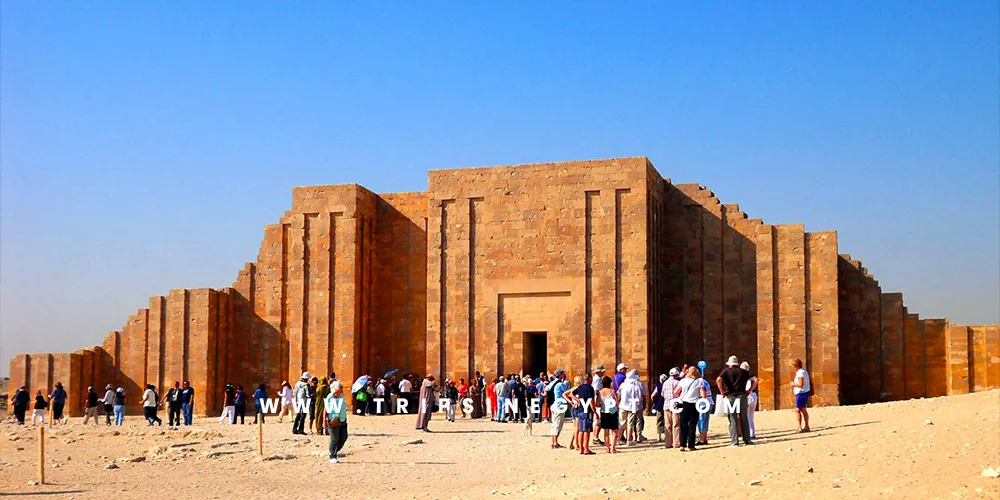
Djoser's reign marks the moment when the Egyptian state became organized enough to undertake projects on a vast scale. The Djoser accomplishments and achievements that historians cite most often are these five:
-
Building the first pyramid, and with it the first monumental architecture in cut stone.
-
Creating the first great royal funerary complex, with its courts, temples and enclosure wall, which every later pyramid complex followed.
-
Sending mining expeditions to Sinai for turquoise and copper.
-
Strengthening royal government from Memphis, with the administration needed to feed and organize a large workforce.
-
Patronizing Imhotep, whose fame as an architect and healer outlived the king by millennia.
Quarrying, transporting and setting hundreds of thousands of cubic meters of stone required a large workforce, a reliable food supply and an administration that could keep records. All three were in place by his reign.
Expeditions to Sinai
Rock reliefs of Netjerikhet at Wadi Maghara in southwestern Sinai show that his expeditions worked the turquoise and copper deposits there. These reliefs are among the earliest royal monuments in Sinai, and later Old Kingdom kings continued to send mining expeditions to the same valley.
Borders and the Libyan Frontier
Later tradition credits Djoser with fixing Egypt's southern border at the First Cataract near Aswan and Elephantine, which remained the traditional frontier with Nubia. Claims of a victory over the Libyans to the west also appear in later accounts. Neither claim is confirmed by inscriptions from his own reign.
A Capital at Memphis
Djoser governed from Memphis, the city at the junction of the Nile Valley and the Delta that tradition said was founded by King Menes (Narmer). Placing his tomb on the desert plateau of Saqqara, overlooking the capital, made the royal burial a permanent presence in the city's skyline.
King Djoser Pyramid
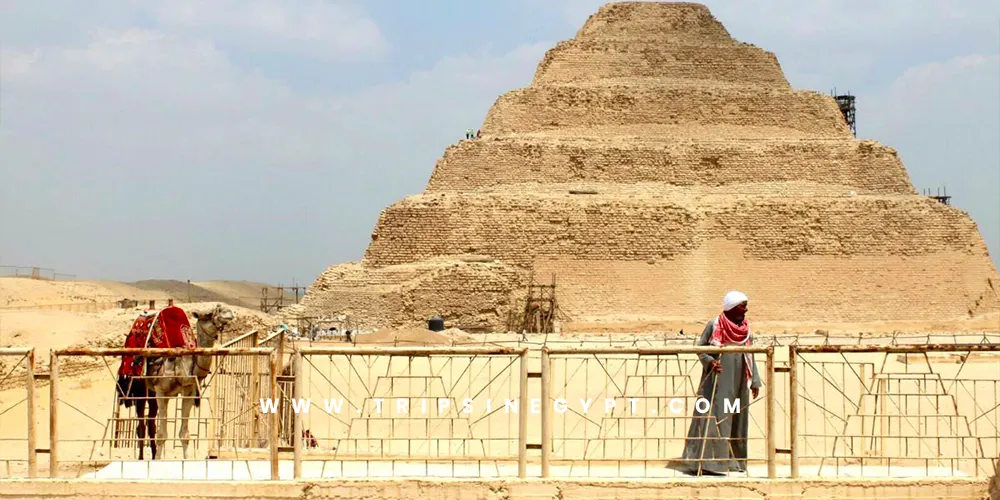
Every pyramid in Egypt descends from this one. Before Djoser, kings and nobles were buried under mastabas, flat-topped rectangular tombs built mainly of mud brick. Djoser's builders made the leap to building entirely in cut limestone, then stacked one mastaba-like level on another until the tomb rose in six steps.
How the Step Pyramid Was Built
Archaeologists identify several building stages:
-
M1 to M3: a square stone mastaba, enlarged twice.
-
P1: a four-step pyramid built over the mastaba.
-
P1′ and P2: an expansion to six steps and a final casing of fine white Tura limestone.
Step Pyramid Facts and Figures
-
Height: 62.5 m as originally built
-
Base: 109 × 121 m
-
Volume: about 330,400 m³ of stone and clay
-
Steps: six
-
Burial shaft: about 7 m square and 28 m deep, ending in a granite burial chamber
-
Underground galleries: nearly 6 km of corridors and chambers
When completed, the Step Pyramid was the tallest building Egypt had ever seen. Most Egyptologists now see pyramid building as the work of organized, paid labor crews rather than slaves. You can read more about building methods in our guide to how the pyramids were built.
Inside the King Djoser Complex
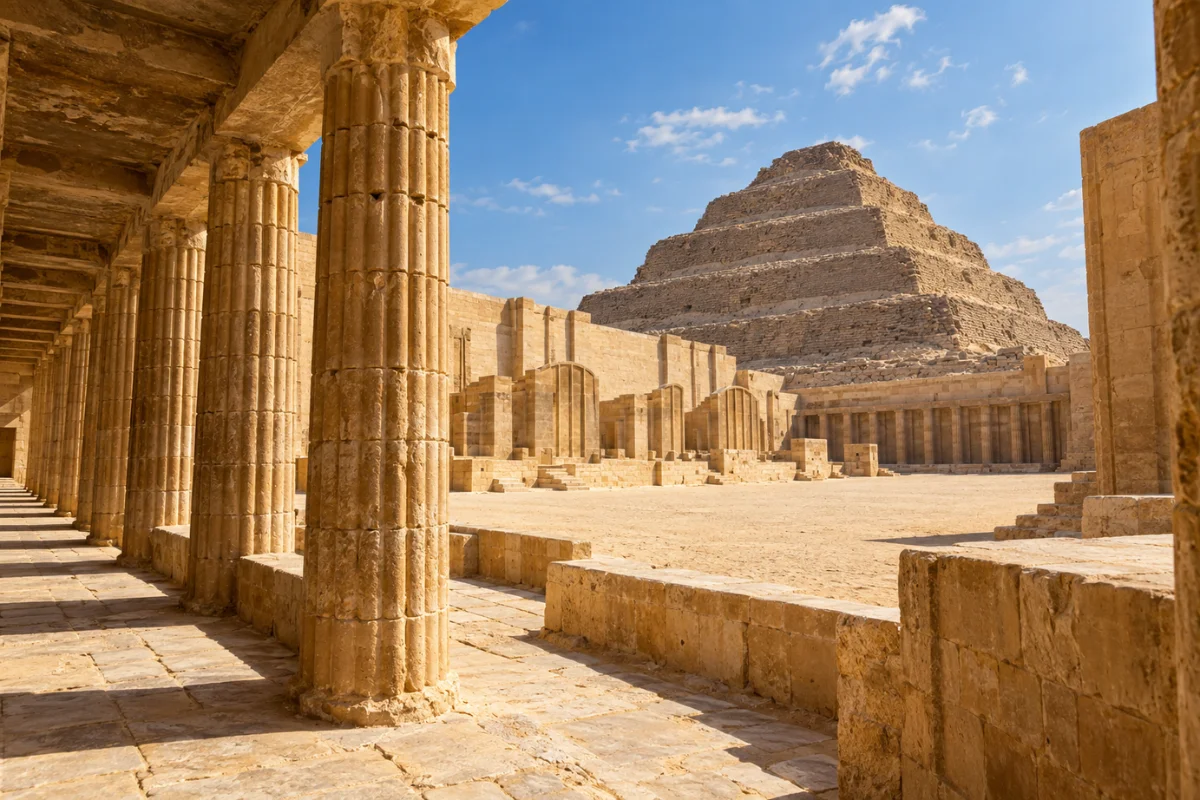
The King Djoser complex is a walled precinct of about 15 hectares. The enclosure wall is 10.5 m high and more than 1.6 km long. Its paneled design has fifteen doorways, and only one of them, at the southeast corner, is real. The other fourteen are false doors carved in stone.
Within the walls, you will find:
-
The entrance colonnade, a corridor of ribbed stone columns carved to imitate bundled reeds.
-
The Heb Sed court, with solid dummy chapels used in the king's eternal celebration of the Sed festival. Our guide to ancient Egyptian festivals explains it in more detail.
-
The Great South Court and the South Tomb.
-
The serdab on the north side, with the king's seated statue.
-
The North Temple, where the mortuary cult was performed.
King Djoser's Tomb and Mummy
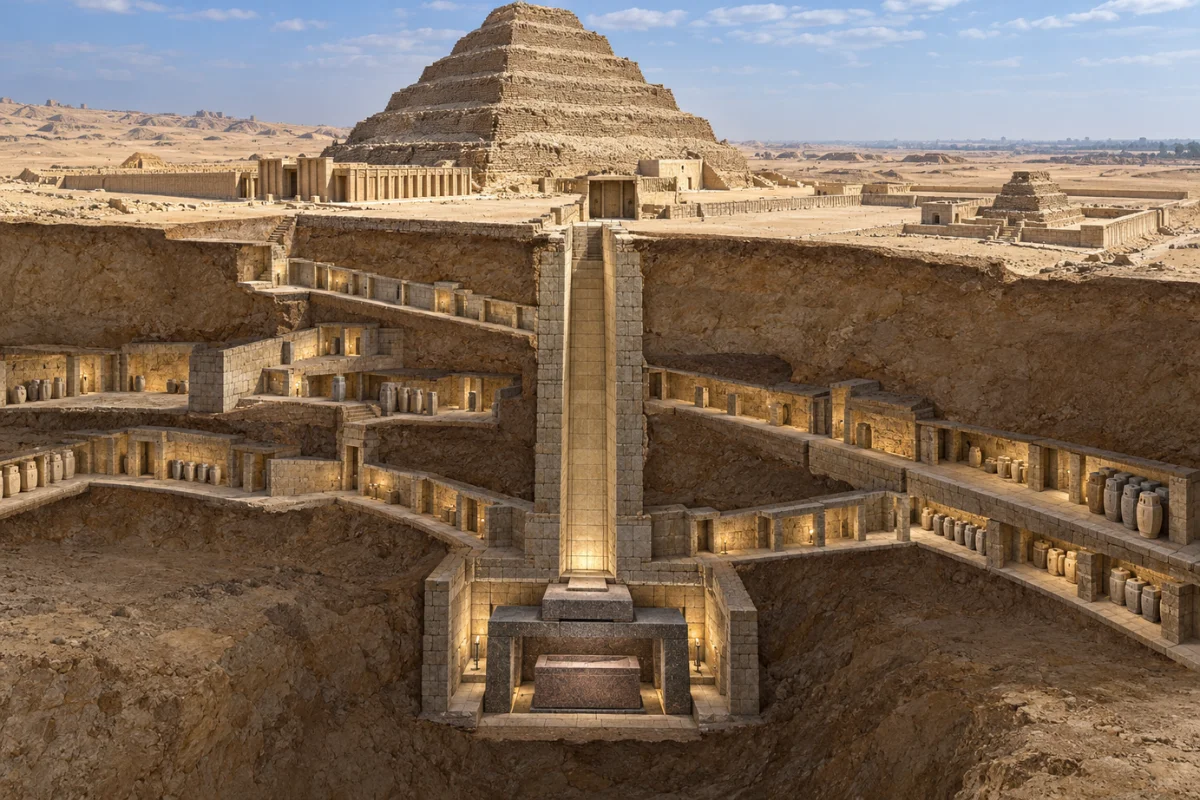
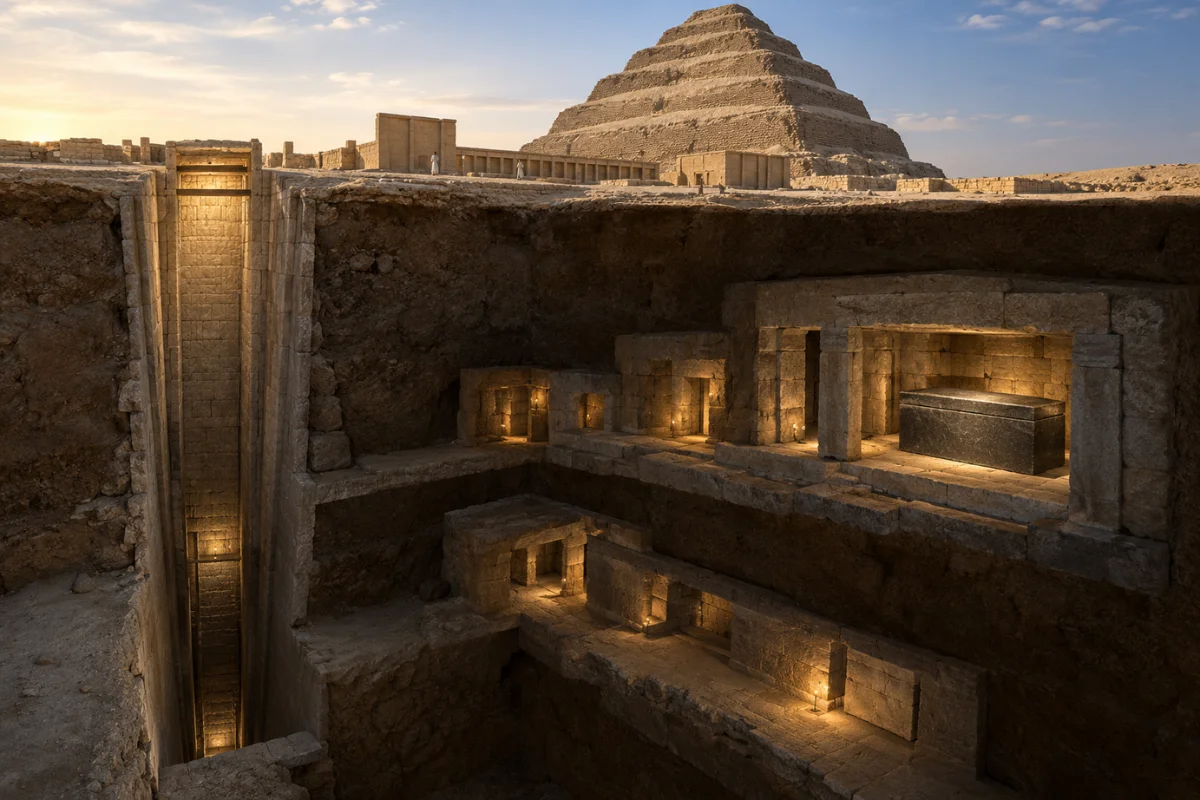
The King Djoser tomb lies at the bottom of the 28 m shaft beneath the pyramid. It is a burial chamber built of granite blocks, entered through a hole in its roof that was sealed with a granite plug weighing about 3.5 tons. Despite that precaution, robbers reached the chamber in antiquity and emptied it.
The South Tomb, at the other end of the complex, copies the main burial on a smaller scale. Its chamber is too small for a body, so most Egyptologists see it as a symbolic tomb, possibly for the king's spirit or for his rule over Upper and Lower Egypt.
The King Djoser mummy has never been securely identified. In 1934, excavators found a mummified left foot and other human remains in the burial chamber. Whether they belong to Djoser is still debated, so no complete body can be confidently called his.
Excavators also recovered more than 40,000 stone vessels from the storerooms beneath the pyramid. The French architect Jean-Philippe Lauer spent much of the 20th century studying and partly reconstructing the complex. After a 14-year restoration, the pyramid reopened to visitors in March 2020. For a deeper look at the monument itself, see our full guide to the Step Pyramid of Saqqara.
The Famine Stele During the Reign of Djoser
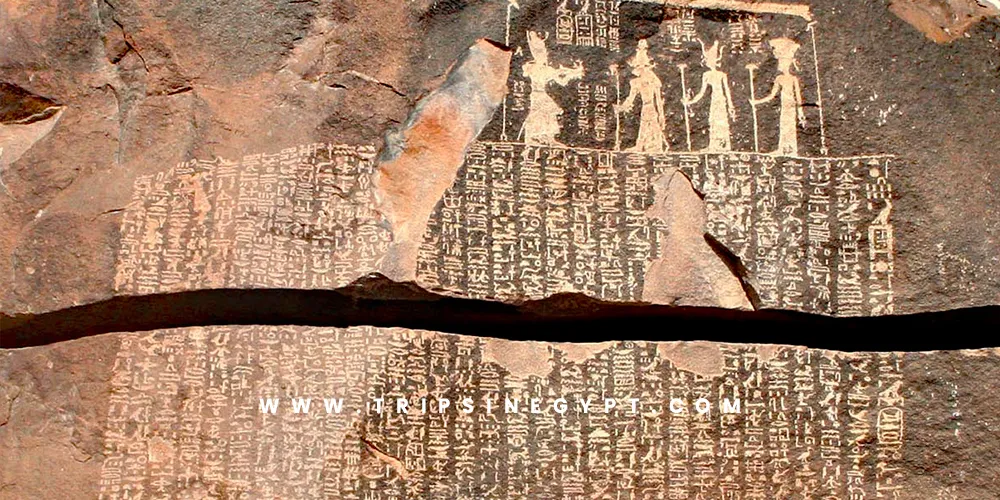
Some of the most vivid stories about Djoser were written down more than two thousand years after he died. The Famine Stele is a granite inscription of 32 columns of hieroglyphs carved on a natural boulder on Sehel Island, in the Nile just south of Aswan. The American Egyptologist Charles Wilbour recorded it in 1889.
The text is set in the 18th year of Djoser's reign. It describes seven years in which the Nile failed to flood, the granaries emptied and people turned to crime. Djoser asks his priests for help, and Imhotep searches the temple archives. He learns that the god Khnum of Elephantine controls the river's flood.
In thanks, Djoser grants Khnum's temple the land between Aswan and Takompso to the south, along with a share of the goods that passed through from Nubia. Egyptologists date the inscription to the Ptolemaic period, probably the reign of Ptolemy V.
The stele survives with a large horizontal crack across the stone, but its text can still be read. Sehel is a short boat ride from Aswan, and it pairs well with other Aswan attractions.
King Djoser and Imhotep
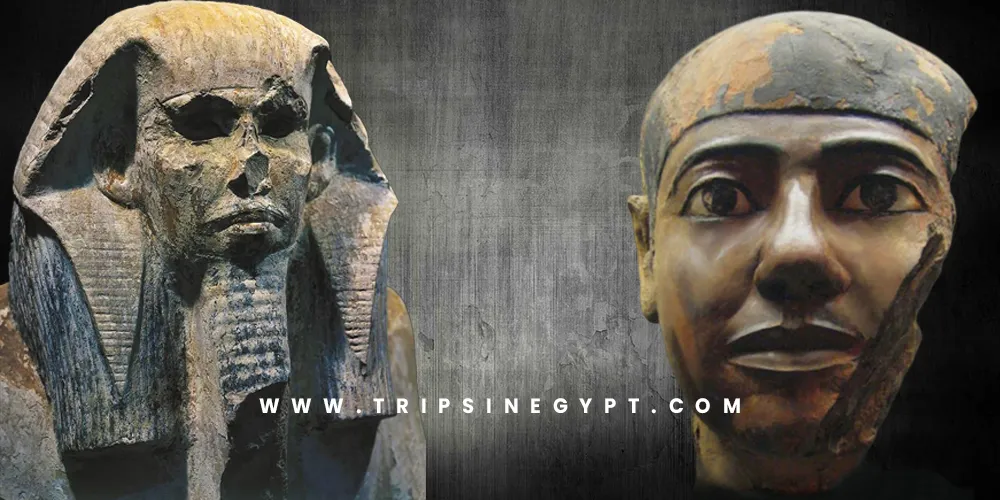
No name is more closely tied to Djoser's than that of his chief official, Imhotep. His existence is confirmed by a contemporary inscription on the base of a statue of Djoser found at Saqqara. The inscription lists Imhotep's titles, including chancellor of the King of Lower Egypt, administrator of the great palace and high priest of Heliopolis.
Most Egyptologists credit him as the architect of the Step Pyramid. A graffito on the enclosure wall of Sekhemkhet's unfinished pyramid suggests that he outlived Djoser and worked on the next king's tomb as well.
Imhotep's reputation grew for millennia. By the Late Period, he was worshipped as a god of healing and wisdom, and the Greeks identified him with Asclepius.
Imhotep may also have appeared in the Djoser-era tale of the Westcar Papyrus, but that section is almost entirely lost. His tomb has never been found, though many believe it lies somewhere at Saqqara.
Visiting Djoser's Step Pyramid Complex Today
Seeing the complex in person is the best way to understand Djoser's achievement. The colonnade, the courts and the pyramid itself are all open to visitors, and the site is quieter than Giza.
-
Location: Saqqara, about 30 km south of central Cairo.
-
Opening hours: daily, 8:00 AM to 5:00 PM.
-
Tickets: the general Saqqara site ticket for foreign adults is EGP 600. Entry to the pyramid's interior, the South Tomb and the Serapeum each needs a separate ticket.
-
Payment: major Egyptian sites now take cards only.
-
Imhotep Museum: near the site entrance, displaying finds from Saqqara.
-
Best time to visit: October to April, early in the morning.
Most travelers combine Saqqara with the open-air museum at Memphis and the pyramids of Dahshur in a single day. Our half-day tour to Memphis, Saqqara and Dahshur covers all three with an Egyptologist guide, entrance fees and lunch included, From $100 per person.
King Djoser's Legacy
Of all the Djoser achievements, the most lasting was opening the age of the pyramids. Within a century, his successors moved from steps to smooth sides. Sneferu built the Bent and Red Pyramids at Dahshur, and his son Khufu raised the Great Pyramid at the Giza Pyramids Complex.
Later Egyptians remembered his reign with reverence. New Kingdom visitors left graffiti in his complex praising the king, and Late Period priests revived his name in texts such as the Famine Stele. To place him among the rulers who followed, see our guide to the Egyptian pharaohs.
Explore the Heritage of Ancient Egypt through Our Tours
Standing in the shadow of the world's first pyramid connects you directly to the beginnings of Egypt's monumental history. Our Egypt tour packages pair Saqqara with Giza, the Egyptian Museum and the temples of the Nile Valley. Our team can tailor any itinerary to the sites you most want to see.
Conclusion
King Djoser turned Egyptian tombs into monuments of stone. With his architect Imhotep, he raised the Step Pyramid at Saqqara, the first pyramid ever built, and surrounded it with a royal complex that later kings copied for centuries. His family, his achievements and the mystery of his mummy still draw historians back to him. More than 4,600 years later, his six golden steps rise above the desert, waiting for you.

5 Days Cairo And Hurghada Trip
Amazing 4 Nights Cairo and Hurghada Trip Itinerary 5 Days Cairo and Hurghada trip wil...
- Duration 5 Days / 4 Nights
- Location Cairo & Hurghada
- Type Historical & Recreational Tour
From$690/per person
View Tour
6 Days Cairo, Alexandria & Faiyum Tour
Unforgettable Cairo, Alexandria & Faiyum Adventure in Six Days 6 Days Cairo, Alex...
- Duration 6 Days / 5 Nights
- Location Cairo - Alexandria - Fayum
- Type Historical Tour
From$720/per person
View Tour
10 Days Cairo, Faiyum & Nile Cruise Holiday
Breathtaking 10 Days Journey of A Lifetime in Egypt 10 Days Cairo, Faiyum & Nile...
- Duration 10 Days / 9 Nights
- Location Cairo, Luxor, Aswan & Faiyum
- Type Classic Tour
From$1350/per person
View Tour SOLD OUT
Ultimate 7-Day Egypt Solar Eclipse Experience with Hurghada 2027
Enjoy a 7-Day Egypt Solar Eclipse Tour with Hurghada 2027 6 Nights Egypt Solar Ecli...
- Duration 7 Days / 6 Nights
- Location Cairo / Giza / Luxor / Hurghada
- Type Astronomical Tour
Sold Out
View Details