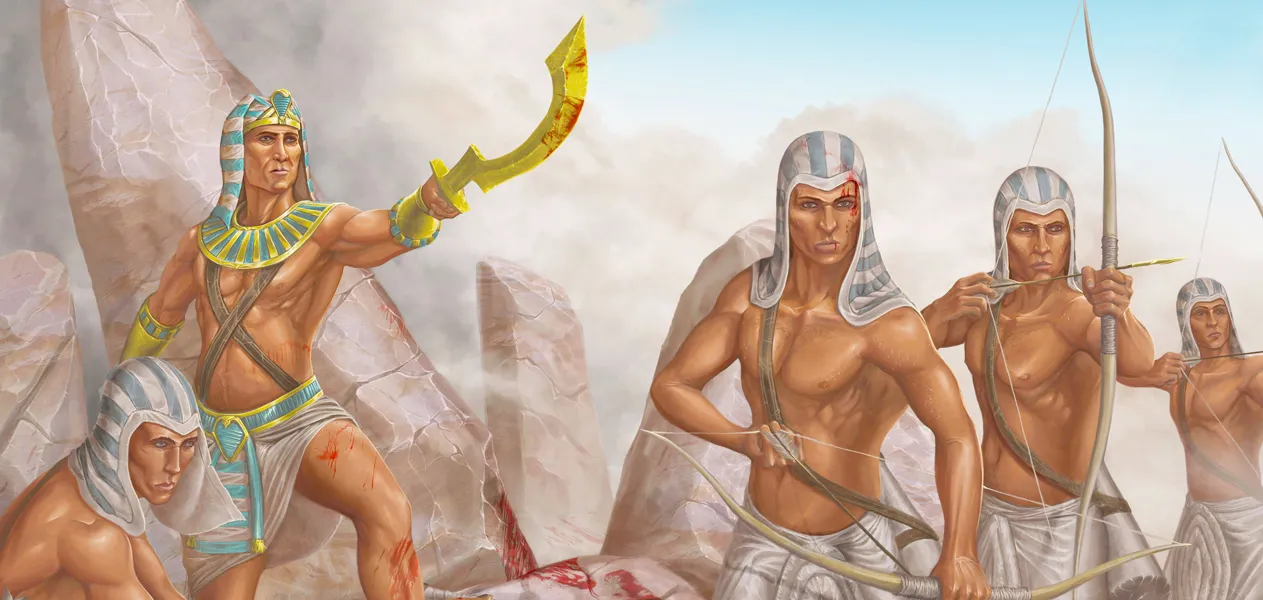




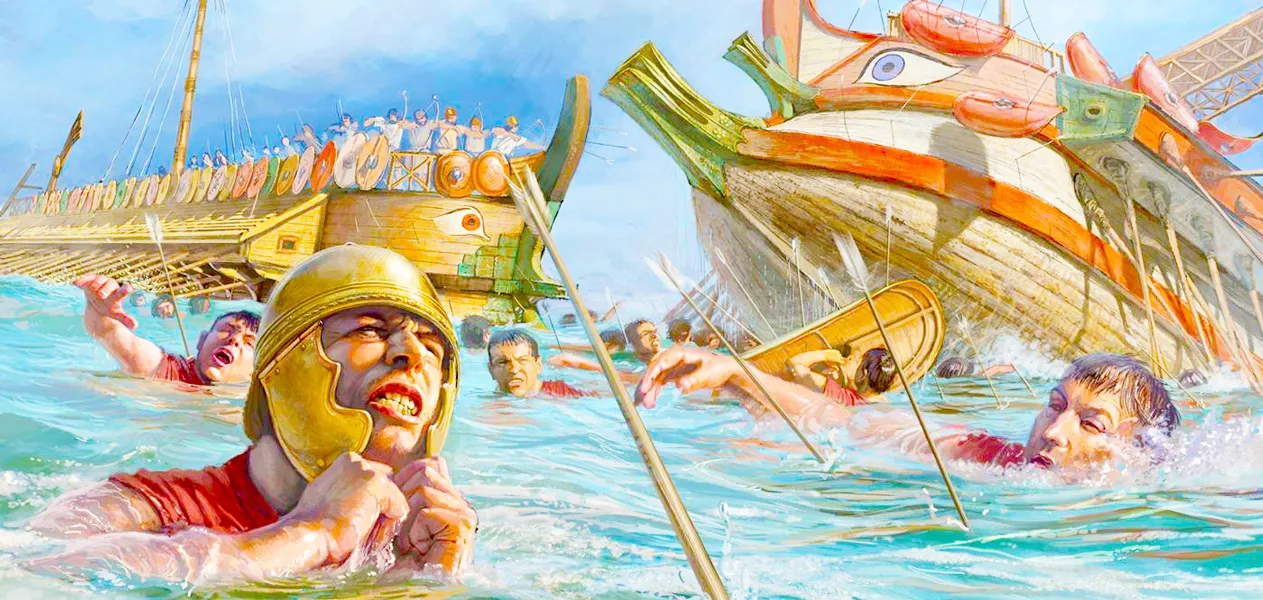
The Battle of Djahy was a land battle fought around 1177 BC, when Pharaoh Ramses III stopped the Sea Peoples on Egypt's northeastern frontier in the Levant. In the same year, he also crushed their fleet in the Nile Delta. Together, these victories saved Egypt as the Bronze Age world collapsed around it. This guide explains who the Sea Peoples were, how both battles unfolded and what victory ultimately cost Egypt.

What Was the Battle of Djahy?
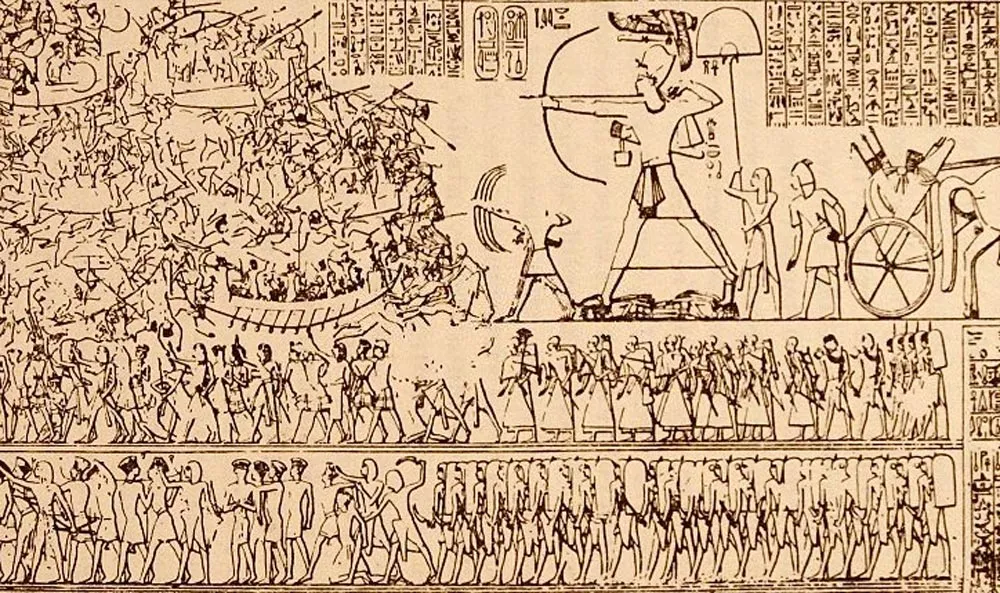
The Battle of Djahy was fought in the eighth year of Ramses III, around 1177 BC, between the Egyptian army and an invading coalition known today as the Sea Peoples. It is known mainly from the pharaoh's own inscriptions and reliefs at Medinet Habu in Luxor. The sections below explain where Djahy was, how the battle differed from the naval Battle of the Delta that followed it and the essential facts surrounding the campaign.
Where Was Djahy?
Djahy, sometimes written Djahi, was the ancient Egyptian name for the coastal lands of the southern Levant, roughly covering parts of modern Lebanon, Israel and the Gaza Strip and forming part of the wider region known in antiquity as Canaan.
During the New Kingdom, Egypt controlled much of this territory through local princes, military garrisons and administrative centers. It served as a strategic buffer between the Nile Valley and the kingdoms farther north.
The exact battlefield has never been identified because the Egyptian inscriptions name only the broader region. Most historians therefore place the fighting somewhere in southern Canaan, where Ramses III could intercept the invading force before it crossed Sinai and reached the Nile Delta.
The Battle of Djahy and the Battle of the Delta
The Battle of Djahy and the Battle of the Delta were two different engagements during the same campaign in Year 8 of Ramses III.
Djahy was the land battle in the Levant, where Egyptian infantry and chariots confronted Sea Peoples moving south with warriors, families and ox-carts. The Battle of the Delta came afterward, when their fleet attempted to penetrate Egypt through the mouths of the Nile.
At the Delta, Egyptian ships and archers positioned along the riverbanks trapped the enemy vessels. The Medinet Habu reliefs portray both clashes, and the naval scene is among the earliest surviving detailed artistic representations of a sea battle.
Battle of Djahy Facts at a Glance
|
Fact |
Detail |
|
Date |
Year 8 of Ramses III, around 1177 BC; some chronologies give 1178 or 1175 BC |
|
Place |
Djahy in the coastal Levant near Egypt's northeastern frontier |
|
Egyptian leader |
Ramses III of the 20th Dynasty |
|
Enemy |
Sea Peoples including Peleset, Tjeker, Shekelesh, Denyen and Weshesh |
|
Type |
Land battle followed by the naval Battle of the Delta |
|
Result |
Decisive Egyptian victory |
|
Main evidence |
Medinet Habu inscriptions and reliefs and Papyrus Harris I |
Who Were the Sea Peoples?
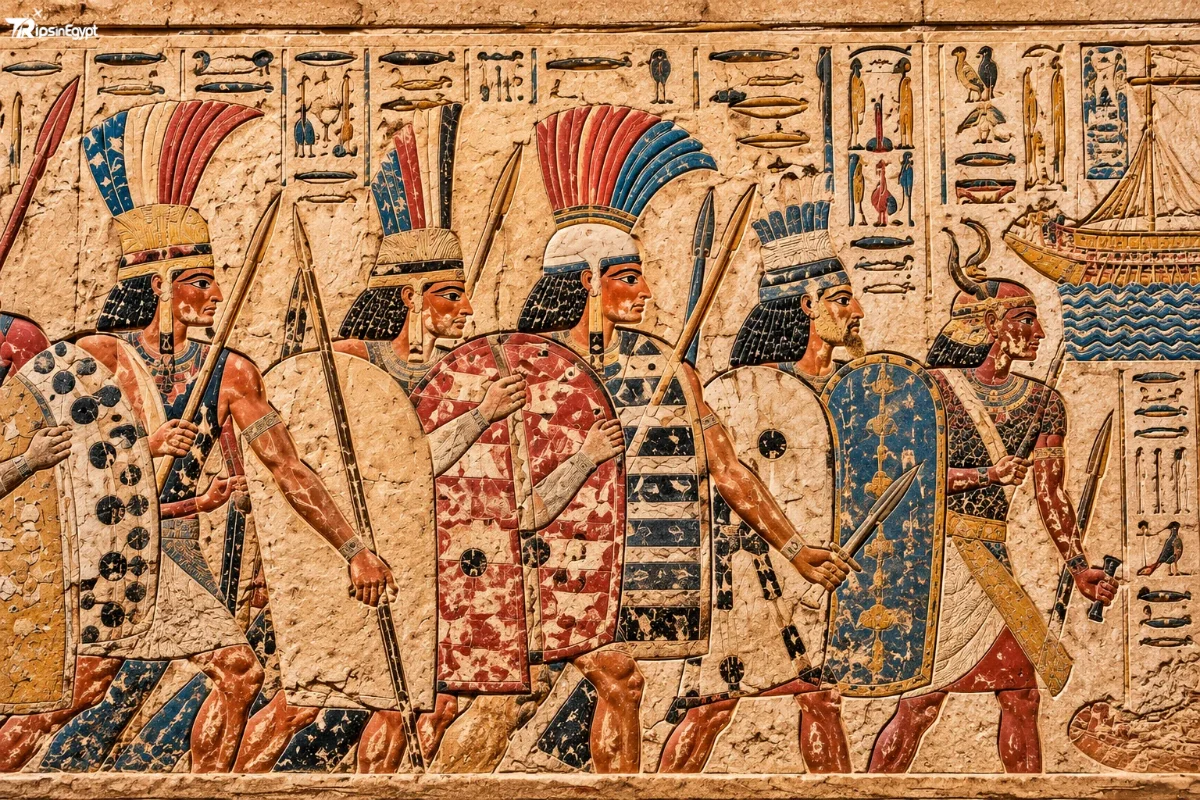
The Sea Peoples were a loose coalition of groups who raided, migrated and fought across the eastern Mediterranean near the end of the Late Bronze Age, roughly between 1200 and 1150 BC. The name itself is modern and was created by nineteenth-century scholars from Egyptian descriptions of enemies associated with the sea and distant islands. Their exact identities remain debated, but Egyptian inscriptions preserve the names of several groups involved in conflicts with Egypt.
The Peoples Named in Egyptian Records
Egyptian texts name around nine groups across the reigns of several pharaohs.
The Year 8 inscriptions of Ramses III identify the Peleset, Tjeker, Shekelesh, Denyen and Weshesh among the invading forces. Earlier records under Merneptah also mention the Ekwesh, Teresh, Lukka and Sherden.
The Sherden are particularly interesting because they appear both as enemies of Egypt and later as soldiers serving in the Egyptian army. Medinet Habu reliefs distinguish some groups visually. Peleset and Tjeker warriors are frequently shown wearing tall feathered headdresses, while Sherden soldiers appear with horned helmets, round shields and long swords.
The Peleset are widely connected with the biblical Philistines, who settled along the southern coast of Canaan during the early Iron Age.
Where Did the Sea Peoples Come From?
No single homeland has been proven for the Sea Peoples, and they probably came from several regions rather than one nation.
Scholars have proposed connections with the Aegean world, western Anatolia, Cyprus and islands across the Mediterranean. The Lukka are commonly associated with Lycia in Anatolia, while similarities in names have led some researchers to connect the Shekelesh with Sicily and the Sherden with Sardinia. These identifications remain debated.
Archaeology provides stronger evidence for at least some movement from the Aegean. Early Philistine pottery shows strong similarities to Mycenaean Greek ceramics, while a 2019 genetic study of burials at Ashkelon detected temporary European-related ancestry among early Iron Age inhabitants before it faded over subsequent generations.
The Sea Peoples and the Bronze Age Collapse
The Sea Peoples appeared during the Late Bronze Age collapse, when established kingdoms and trading systems across the eastern Mediterranean broke down within several decades.
The Hittite Empire disappeared, the palace centers of Mycenaean Greece were destroyed and the Syrian trading city of Ugarit was burned around 1185 BC. Letters from Ugarit describe enemy ships attacking coastal settlements shortly before the city vanished from history.
Modern historians do not attribute this collapse solely to the Sea Peoples. Climate stress, drought, food shortages, internal revolts, earthquakes and disruption to international trade probably combined with warfare and migration.
The Sea Peoples may therefore have included displaced populations searching for new homes as well as organized raiders and military groups. Egypt was one of the few major Bronze Age states to survive the upheaval.
Ramses III and the Sea Peoples
Egypt's wealth and strategic position made it a natural target for foreign coalitions during the New Kingdom, but the Sea Peoples did not first appear during the reign of Ramses III. Egyptian rulers had encountered some of these groups for nearly a century, sometimes fighting them and sometimes employing them as mercenaries. Earlier clashes under Ramses II and Merneptah reveal how the threat developed before the largest confrontation under Ramses III.
Earlier Clashes Under Ramses II and Merneptah
During the reign of Ramses II, Sherden raiders attacked Egypt's Delta coast and were defeated. Some were subsequently incorporated into the Egyptian military and later appear as royal bodyguards and soldiers during the Battle of Kadesh in 1274 BC.
A more serious crisis occurred during the reign of Merneptah. Around 1208 BC, in his fifth regnal year, a Libyan coalition supported by several Sea Peoples groups invaded Egypt's western Delta.
Merneptah defeated them at the Battle of Perire. A major inscription at Karnak records the campaign and lists large numbers of enemy casualties, while the famous Merneptah Stele commemorates the wider victories of his reign.
The Rise of Ramses III
Ramses III came to the throne around 1186 BC as the second ruler of Egypt's 20th Dynasty, following political instability at the end of the 19th Dynasty.
He consciously modeled aspects of his kingship on Ramses II and soon faced military threats from several directions. In his fifth year, he defeated a Libyan invasion to the west, and another major Libyan conflict occurred during his eleventh year.
Between those wars came the greatest danger of his reign. Sea Peoples advanced south through the Levant while another force approached by sea.
Ramses III's defense of Egypt helped establish his reputation as the last great warrior pharaoh of the Egypt New Kingdom.
How the Sea Peoples Reached Egypt's Borders
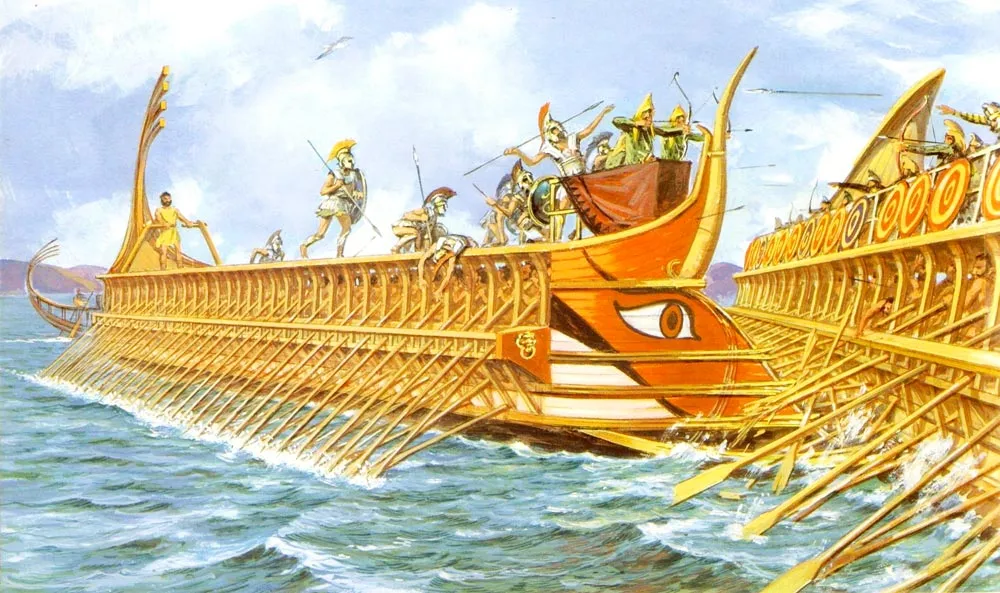
By the eighth year of Ramses III, major political centers across Anatolia, Cyprus and Syria had already been disrupted or destroyed. Egypt remained wealthy in grain, precious metals, stone and fertile agricultural land, making the Nile Valley an attractive destination. The coastal route through Syria and Canaan offered the most direct approach toward Egypt, while Egyptian military positions in Djahy formed the first defensive barrier before the invaders could reach Sinai.
The Advance Through Anatolia and Syria
The Year 8 inscription at Medinet Habu describes the crisis dramatically, claiming that foreign lands formed a conspiracy and that no country could stand before them.
It names Hatti, Kode, Carchemish, Arzawa and Alashiya, or Cyprus, among the regions overwhelmed during the movement south.
The text then places the invaders' camp in Amurru, in Syria, before their advance toward Egypt.
The accompanying reliefs are important because they show more than soldiers. Women, children and loaded ox-carts appear alongside the warriors. That imagery has encouraged historians to interpret at least part of the movement as a migration involving whole communities rather than simply an army conducting a temporary raid.
Did the Sea Peoples Attack Kadesh?
The surviving Egyptian evidence names Kode, not the city of Kadesh.
Kode is generally placed in Cilicia in southern Anatolia or northern Syria. It should not be confused with Kadesh on the Orontes River, famous because Ramses II fought the Hittites there about a century earlier during the Battle of Kadesh.
This distinction corrects a common mistake in modern retellings of the Sea Peoples campaign.
As the invaders moved south, Ramses III strengthened Egypt's frontier positions in Djahy, mobilized his land forces and prepared ships near the mouths of the Nile. His strategy meant that the invasion would be confronted before it could penetrate Egypt by either land or sea.
The Beginning of the Djahy Battle
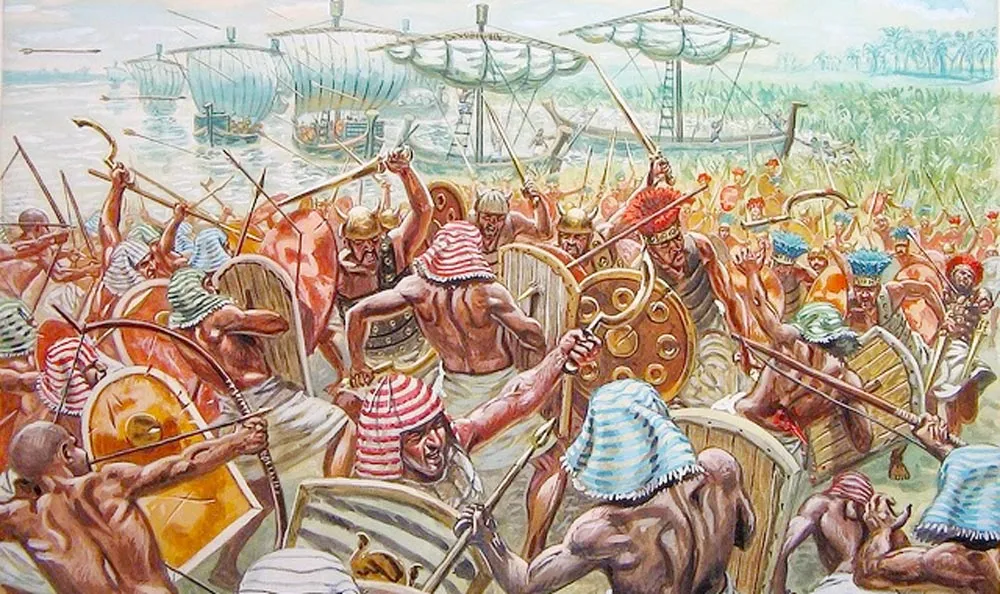
The campaign of Year 8 unfolded in two principal stages. Egyptian forces first stopped the land migration in Djahy before confronting the enemy fleet in the Nile Delta. Ramses III recorded both victories extensively at Medinet Habu, where the battle scenes rank among the most detailed military images to survive from ancient Egypt. They also reveal how Egypt combined chariots, archers, infantry, ships and prepared defensive positions against different parts of the invasion.
The Land Battle in Djahy
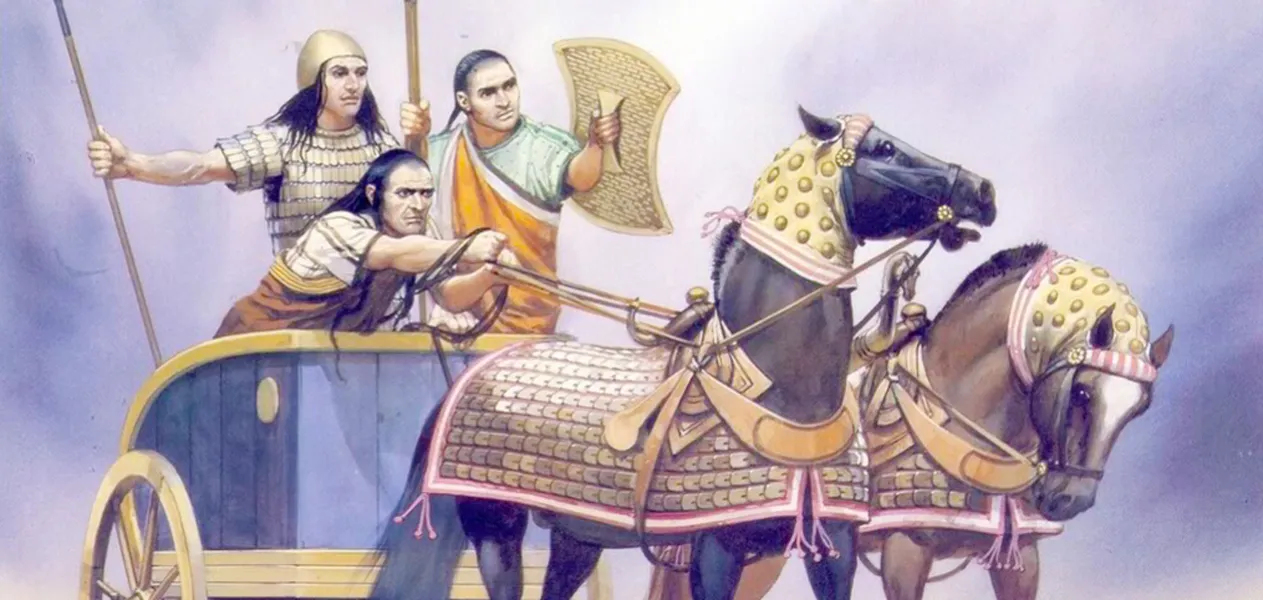
At Djahy, Ramses III confronted the Sea Peoples with Egyptian infantry, chariots and foreign mercenaries, including Sherden soldiers who now fought on Egypt's side.
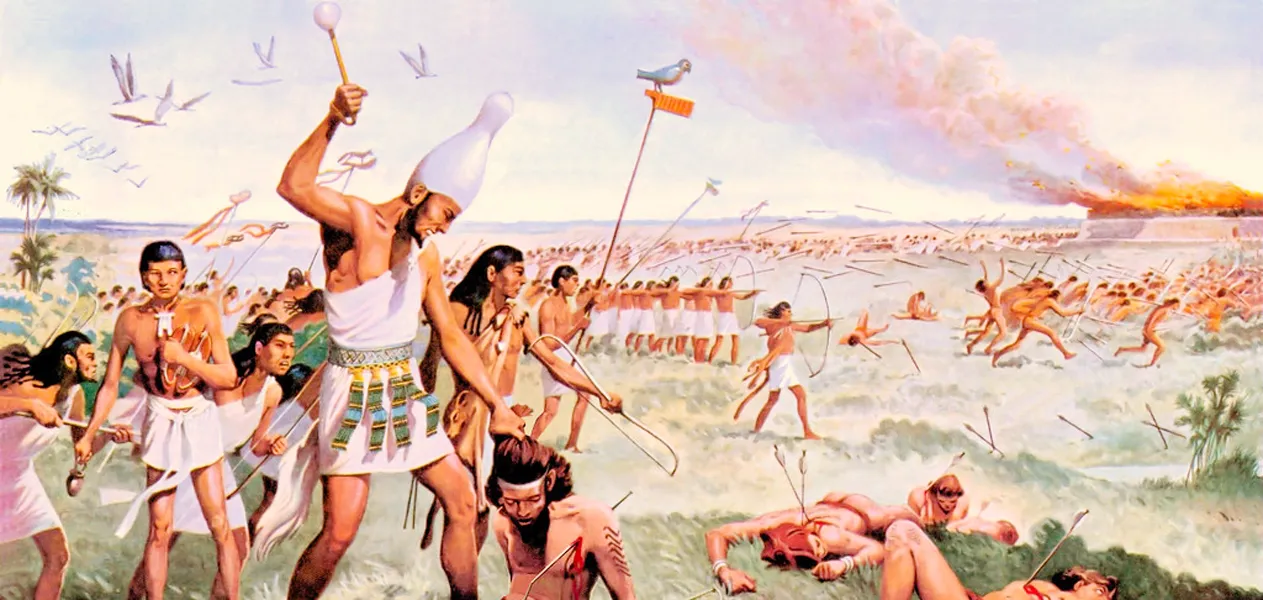
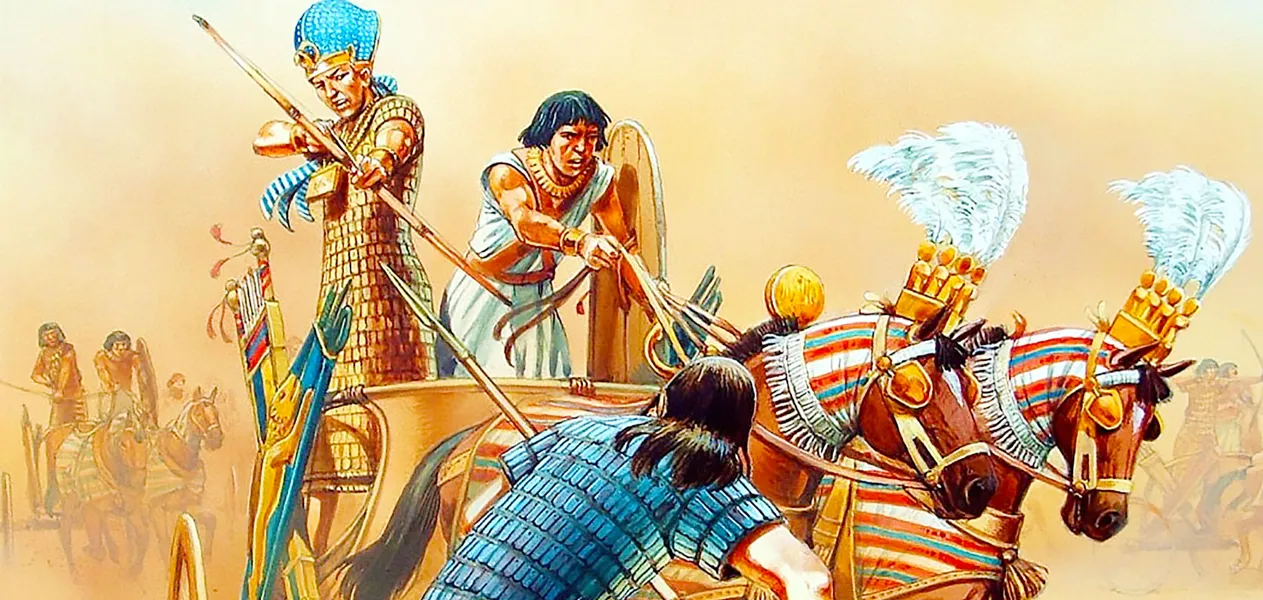
The Medinet Habu reliefs depict Egyptian chariots charging into enemy formations around ox-carts while the king fires arrows from his own chariot.
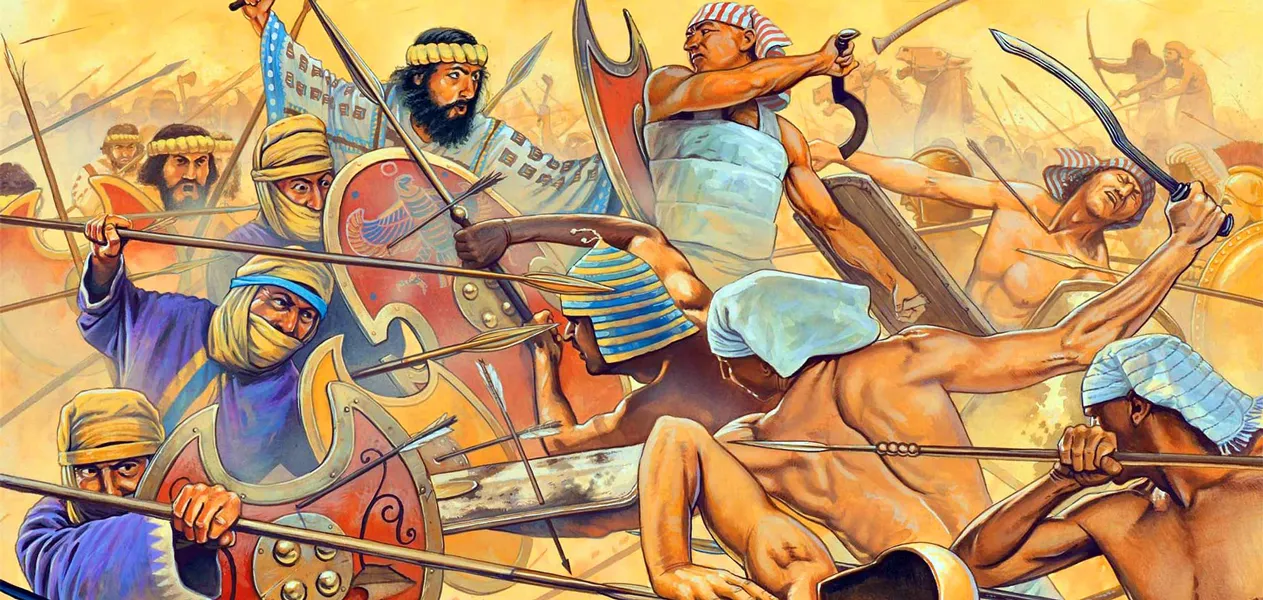
The invading warriors are shown fighting mostly on foot with swords, spears and round shields. Against Egyptian chariot archers, this exposed them to repeated missile attacks before they could engage at close range.
The scenes conclude with defeated warriors captured and the invading camp overwhelmed. The land force was stopped before it could cross into Egypt.
The Naval Battle of the Delta
The remaining Sea Peoples fleet approached the mouths of the Nile river, where Ramses III had prepared a second defensive line.
According to the Egyptian account, the enemy ships were allowed into restricted waterways where Egyptian vessels and archers positioned along the banks could attack from several directions.
Egyptian ships used both sails and oars, while Medinet Habu depicts enemy vessels with sails and distinctive bird-headed prows. Archers fired volleys from Egyptian ships and from shore while marines closed with the enemy and used grappling techniques to pull vessels together or overturn them.
The trapped fleet could not effectively maneuver, and the naval force was destroyed.
Egyptian Weapons and Tactics
Missile fire was central to the Egyptian strategy.
The composite bow gave Egyptian archers considerable range and penetrating power, allowing them to attack before enemy infantry could enter close combat. Ramses III deployed archers from moving chariots during the land battle and from ships and prepared riverbanks during the naval confrontation.
Egyptian soldiers also used spears, shields and the curved khopesh sword.
The army operated through organized divisions supported by scribes, supply systems and military administrators. Medinet Habu scenes also show captives being processed after the fighting, while some defeated foreign warriors were later integrated into Egyptian service, following a practice already seen with earlier groups such as the Sherden.
The Egyptians Won, But the Results of the Djahy Battle Were Bad
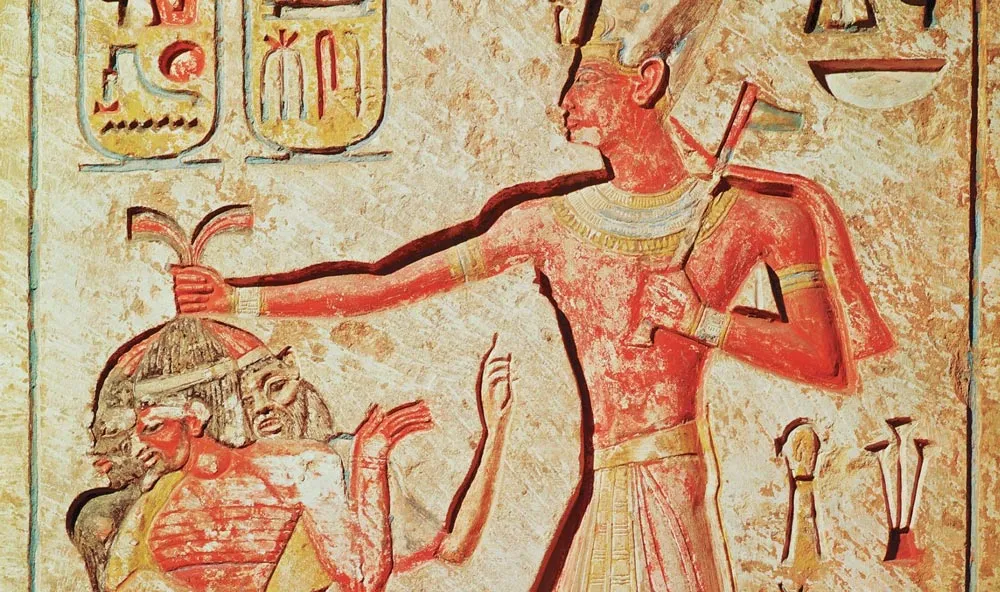
Egypt won both the land and naval engagements, but military survival did not restore the stability of earlier New Kingdom centuries. Warfare consumed resources, Egypt's influence in the Levant weakened and later rulers struggled with economic and political pressures at home. The aftermath also transformed the eastern Mediterranean because some defeated Sea Peoples settled permanently along the coast of Canaan. The victory therefore protected Egypt from immediate conquest while opening a much more complicated final chapter of the New Kingdom.
What Happened to the Sea Peoples?
After the conflicts of Ramses III, several Sea Peoples groups established themselves along the Levantine coast.
Papyrus Harris I, compiled after Ramses III's death, claims that the king settled defeated peoples in fortified settlements under Egyptian authority and required them to pay tribute.
The Peleset became associated with the Philistines and occupied or developed major cities including Gaza, Ashkelon, Ashdod, Gath and Ekron.
The Tjeker appear farther north at Dor in the later Egyptian tale of Wenamun.
Over subsequent generations, these communities adopted many aspects of local Canaanite culture. The later geographical name Palestine ultimately developed through the historical name associated with the Philistines.
Egypt After the Battle of Djahy
The victory preserved Egyptian independence but did not inaugurate another golden age.
By Year 29 of Ramses III, workers responsible for constructing royal tombs at Deir el-Medina staged the first securely recorded labor strike in history after their grain payments were repeatedly delayed.
Ramses III himself died around 1155 BC following the famous harem conspiracy. Modern CT examination of his mummy in 2012 revealed a severe wound across his throat.
Under his successors, Egyptian control over Canaan continued to weaken. Political and economic pressures increased throughout the 20th Dynasty, and the Egypt New Kingdom eventually ended around 1070 BC.
Djahy therefore represents both a spectacular military victory and part of a wider turning point in Egyptian history.
See the Battle at Medinet Habu
The best surviving visual record of the Battle of Djahy and the Battle of the Delta remains at Medinet Habu, the mortuary temple of Ramses III on the west bank of Luxor.
Its exterior walls preserve the famous naval battle, while nearby reliefs and pylons show land combat, captured enemies and the king's military triumphs.
Out of Ordinary Luxor West Day Tour combines Medinet Habu with the Valley of the Queens, Deir el-Medina and the Ramesseum. From $60.
10 Days Cairo, Faiyum & Nile Cruise Holiday combines Cairo and Faiyum with a Nile cruise between Luxor and Aswan. From $1,350.
For a longer journey through Egyptian history, browse our Egypt tour packages to combine Cairo's pyramids and museums with the temples of Upper Egypt, where the New Kingdom pharaohs recorded their victories on stone.
A Nile cruise between Luxor and Aswan also makes it easy to combine the west bank of Luxor with Karnak, Edfu and Kom Ombo. Travelers particularly interested in Ramses III can ask whether Medinet Habu is included in their west-bank itinerary.
Many cruises begin or end in Aswan, allowing travelers to continue to Philae and Abu Simbel, whose monuments belong to Ramses II, the earlier ruler whose encounters with groups such as the Sherden form part of the longer story leading toward the Sea Peoples conflicts of Ramses III.
The Battle of Djahy, followed by the naval Battle of the Delta, was Egypt's answer to the upheaval that destroyed much of the Bronze Age world. Ramses III stopped the Sea Peoples on land and at sea and carved his triumph into Medinet Habu. Yet victory left Egypt weaker, and the New Kingdom slowly faded. Standing before those carved ships today, you can still witness the end of an entire age.

5 Days Cairo And Hurghada Trip
Amazing 4 Nights Cairo and Hurghada Trip Itinerary 5 Days Cairo and Hurghada trip wil...
- Duration 5 Days / 4 Nights
- Location Cairo & Hurghada
- Type Historical & Recreational Tour
From$690/per person
View Tour
6 Days Cairo, Alexandria & Faiyum Tour
Unforgettable Cairo, Alexandria & Faiyum Adventure in Six Days 6 Days Cairo, Alex...
- Duration 6 Days / 5 Nights
- Location Cairo - Alexandria - Fayum
- Type Historical Tour
From$720/per person
View Tour
10 Days Cairo, Faiyum & Nile Cruise Holiday
Breathtaking 10 Days Journey of A Lifetime in Egypt 10 Days Cairo, Faiyum & Nile...
- Duration 10 Days / 9 Nights
- Location Cairo, Luxor, Aswan & Faiyum
- Type Classic Tour
From$1350/per person
View Tour SOLD OUT
Ultimate 7-Day Egypt Solar Eclipse Experience with Hurghada 2027
Enjoy a 7-Day Egypt Solar Eclipse Tour with Hurghada 2027 6 Nights Egypt Solar Ecli...
- Duration 7 Days / 6 Nights
- Location Cairo / Giza / Luxor / Hurghada
- Type Astronomical Tour
Sold Out
View Details