




Crime and punishment in ancient Egypt was the key to prosperity, ultimate balance, and lasting peace. Ancient Egyptians were able to strike a real and effective balance between peace and fear plus establish an early draft about the works of sociology and jurisprudence. Ancient Egyptian society achieved everlasting harmony by creating a complex and highly regulated system designed to maintain order and stability in society. The ancient Egyptians know their way to sophistication and were able to establish the first documented self-governed body in the history of the world with its own court system and the world's oldest surviving legal system.
Their religious faith and moral principles acted as the Shepard guiding them to an ancient version of utopia where everyone will live in the safest surrounding and be motivated to create the most immortal innovation. The divine principles that were put into place were incredibly beneficial to the entire society. The laws were strict and the punishments severe and they were intended to serve as a deterrent to others who might consider breaking the law. Their legal system depended on fairness, truth, and symmetry which deprived their strength of the principle of Ma'at. The ancient Egyptians created these laws to bring out the good in everyone and put everyone on the right path. This article will discover all the information and facts relating to the laws and legal system of ancient Egypt:
Structure of the Legal System in Ancient Egypt
The structure of the legal system and the laws were believed to have been handed down by the gods from the Predynastic Period (6000 BC - 3150 BCE) all the way to 30 BC. The entire legal system had the shape of a judicial hierarchy where the king was on the top and was seen as the main representative of the ancient Egyptian gods and the enforcer of their divine justice, and just underneath him is the vizier who was responsible for a number of duties which are the overall practical administration of the entire justice departments, hiring magistrates who would hear the cases within the courts of their village, and take control of the local or regional courts if needed. The word crime was known in ancient Egypt as "n mwt".
The legal system was made regionally by a number of individual districts called "Nomes" which were then presided over by the nomarch "governor" and his steward. A number of inscriptions in the old kingdom of ancient Egypt (2613 BCE - 2181 BCE) found across papyri, tombs, and stelae showcase the ancient Egyptians developed their legal system after a very long time of experimentations that lasted for thousands of years as it shows it started very simple and evolved with time to be more bureaucratic. Most of the judges that operated were priests in the old kingdom who would consult with their god "Prey on It" to reach a verdict rather than analyzing the evidence and listening carefully to all the testimonies. In the middle kingdom of ancient Egypt (2040 BCE - 1782 BCE) legal system began to advance to hiring professional judges to preside over all the courts which lead the entire judicial system to have a more rational pattern. Within the middle kingdom was the first time establishment of a professional police force that imposed the law, apprehended the suspects to put them in custody, and stand in court to testify.
Ancient Egypt Court System
The courts took control of the laws which were administered under these three groups which are the "Seru" which was composed of a number of elders located within the rural society, the "Kenbet” was an incredible court that served across the regional and national level, and the "Djadjat" the imperial court. The system of the courts operating in a manner in which when a crime in the village was committed and the Seru was unable to reach a verdict, the case was transformed into the Kenbet and the Djadjat.
The Seru handled all the cases of the village, the Kenbet was responsible for making all the laws and apportioned punished punishments on both regional and national levels, the Djadjat acted as the supreme court that made the final say if the law was completely legal, and in balance with the principles of Maat. The ancient Egyptians were considered law-abiding citizens across most of their history but many of the records show that they had their own arguments and conflicts over water and land rights, livestock ownership, and the right to a hereditary title or a job. The judges of the Kenbet were actually members of the Kenbet where every single capital of all districts has one in every session on a daily basis. The king’s main vizier acted as the supreme judge plus all the court cases were under the authority of lower civil officers.
One of the major disputes that played in courts was the absence of a will after the death of the matriarch or patriarch of the family. The ancient Egyptians didn’t have a will per se but they created a transfer document that stated who gets every portion of the estate; sometimes the family members would dispute with each other and fight in court. The courts would witness would oversee cases of infidelity, abuse, and divorce. Women had the power to sue for divorce just like men; also women had the power to sue over business arrangements and legal sales. Cases that involved infidelity were made by both sexes. The ancient Egyptians gave their testimonies to the judges when needed. All witnesses were severely beaten to make sure that they were telling the truth. There was no existence of lawyers in ancient Egypt. The false charge was seen as a very illegal offense as it would question the entire creditability of the entire court system. If the witness was caught lying then, he or she would suffer a terrible punishment that includes amputation and death by drowning.
Divine Justice in Ancient Egypt
The divine justice of ancient Egypt has leniency to mercy but the operative legal opinion still stood that "Everyone was guilty until proven innocent" since no one would have been accused in the first place which shows the total faith and trust the ancient Egyptians had in their legal system and laws. the concept of divine justice was central to ancient Egyptians' religious beliefs and practices and played an important role in shaping their views on morality, ethics, and social order.
The Egyptians believed that the gods and goddesses were responsible for maintaining order and justice in the world and that they would punish those who acted unjustly. Divine retribution was a key concept for the ancient Egyptians who believed that the gods would punish those who acted unjustly or violated the moral and ethical codes of the society. This punishment could take many forms ranging from sickness and misfortune to eternal damnation in this life and the afterlife.
Laws in Ancient Egypt
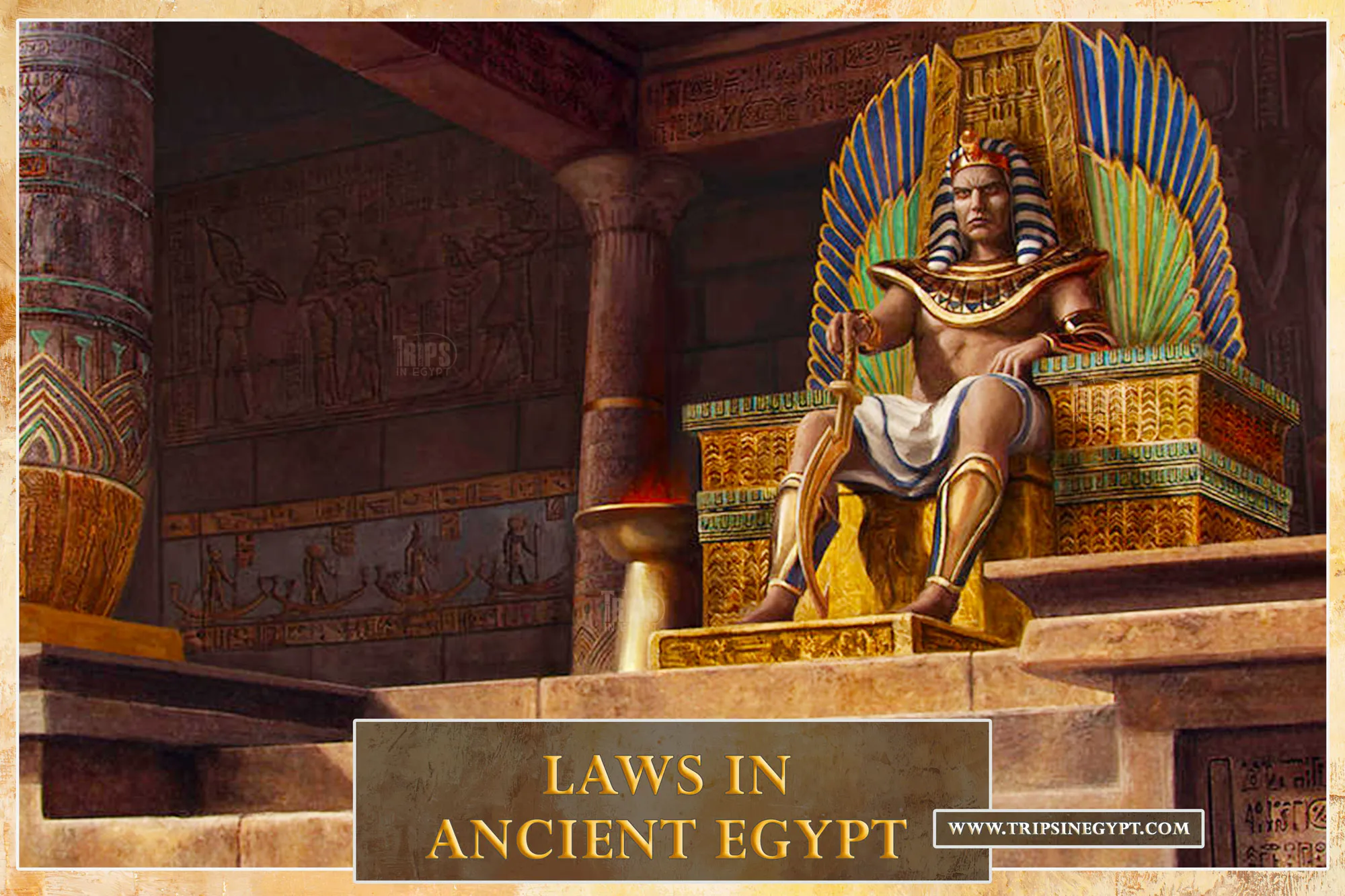
The laws of the ancient Egyptians functioned and behaved like it would in our modern day in any country of the world. The laws of the ancient Egyptians were divided into civil laws and criminal laws. These laws were basically agreed upon set of rules by the royal rulers which were established and constructed by a number of skilled experts in the judicial system who decide on the clarity of the evidence proving the violation of these laws. The police officers were able to enforce these rulers and has the power to bring all the lawbreakers to justice. These transgressors If proven guilty were punished severely.
Some laws demanded responsibilities from the Egyptian families by putting tomb offerings for their dead loved ones. If they couldn’t offer it, the family can hire ka-priests to provide the needed offerings at the tomb for a price. So as long the family is paying, the ka-priest will keep paying and even pass it to his kid, and if the family stopped paying then the ka-priest can go to court. The efficiency of the laws started to decrease from the final days of the New Kingdom of ancient Egypt ( 1550 – 1070 BC) as new violations and corruption started to take place and the crime waves began to rise to unfathomable heights, the cult of Amun held all the powers, and the pharaohs were only concerned with their ego gratification and comfort.
The Concept of Maat
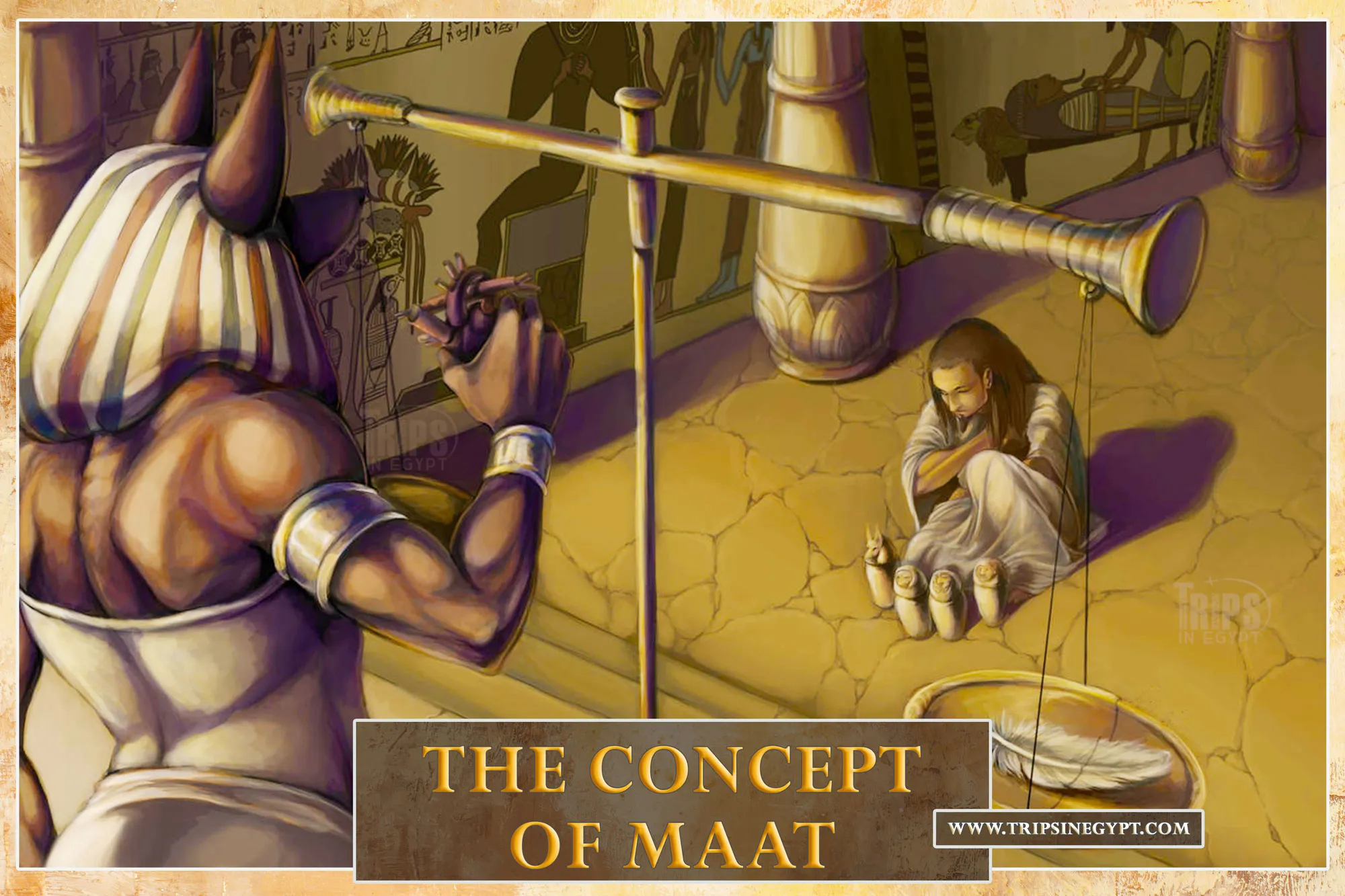
Maat is an ancient Egyptian concept that embodies the ideas of balance, harmony, truth, justice, morality, and order in the entire existence. It was considered one of the fundamental principles upon which the universe was built and was personified as a goddess who represented these principles. The word Maat comes from the Egyptian word "mꜣꜥt," which means "that which is straight" or "True". The concept of Maat was central to Egyptian culture and was reflected in their religion, art, and daily life.
In Egyptian mythology, the goddess Maat was often depicted as a woman with a feather on her head, symbolizing truth and balance. She was believed to weigh the hearts of the deceased against her feather during the judgment of the dead, ensuring that only those who lived a balanced and just life could enter the afterlife. In Egyptian society, Maat was also used as a guide for ethical behavior and was considered the foundation of a just and well-ordered society. The concept of Maat was reflected in their laws, social norms, and even their architectural design, which was often built to reflect balance and symmetry.
Crime & Punishment Types in Ancient Egypt
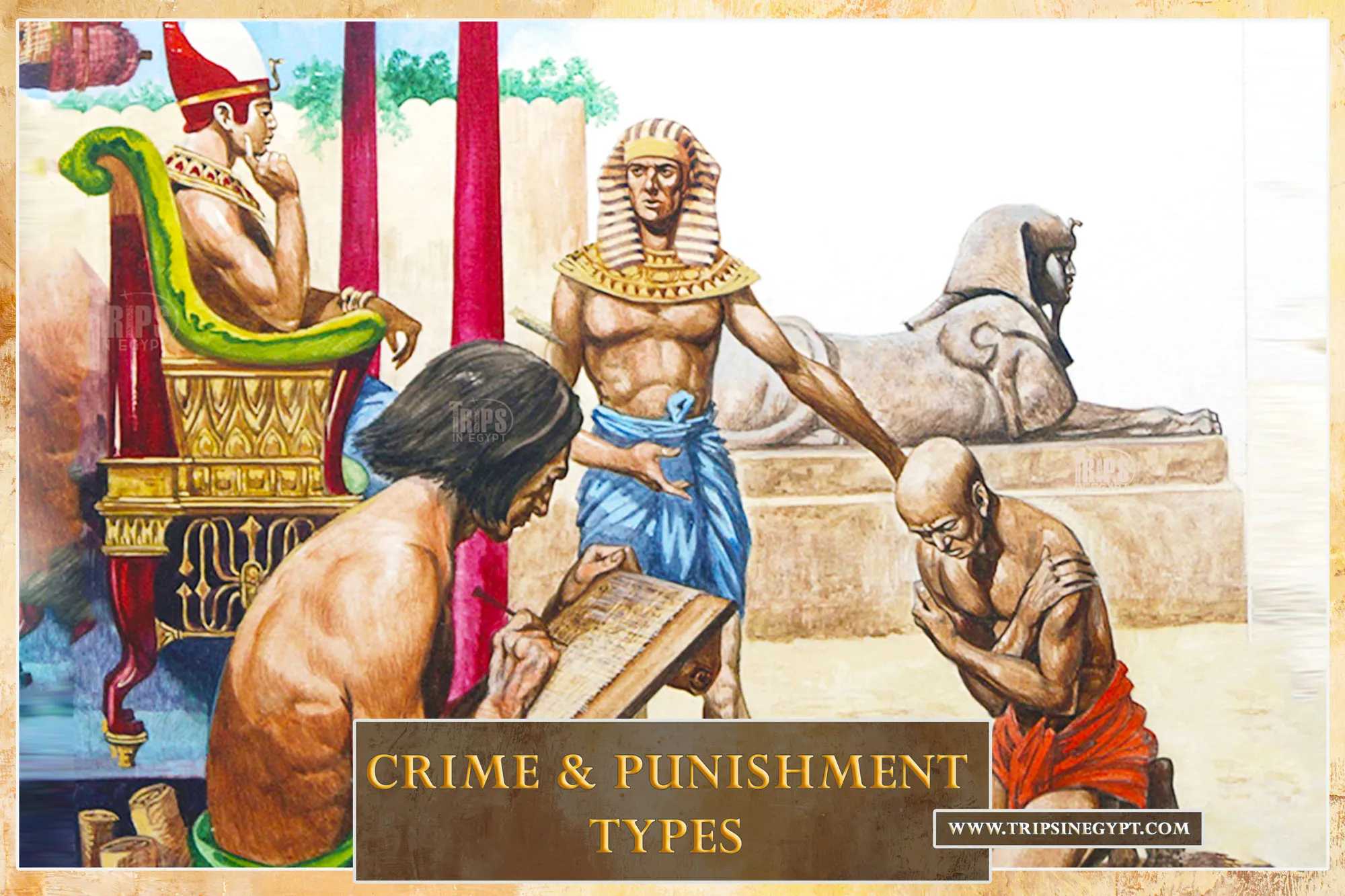
Ancient Egyptian society was not perfect, as it had its own faults and crimes which had their own punishments executed by professional judges and police force. These crimes included:
1. Murder
The ancient Egyptians apricated life and its sanctity but they enforced the use of the death penalty against murders after the courts did their job, in order to execute punishment and preserve future lives by using the element of fear and prevent the loss of any life through manslaughter or murder. The murders were suspected of a number of psychological pains before the overall execution to stand as a powerful example. Murderers when proven guilty were beaten burned to death, fed to crocodiles, or executed in any number of ways as determined by the judges.
When it came to the killing of a first kin like a son, daughter, or father, the killer while still alive would be tied up to the body for three days and then burned alive. The act of suicide was given as a sort of mercy for people sentenced to death in some cases. In the cases of involuntary manslaughter, the suspect is innocent in the eyes of the court but not in the eyes of society as he or she needs to cleanse himself from the sin of taking a life by making compensations, offerings, and asking for total forgiveness. Those who were caught hiding any evidence were sentenced to death. Anyone who would kill a religious animal that holds any symbolic value would be executed.
2. Adultery
Adultery was seen as a serious crime and there are a number of punished that would apply in this situation as the ancient Egyptians viewed it as a violation of the sanctity of marriage and the unity of the entire society. The nuclear family in the eyes of the ancient Egyptians was seen as the core of a stable and productive community. The ancient Egyptians had a number of teachings like the guidelines of Ptah-Hutb which stated that everyone should not be fascinated by any women and be careful with his approaches to women.
In some cases, the punishment was the cutting of the genital organ and burning which was based on the Bulaq papyrus, the inscriptions of Ani, and the Leed papyrus. Any proven adultery with a married woman was sentenced to death in some cases. The married woman if caught then the husband has the power to decide her fate or leave to the court. If the husband were caught then he would be subjected to a thousand blows which were considered an easy sentence.
3. Theft of Individuals
The crime of theft from others was punished by paying a fine that was two or three times the value of the stolen items. When stealing from society the thieves would pay up to 180 times the total amount of the stolen items after returning the stolen goods, confessing their crimes, and beaten a hundred strokes in front of a live audience where they would make a public oath for everyone that he or she would be thrown in a river to the crocodiles if he was caught again.
4. Bribery
The crime of bribery was a severe crime that was seen as a violation against the administrative branch of the state. The employee caught would be fired from his job and be reduced from a high official to a simple peasant. The act of bribery is considered a very damaging action that leads to the whole crumble of the entire administrative sector and the rise of corruption. Many briberies were paid to the judicial system to free many thieves and grave robbers during the reign of Ramses IX.
5. Treason
The act of treason against the state and the Pharaoh was seen as a heinous crime that could lead to the destruction of the entire state. Execution was the punishment for this crime which applied to all social classes, especially if the accused were close to the king. One of the most famous examples of royal treason was during the times of Ramses III who chose a different heir to his throne other than the son of his middle-class wife to the throne in what became known as "The Harem Conspiracy Against King Ramses III". The plot failed and the culprits were punished by sentencing the worst to death & their bodies through to the river, some were allowed to commit suicide, and some were sentenced to have their noses and ears cut off.
6. Theft of Cemeteries "Grave Robbing"
The ancient Egyptians view grave robbing as a heinous crime epically if the tomb belongs to a royal figure such as a prince, queen, or king. Everyone will be punished severely as it is considered to be a crime against society and the gods. Some of the punishments included the beating of 100 blows, and the cutting of their hands if the mummy was left untouched. A number of laws were created specifically for this crime. The punishment for robbing a temple was 100 blows. In some cases, the accused punished for robbing the tomb was sentenced to death. In some cases, the tomb robbers who were caught were able to free themselves by bribing any court scribe or police officer.
7. Rape
The act of rape shared the same punishment which included the cutting of the genital organ and burning which was based on the Bulaq papyrus, the inscriptions of Ani, and the Leed papyrus. The ancient Egyptians had a strong moral stance on any form of sexual transgressions such as rape, domestic violence, and harassment which were considered to be very major crimes with server punishments as seen across a series of papyrus that dates back to 1200 BC during the time of Thebes.
8. Violence
Violence was seen by the ancient Egyptian as a tool to control the masses that’s why some forms of violence were encouraged and some were denied. The ancient Egyptians believed that violence was the key to maintaining order.
Conclusion
The justice and court systems in ancient Egypt were complex and highly regulated systems designed to maintain order and stability in society. The laws were strict and the punishments severe and they were intended to serve as a warning to others who want to consider breaking the law. All our Egypt tours and Nile cruises will shed light on all the temples and tombs that explore the minds and beliefs of the ancient Egyptians who were able to create the first self-governed sophisticated community on the face of the earth.

5 Days Cairo And Hurghada Trip
Amazing 4 Nights Cairo and Hurghada Trip Itinerary 5 Days Cairo and Hurghada trip wil...
- Duration 5 Days / 4 Nights
- Location Cairo & Hurghada
- Type Historical & Recreational Tour
From$690/per person
View Tour
6 Days Cairo, Alexandria & Faiyum Tour
Unforgettable Cairo, Alexandria & Faiyum Adventure in Six Days 6 Days Cairo, Alex...
- Duration 6 Days / 5 Nights
- Location Cairo - Alexandria - Fayum
- Type Historical Tour
From$720/per person
View Tour
10 Days Cairo, Faiyum & Nile Cruise Holiday
Breathtaking 10 Days Journey of A Lifetime in Egypt 10 Days Cairo, Faiyum & Nile...
- Duration 10 Days / 9 Nights
- Location Cairo, Luxor, Aswan & Faiyum
- Type Classic Tour
From$1350/per person
View Tour SOLD OUT
Ultimate 7-Day Egypt Solar Eclipse Experience with Hurghada 2027
Enjoy a 7-Day Egypt Solar Eclipse Tour with Hurghada 2027 6 Nights Egypt Solar Ecli...
- Duration 7 Days / 6 Nights
- Location Cairo / Giza / Luxor / Hurghada
- Type Astronomical Tour
Sold Out
View Details