




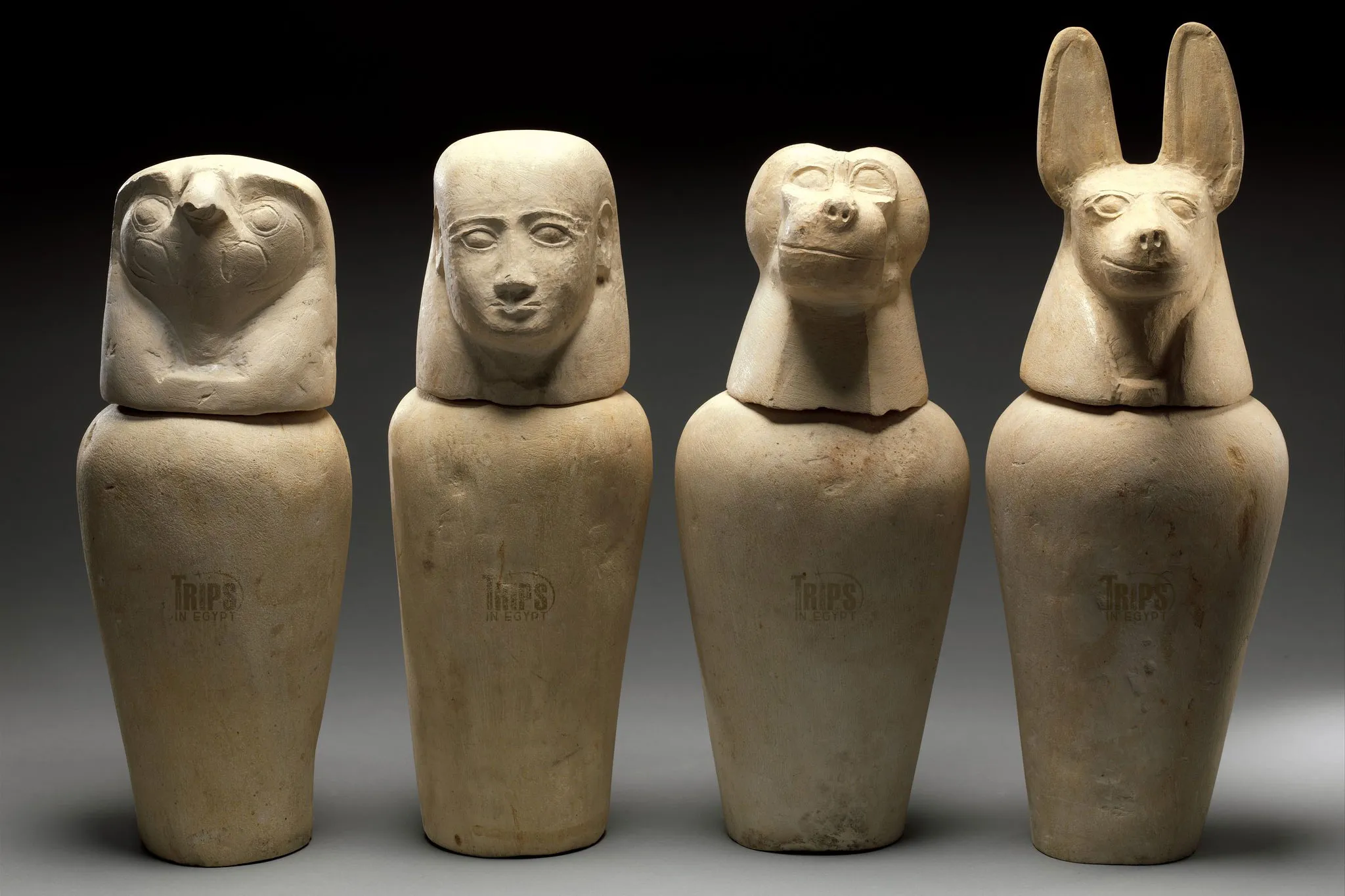
Imagine walking through the halls of an ancient Egyptian tomb, adorned with intricate carvings and hieroglyphs. As you make your way deeper into the tomb, you come across a collection of ornate jars, each one intricately decorated with a different animal head. These are the Canopic jars, fascinating artifacts of ancient Egyptian burial practices, which used to hold the organs of the deceased, the Canopic jars were not only practical but also held deep religious significance in ancient Egypt.
The Canopic jars had a great part in the process of mummification, as the Ancient Egyptians believed that each jar has a God to keep organs of the body of the deceased as death is not the end of the journey, but it is a new chapter to start a new life. Join us through our article as we will take you on a journey to explore the wonder of the Canopic jars and their importance in ancient Egyptian culture. Our article will help you to know more about Canopic jars, their history, the four sons of God "Horus", the art of the Canopic jars, and their significance in ancient Egyptian life.
History of Canopic Jars in Ancient Egypt
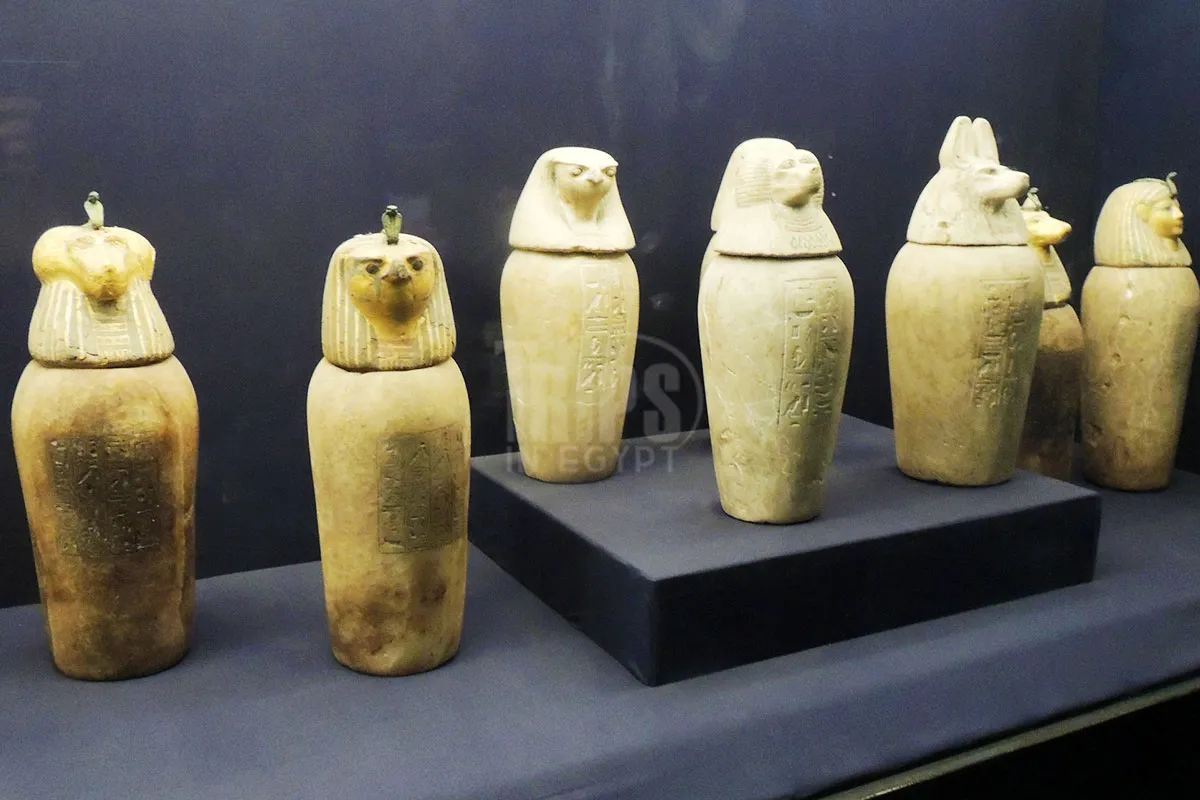
The earliest canopic jars had plain lids during the Old Kingdom of Egypt (2575-2130 BC), then they were decorated with sculpted human heads during the Middle Kingdom of ancient Egypt (1938–1630 BC). In the nineteen dynasties until the end of the Egyptian New Kingdom (1536–1075 BC) the canopic jars represented the four sons of God "Horus". Canopic jars are often fashioned from limestone, clay, or ceramics to store and preserve the vital organs of the deceased.
Throughout most eras of Ancient Egyptian history, a set of four canopic jars constituted an important component of burial. The greatest examples of these Canopic jars feature shaped like the heads of four sons known as the Sons of God "Horus". The development of the Canopic jar throughout history can be traced back to the 4th dynasty, with the first Canopic jars found belonging to Queen "Hetepheres", the wife of King "Sneferu" and mother of "King Cheops", and the first Canopic jars to be found belongs to Queen Meresankh III" the wife of "King Khafre".
Discovering the Canopic Jar Names of Horus' Four Sons
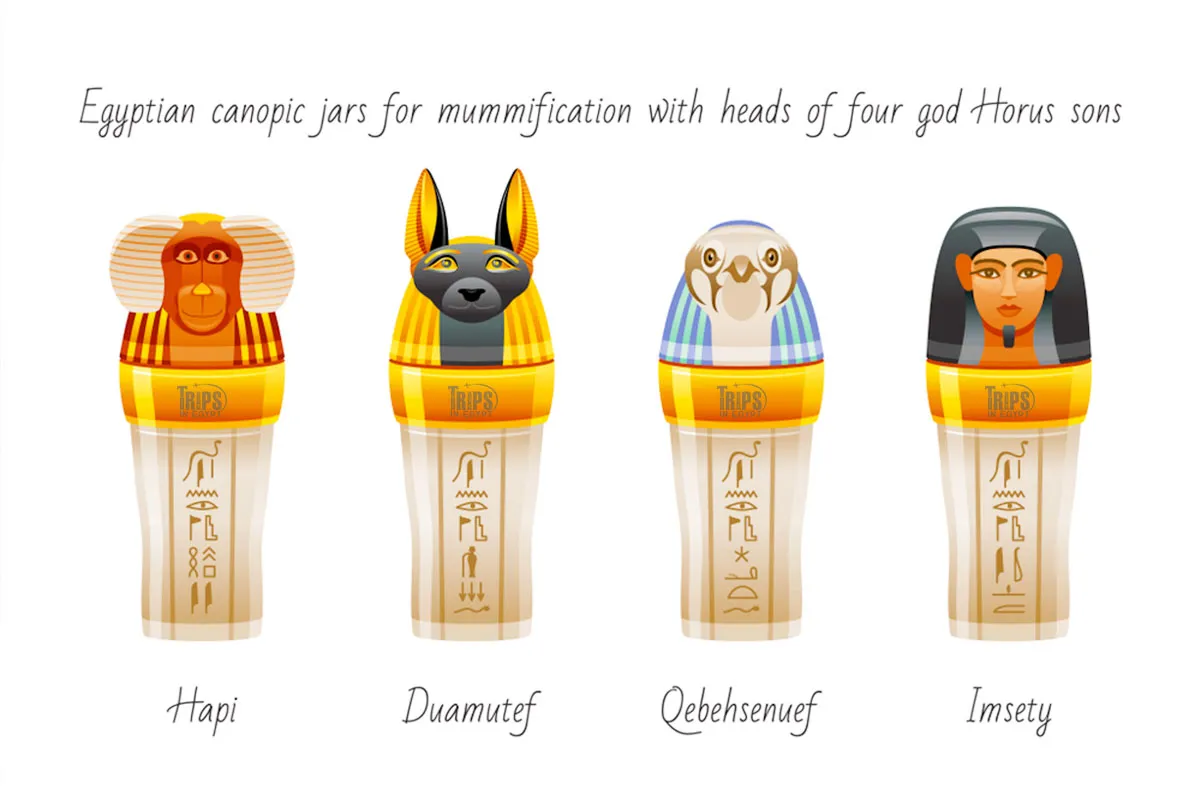
The four sons of Horus were a group of deities in ancient Egyptian religion who were believed to protect the organs of the deceased stored in Canopic jars. Each son of God "Horus" was associated with a specific organ and had his unique hieroglyphic symbol.
- The first son was named "Imsety", and he was with a human head. The job of "Imsety" was to protect the liver of the deceased, and he was protected by his mother Goddess "Isis".
- The second son named "Hapy", had a baboon head and was responsible for the lungs of the deceased. "Hapy" was associated with the north and was often depicted on the Canopic jars with the color blue. He was also protected by the Goddess "Nephthys".
- The third son named "Duamutef" had a jackal head and was the guardian of the stomach of the deceased. "Duamutef" was associated with the east and was often depicted with the color red, he was protected by the Goddess "Neith".
- The fourth son "Qebehsenuef" had a falcon head and was responsible for the intestines of the deceased, representing the west, and he was protected by the Goddess "Serqet".
Canopic jars were associated with the four sons of Horus representing the cardinal points and were believed to protect the organs of the deceased to ensure their passage into the afterlife safely. The Canopic jars, with their unique designs and carvings, were an important part of the funeral rites and were believed to have magical powers that could protect the organs of the deceased.
The top cover of the Canopic jars which reflected each of the four sons of Horus changed and transformed with time according to the constant shift in the shape of the gods which would explain the difference between the Canopic jars from one period to another from the start of the Old Kingdom to the end of the Hellenistic period.
What Are Canopic Jars Made from?
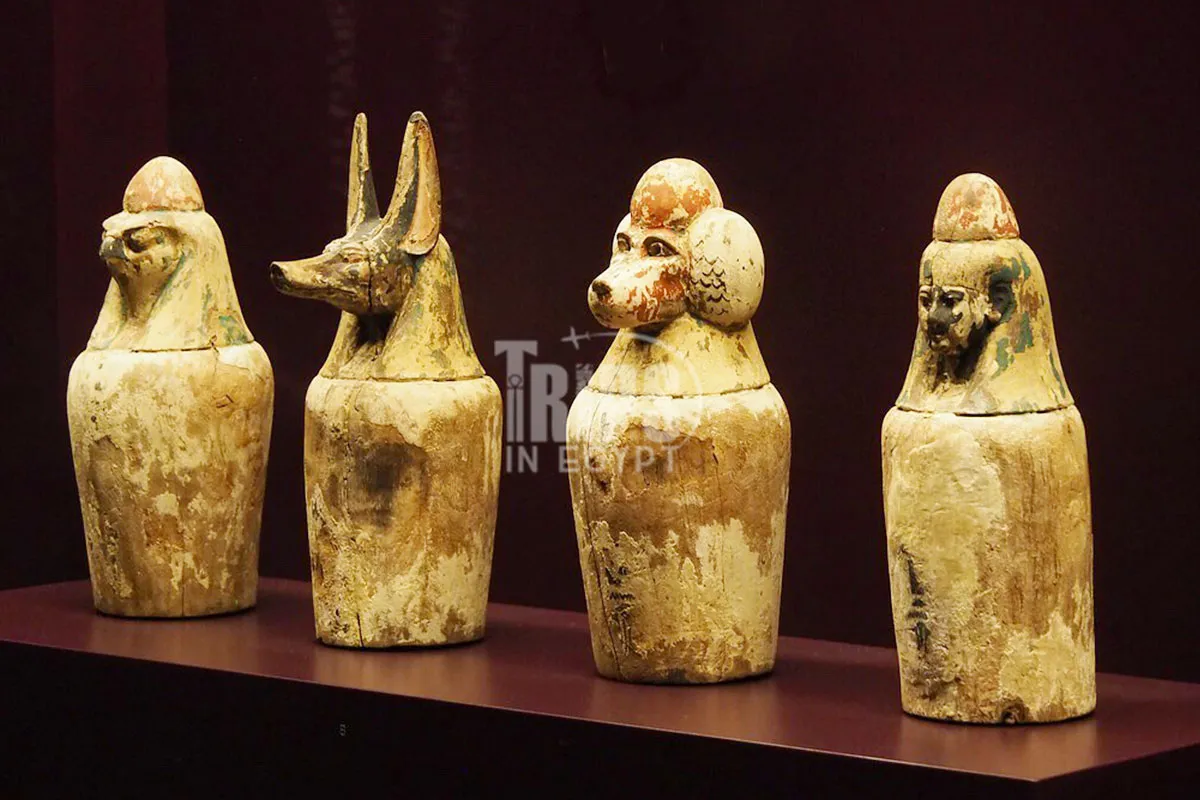
The Canopic Jars could be made of different materials such as; alabaster, pottery, glazed composition, wood, limestone, or calcite.
The old kingdom of Ancient Egypt (2686-2181 BC) and during this era there were no inscriptions or writing on the Canopic jars.
In the Middle Kingdom (2025-1700 BC) they started to put inscriptions, writing, or hymns for the deceased.
In the eighteenth dynasty, they started to decorate each Canopic jar with a different head of the four sons of God "Horus" the God of the sky.
Canopic Jars in Modern Culture
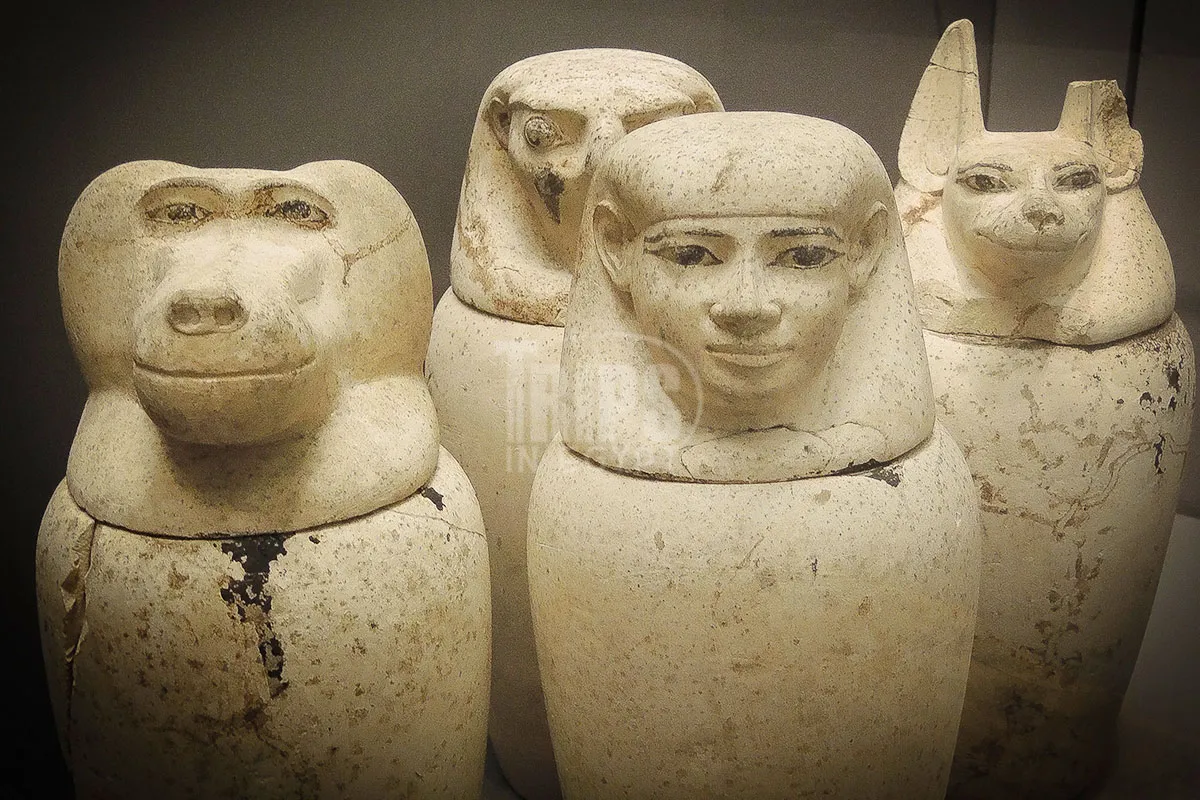
The Ancient Egyptian people believed that the deceased need his or her organs to be reborn once again, so they kept their organs in Canopic jars to protect them from decomposition.
There is similar preservation in our modern life as there are different people from all over the world who use vases to hold cut flowers. This is the same idea that was one of the inspirations of ancient Egypt. Modern movies and TV shows had Canopic jars as an essential factor in the main scenes during the mummification process to contain the vital organs for the afterlife. In the famous movie "The Mummy" which portrayed ancient Egyptian life, you can see the existence of the four Canopic jars which became an important element in Egyptian burial.
Why Was the Heart Not Put in the Canopic Jar?
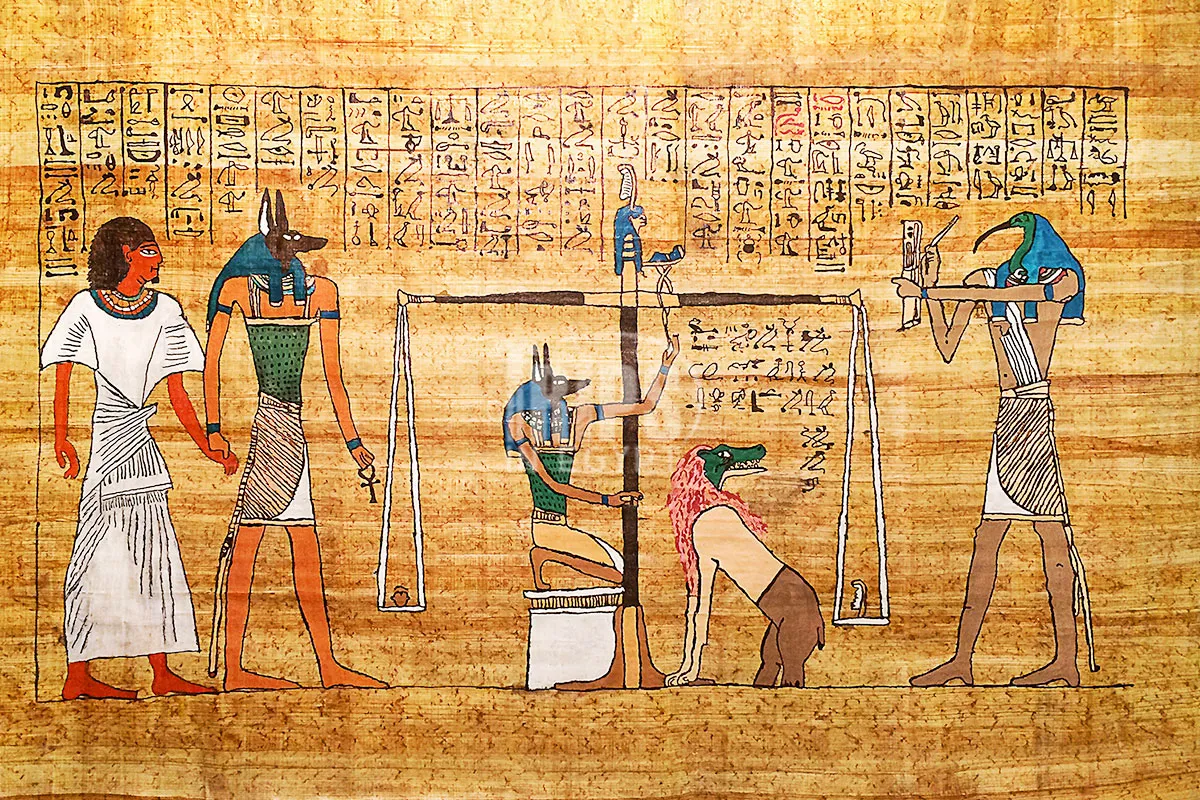
Ancient Egyptians preserved certain organs except for the heart, as it is the most important organ in the whole body. The heart is the main source of the good and bad deeds of the person, the weight of the heart was an important source in the afterlife because it determined whether the deceased would go to heaven or will be eaten by the monster. This process was believed that happens by the Goddess "Maat" the Goddess of law, justice, and balance.
- The Feather of Goddess Maat "Judgement Process"
During this judgment process, if the heart of the deceased was lighter than the feather of the Goddess "Maat" then the deceased will move to heaven which is called "The Field of Reeds" where joy, happiness, and a better life with whom they love. If the heart of the deceased is heavier than the feather of Goddess "Maat", then the soul of the deceased will be stuck in the underworld, and the body will be eaten by a scary monster "Goddess "Ammut", then the deceased will be lost forever. The Ancient Egyptians had a primary purpose in life; to be good people so that the heart would be lighter than the feather, and they desired to commit good actions to avoid extinction and punishment in the afterlife.
Canopic Jars and Their Significance in Ancient Egyptian Life
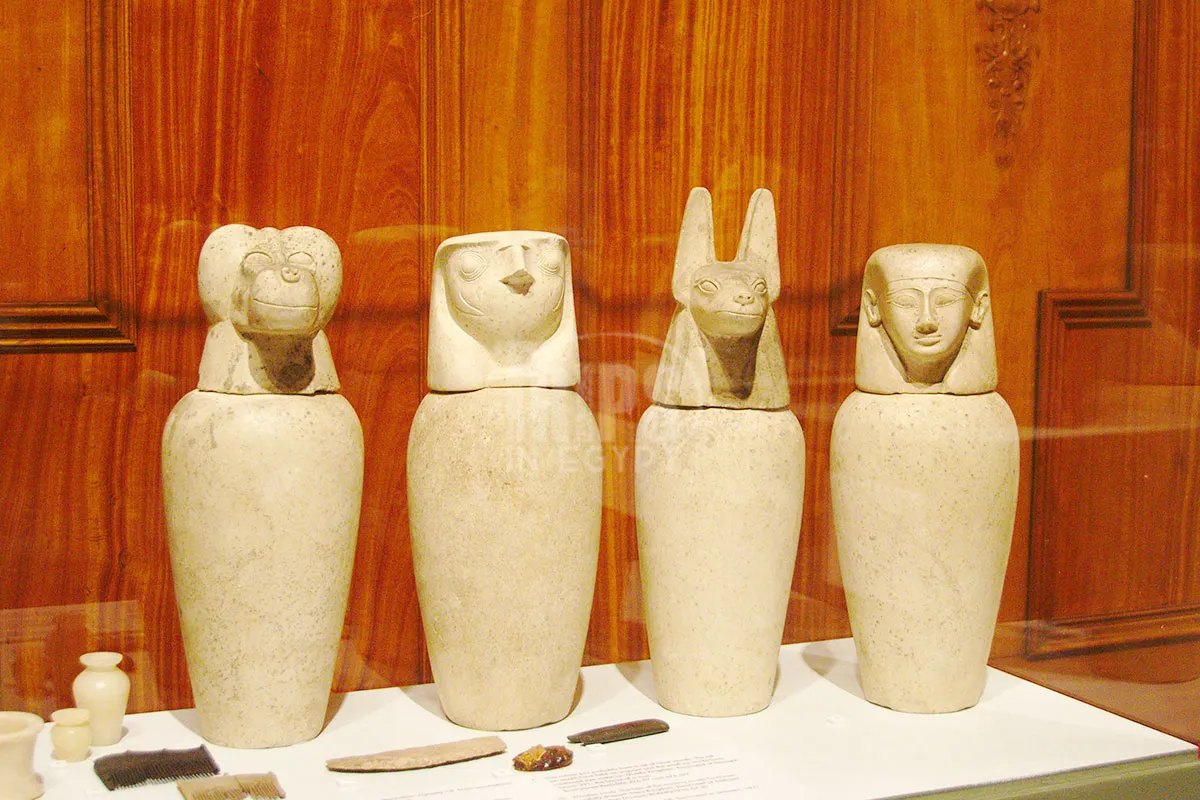
The Canopic jars of ancient Egypt were a greatly significant part of the mummification process itself, as they were used to store the vital organs of the deceased except the heart. These four jars were made of clay, gold, stone, wood, or even alabaster, depending on the wealth of the deceased as there were different prices for each kind. The covers on each of the four jars represented one of the four sons of God "Horus".
The Canopic jars had the main function which is storing the intestines, stomach, liver, and lungs. The Ancient Egyptian people believed that these organs would be needed in the afterlife so they need them in their vital case. The Canopic jars were put in the tombs beside the remains and played an important role in the burial ceremony.
The Art of the Canopic Jars
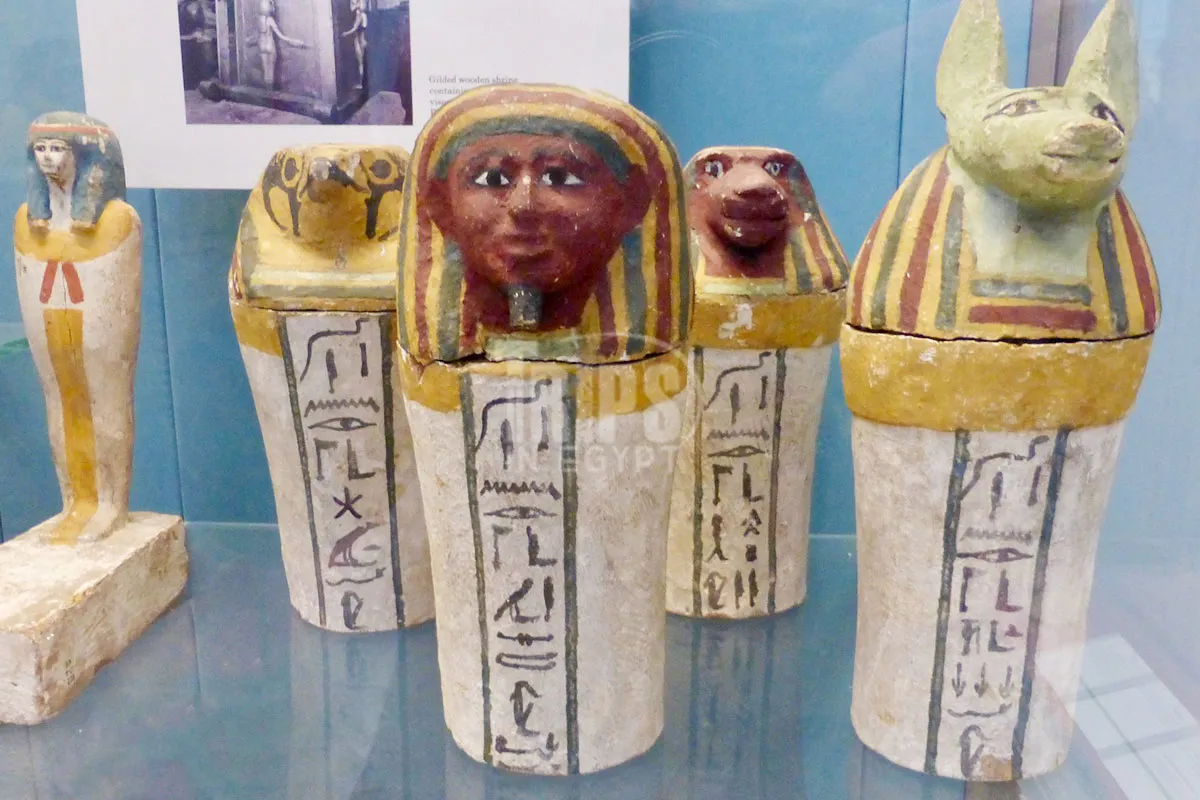
Canopic jars were an important factor in ancient Egyptian burial practices and their life as a whole. As part of the mummification process, these incredible jars were used to keep the deceased's internal organs. Making Canopic jars was a delicate technique that demanded great workmanship as well as a thorough grasp of ancient Egyptian religious beliefs.
The design of the canopic jar was significant since each jar represented a different organ of the body. Imsety, Duamutef, Hapi, and Qebehsenuef, the four sons of God "Horus" the God of the sky. The four sons of "Horus" were the protectors of the organs of the deceased, and each had a unique job; the jars were painted with complex patterns and hieroglyphics depicting the role of each son of Horus. The lids of the jars were also decorated with unique designs and featured the head of one of the sons of "Horus".
Great Facts about Canopic Jars in Ancient Egypt
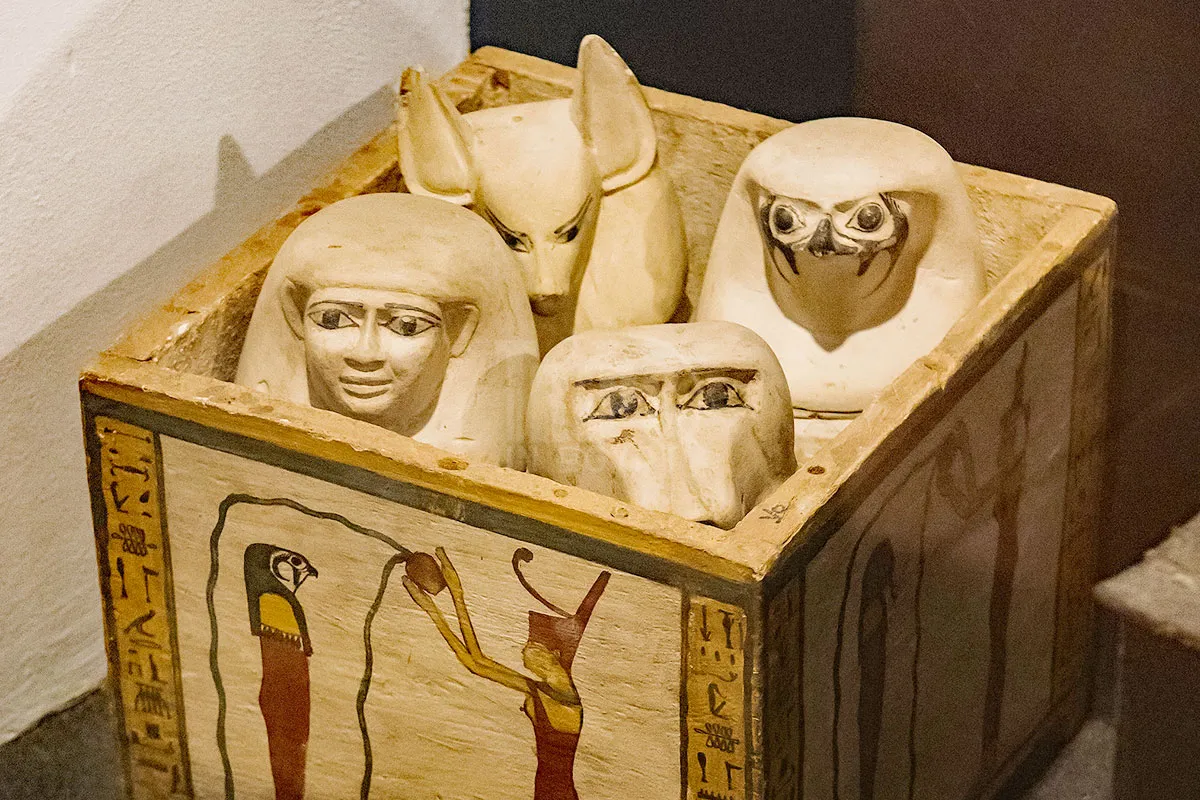
- There are four Canopic jars, and they are the four sons of God "Horus" the God of the sky.
- The names of the four sons were "Imsety, Hapi, Duamutef, and Qebehsenuef"
- The Canopic jars were buried alongside the deceased in their tombs.
- Ancient Egyptians believed that they will need their organs in the afterlife.
- Each jar has a specific rule for protecting a certain organ.
- The four vital organs that must include are "the liver, stomach, lungs, and intestines".
- The guardian "Imsety" was responsible for protecting the liver.
- The guardian "Hapy" was responsible for protecting the lungs.
- The guardian "Qebehsenuef" was responsible for protecting the intestines.
- The guardian "Duamutef" was responsible for protecting the stomach.
- The four sons were symbols to honor the God "Horus".
- The heart is the most important part of the deceased.
- The brain was not important as the other parts, so they destroyed it.
- Canopic jars were elaborately designed, and the top of each jar served as a cover.
- In ancient Egyptian belief, the body needed to be kept so that the person could return.
- The God "Horus" was the God of war and the sky.
- God "Horus" was married to the Goddess "Hathor".
Conclusion
In closing, the significance of Canopic jars was a highly respected profession in ancient Egypt, as the Canopic jars were considered some of the masterpieces of art decorated with elaborate scenes from Ancient Egyptian mythology. Canopic jars are regarded as some of the most beautiful and interesting relics of ancient Egypt in the current age.
These jars were a witness to the skill and talent of the artisans who constructed them, as well as the ancient Egyptians' intense veneration for their deceased.
Trips in Egypt is a specialized travel agency that is ready to make your dream come true by arranging a perfect Egypt tour for your lifetime to museums to witness masterpieces of Canopic jars. The ancient Egyptian monuments will captivate and inspire you to explore the jars sky in all its beauty.

5 Days Cairo And Hurghada Trip
Amazing 4 Nights Cairo and Hurghada Trip Itinerary 5 Days Cairo and Hurghada trip wil...
- Duration 5 Days / 4 Nights
- Location Cairo & Hurghada
- Type Historical & Recreational Tour
From$690/per person
View Tour
6 Days Cairo, Alexandria & Faiyum Tour
Unforgettable Cairo, Alexandria & Faiyum Adventure in Six Days 6 Days Cairo, Alex...
- Duration 6 Days / 5 Nights
- Location Cairo - Alexandria - Fayum
- Type Historical Tour
From$720/per person
View Tour
10 Days Cairo, Faiyum & Nile Cruise Holiday
Breathtaking 10 Days Journey of A Lifetime in Egypt 10 Days Cairo, Faiyum & Nile...
- Duration 10 Days / 9 Nights
- Location Cairo, Luxor, Aswan & Faiyum
- Type Classic Tour
From$1350/per person
View Tour SOLD OUT
Ultimate 7-Day Egypt Solar Eclipse Experience with Hurghada 2027
Enjoy a 7-Day Egypt Solar Eclipse Tour with Hurghada 2027 6 Nights Egypt Solar Ecli...
- Duration 7 Days / 6 Nights
- Location Cairo / Giza / Luxor / Hurghada
- Type Astronomical Tour
Sold Out
View Details