



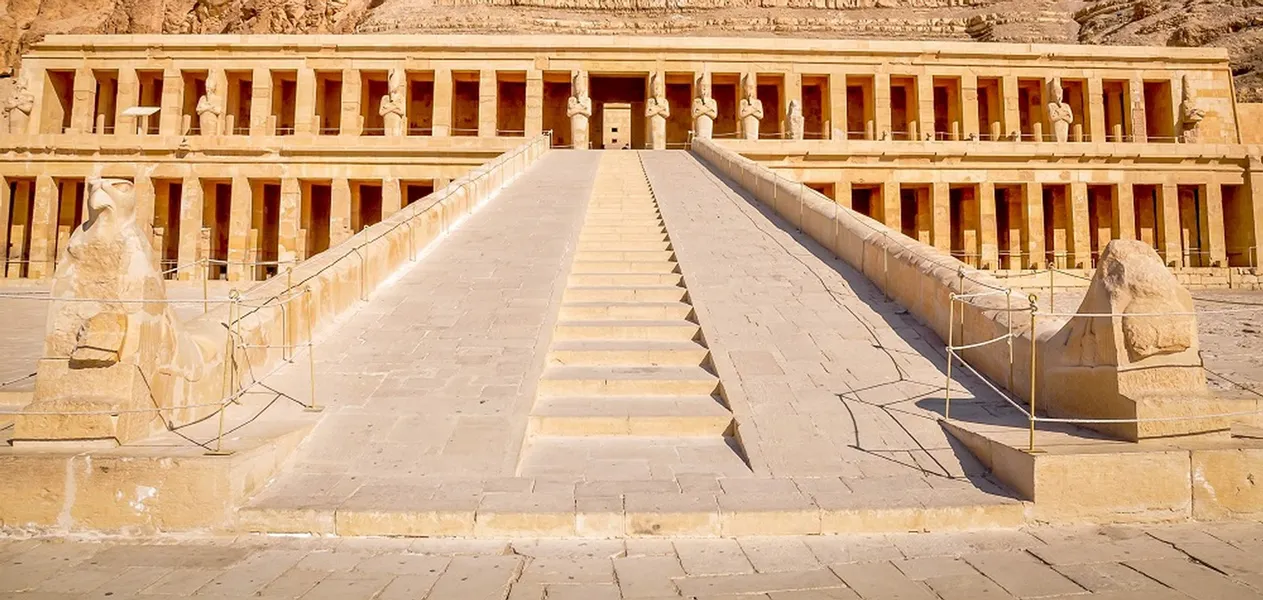
Carved into the golden cliffs of Deir el-Bahari, the Temple of Hatshepsut looks almost modern, with its long terraces, clean colonnades and wide ramps. Queen Hatshepsut built it about 3,500 years ago to honor the god Amun and secure her own eternal cult. This guide covers all the key Hatshepsut temple facts: when it was built, who designed it, its architecture, what is inside, its reconstruction and visiting tips.

Queen Hatshepsut Temple at a Glance
| Fact | Details |
|---|---|
| Ancient name | Djeser-Djeseru, "Holy of Holies" |
| Built for | Queen Hatshepsut, 18th Dynasty, New Kingdom |
| Reign | About 1479 to 1458 BC |
| Architect | Senenmut, her steward and chief official |
| Type | Mortuary (memorial) temple, not a tomb |
| Dedicated to | Amun, with chapels for Hathor and Anubis |
| Location | Deir el-Bahari, West Bank of Luxor |
| Layout | Three terraces joined by ramps |
| Excavated | Édouard Naville, 1890s |
| Restoration | Polish-Egyptian mission, since 1961 |
The History of Hatshepsut Temple
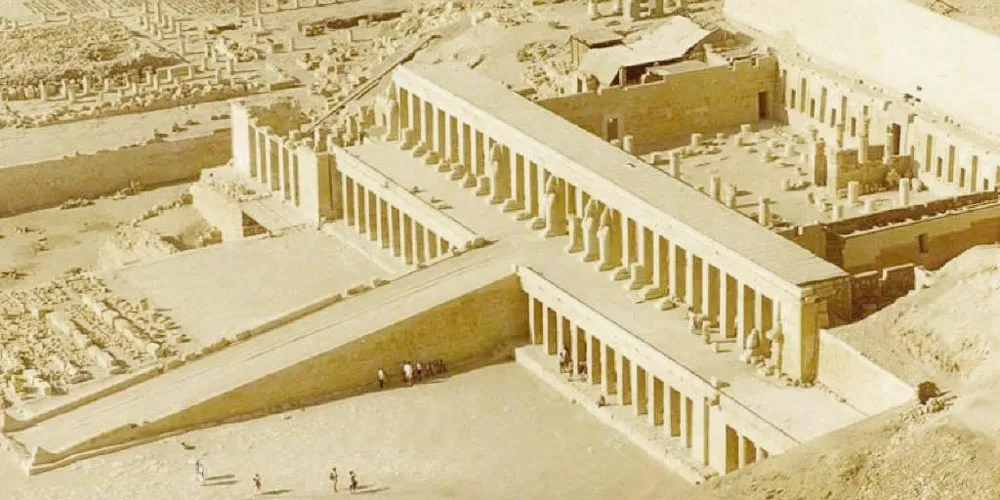
Queen Hatshepsut built the temple during the 18th Dynasty of the New Kingdom, on the west bank of ancient Thebes beneath the cliffs of Deir el-Bahari. It served as her mortuary temple, where priests would keep her cult alive after death, and its ancient name, Djeser-Djeseru, means "Holy of Holies."
The site was chosen with care. Right beside it stands the mortuary temple of Mentuhotep II, an 11th Dynasty king who ruled about 500 years earlier, and his terraced design was a clear model for Hatshepsut's architects.
The temple also faces the great temple of Amun across the river. During the yearly Beautiful Festival of the Valley, the statue of Amun sailed from the Karnak Temple to Deir el-Bahari, and Hatshepsut's temple became its most important stop on the West Bank.
When Was the Temple of Hatshepsut Built?
The Temple of Hatshepsut was built during her reign, which lasted from about 1479 to 1458 BC. Work is generally thought to have started early in her rule and continued for around 15 years, with decoration still being added in her final years. Exact dates vary between scholars, since ancient Egyptian chronology is calculated from king lists and astronomical records.
Know More Who Is Queen Hatshepsut
Hatshepsut was the daughter of Thutmose I and the wife of Thutmose II. She also held the powerful religious title God's Wife of Amun. When her husband died, she acted as regent for his young son by another wife, Thutmose III, and within a few years she had herself crowned as king.
Why Is Queen Hatshepsut Famous?
She was not the first woman to rule Egypt, but she is widely regarded as one of the most successful. Her reign was peaceful and prosperous, and she sent a famous trade expedition to the Land of Punt. She also added obelisks and shrines to Karnak and was often shown with the royal false beard. You can read her full story in our guide to Queen Hatshepsut.
Her rule also says a great deal about how women could hold power in Egypt. Our article on the role of women in ancient Egypt explains the rights and positions women enjoyed.
Who Designed the Temple of Hatshepsut?
The temple was designed by Senenmut, Hatshepsut's steward and one of the most powerful officials of her reign. He oversaw the royal estates of Amun and was tutor to her daughter, Neferure.
Senenmut left his mark on the temple in a quiet way. Small figures of him were carved behind the doors of several chapels, where they were hidden when the doors were open. He also prepared a tomb for himself close to the temple's forecourt.
His design was a turning point. Instead of the huge geometric masses of the Old Kingdom pyramids, he set the temple into the landscape, so the cliffs themselves became part of the architecture.
The Architecture of Queen Hatshepsut Temple
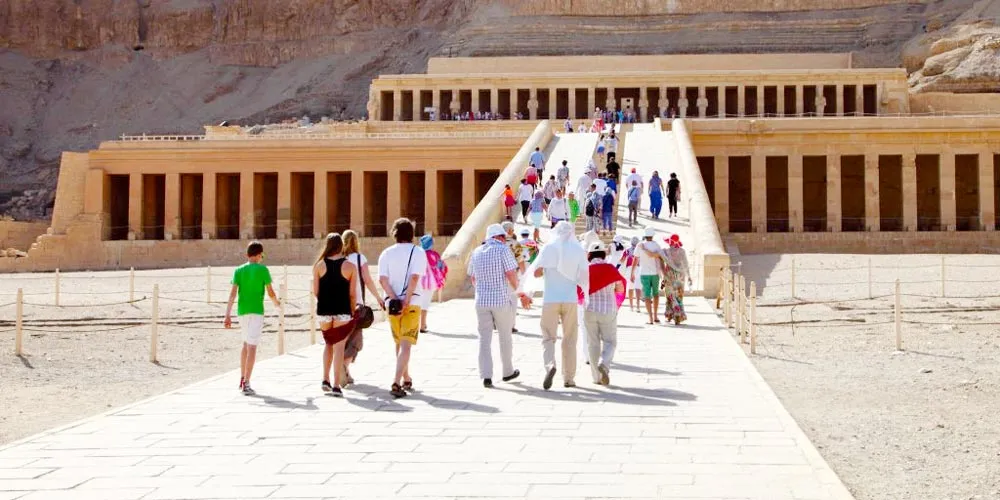
The temple rises in three broad terraces, each fronted by colonnades of square pillars and joined by long central ramps. A processional causeway once lined with sphinxes of Hatshepsut led up from a valley temple near the cultivated land.
The Lower Terrace
The lower terrace opens onto a wide courtyard. Its colonnades carry reliefs of obelisks being moved by boat to Karnak, and pits in front of the temple held the trees brought back from Punt. Remains of the ancient tree stumps can still be seen today.
The Middle Terrace: Punt and the Divine Birth
The middle colonnade holds the temple's best-known reliefs. On the south side, the Punt expedition shows ships loaded with myrrh trees, incense, ebony, ivory and exotic animals, along with the ruler of Punt and his wife. The original block showing the queen of Punt is now in the Egyptian Museum in Cairo.
On the north side, the divine birth reliefs present Hatshepsut as the daughter of Amun himself. This story gave her a sacred right to rule as king.
The Chapels of Hathor and Anubis
At the south end of the middle terrace, the Chapel of Hathor has columns topped with the face of the cow-eared goddess, one of the ancient Egyptian gods and goddesses closely linked with the West Bank.
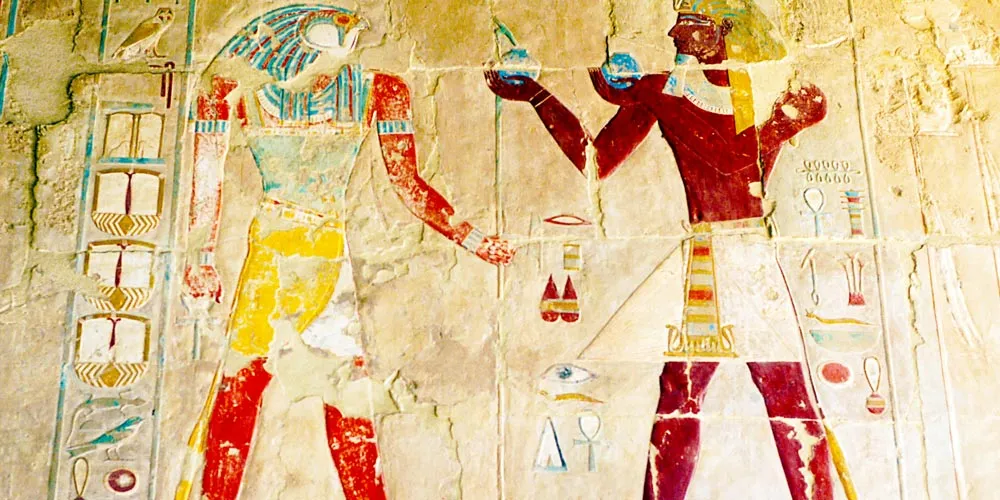
At the north end, the Chapel of Anubis has fluted columns that look surprisingly like later Greek Doric columns, which is why scholars call this style "proto-Doric." Its painted reliefs keep some of the brightest colors in the temple.
Inside the Temple: The Upper Terrace and the Sanctuary of Amun
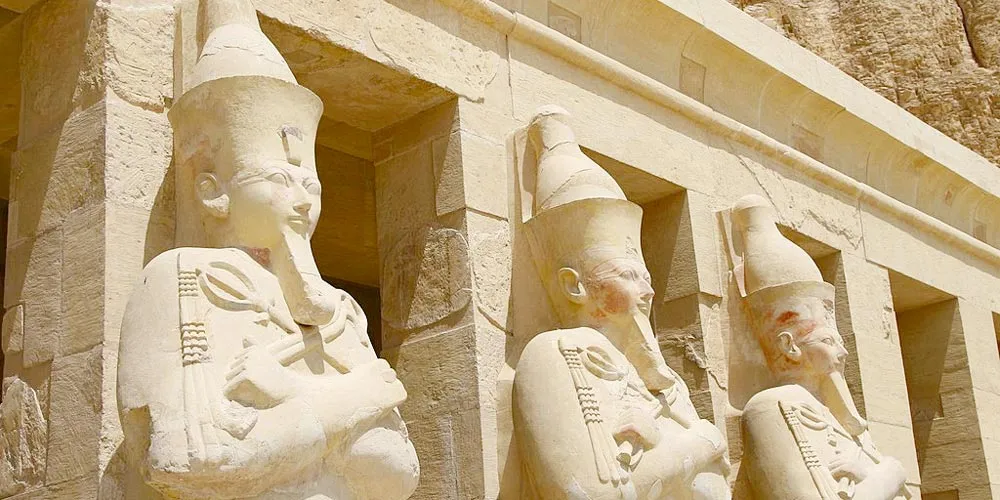
The upper terrace is fronted by a row of Osiride statues of Hatshepsut, showing her in the form of Osiris. Behind them lie a large festival court, an open-air solar court dedicated to the sun god Ra, and chapels for the royal cult of Hatshepsut and her father, Thutmose I.
The innermost room is the Sanctuary of Amun, cut directly into the cliff. Researchers have noted that around the winter solstice the rising sun shines along the temple's axis into this sanctuary. It is a gentler version of the solar alignment that makes the Temple of Abu Simbel famous.
15 Facts About the Temple of Hatshepsut
-
Its ancient name, Djeser-Djeseru, means "Holy of Holies."
-
It was built in the 18th Dynasty, during Hatshepsut's reign of about 1479 to 1458 BC.
-
It is a mortuary temple for her cult, not her burial place.
-
Her architect was Senenmut, who hid small images of himself behind chapel doors.
-
The design was inspired by the neighboring temple of Mentuhotep II.
-
It has three terraces connected by ramps.
-
The Punt reliefs record one of the earliest well-documented trade expeditions in history.
-
Trees from Punt were planted in front of the temple, and their pits survive.
-
The divine birth reliefs show Hatshepsut as the daughter of Amun.
-
The Anubis Chapel has proto-Doric fluted columns.
-
The Hathor Chapel columns carry the face of the goddess Hathor.
-
After her death, Thutmose III had many of her images and statues erased or smashed.
-
In the 7th century AD, a Coptic monastery was built on the upper terrace, giving the area its Arabic name Deir el-Bahari, "Monastery of the North."
-
Excavators from the Metropolitan Museum of Art recovered and reassembled many of her broken statues in the 1920s.
-
A Polish-Egyptian mission has been restoring the temple since 1961.
Hatshepsut Temple Before Reconstruction
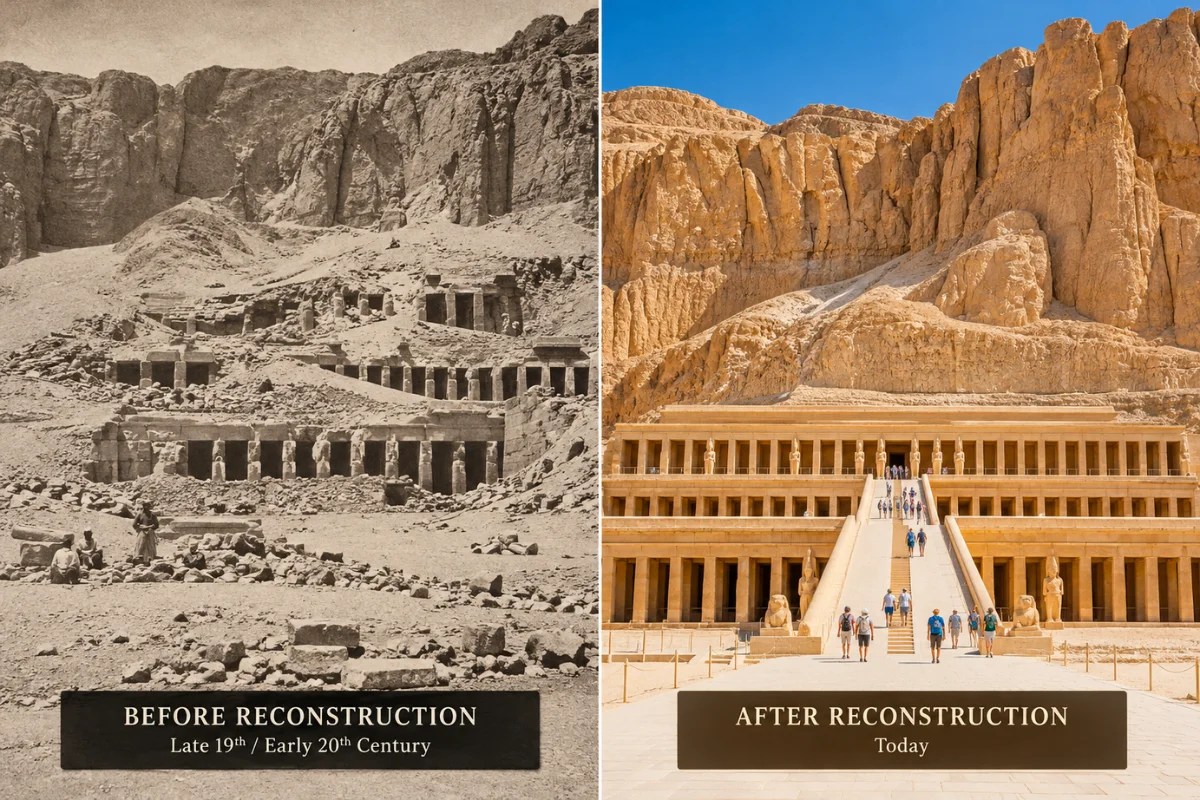
Visitors today see clean terraces and rebuilt colonnades, but the temple looked very different in the 19th century. Rockfalls from the cliffs, layers of sand and the ruins of the Coptic monastery covered most of the upper levels.
The Swiss Egyptologist Édouard Naville cleared much of the site for the Egypt Exploration Fund between the 1890s and early 1900s. In the 1920s, Herbert Winlock and the Metropolitan Museum team found hundreds of fragments of Hatshepsut's statues in nearby quarries and pits, where they had been dumped after Thutmose III's campaign against her memory.
Since 1961, the Polish-Egyptian Archaeological and Conservation Mission has worked on the upper terrace, the Osiride statues and the sanctuary. Some parts are original stone, while others are modern reconstructions, so look closely and you will see where ancient blocks meet new masonry. Old photographs of the site show piles of rubble where the colonnades now stand.
Why Is the Temple of Hatshepsut So Important?
The temple is important for three reasons. Its terraced design is unlike any of Egypt's other ancient Egyptian temples, its reliefs record the Punt expedition and Hatshepsut's claim to divine birth, and its damaged images show how a later king tried to erase a female pharaoh from history.
It also stands at the heart of the West Bank necropolis, surrounded by royal tombs and the tombs of nobles. For anyone exploring ancient Thebes, it is a key stop between the great cult temples of the East Bank and the royal tombs behind the cliffs.
Visiting Hatshepsut Temple Today
The Temple of Hatshepsut is well worth visiting. It is on the West Bank of Luxor, across the Nile from the city center and directly opposite Karnak. Most visitors combine it with the Valley of the Kings and the Colossi of Memnon in one morning.
-
Getting there: cross the Nile by bridge, ferry or tour bus. A small electric tram runs from the visitor center to the temple for a small extra fee.
-
When to go: arrive at opening time. The terraces face east and have little shade, and the sun is strong by late morning.
-
How long to stay: allow about one to one and a half hours.
-
Tickets and hours: prices and opening times change, so check them before you go or ask your guide.
-
What to bring: a hat, water and comfortable shoes for the ramps.
For the best season and daily temperatures, see our guide to the best time to visit Luxor.
Is Hatshepsut Temple in the Valley of the Queens?
No. The temple stands at Deir el-Bahari, in a bay of cliffs on the West Bank. The Valley of the Queens, where queens such as Nefertari were buried, lies a few kilometers to the south-west, and the Valley of the Kings is on the other side of the same cliffs.
Tours That Include Hatshepsut Temple
A guided day tour is the easiest way to see the temple. Our Full Day Tour to Luxor West Bank is From $60 per person and covers the Valley of the Kings, Hatshepsut Temple and the Colossi of Memnon.
Discover All the Powerful Attractions in Egypt with "Trips in Egypt"
Hatshepsut's temple is only one of the treasures of Luxor, and the rest of Egypt has many more. You can see them on one of our Egypt tour packages, which combine Cairo, Luxor, Aswan and the Red Sea.
For a slower pace, travel by river. Sailing between Luxor and Aswan on one of our Nile cruises lets you add Edfu, Kom Ombo and Aswan to the West Bank.
Conclusion
The Temple of Hatshepsut is more than a beautiful ruin. It tells the story of a woman who ruled as king, an architect who shaped a cliff into a temple, a voyage to distant Punt and a successor who tried to erase her memory. Visit early, climb all three terraces and look closely at the Punt reliefs. Few places in Egypt let you meet a pharaoh so directly in stone.

5 Days Cairo And Hurghada Trip
Amazing 4 Nights Cairo and Hurghada Trip Itinerary 5 Days Cairo and Hurghada trip wil...
- Duration 5 Days / 4 Nights
- Location Cairo & Hurghada
- Type Historical & Recreational Tour
From$690/per person
View Tour
6 Days Cairo, Alexandria & Faiyum Tour
Unforgettable Cairo, Alexandria & Faiyum Adventure in Six Days 6 Days Cairo, Alex...
- Duration 6 Days / 5 Nights
- Location Cairo - Alexandria - Fayum
- Type Historical Tour
From$720/per person
View Tour
10 Days Cairo, Faiyum & Nile Cruise Holiday
Breathtaking 10 Days Journey of A Lifetime in Egypt 10 Days Cairo, Faiyum & Nile...
- Duration 10 Days / 9 Nights
- Location Cairo, Luxor, Aswan & Faiyum
- Type Classic Tour
From$1350/per person
View Tour SOLD OUT
Ultimate 7-Day Egypt Solar Eclipse Experience with Hurghada 2027
Enjoy a 7-Day Egypt Solar Eclipse Tour with Hurghada 2027 6 Nights Egypt Solar Ecli...
- Duration 7 Days / 6 Nights
- Location Cairo / Giza / Luxor / Hurghada
- Type Astronomical Tour
Sold Out
View Details