



The Egyptian Book of the Dead is a collection of about 200 spells written on papyrus and placed in tombs to guide the dead safely through the underworld. Its purpose was to protect the soul, pass the judgment of Osiris and reach eternal life in the Field of Reeds. This guide explains clearly what the Book of the Dead is, what it says, how it developed and why it mattered.

What Is the Egyptian Book of the Dead?
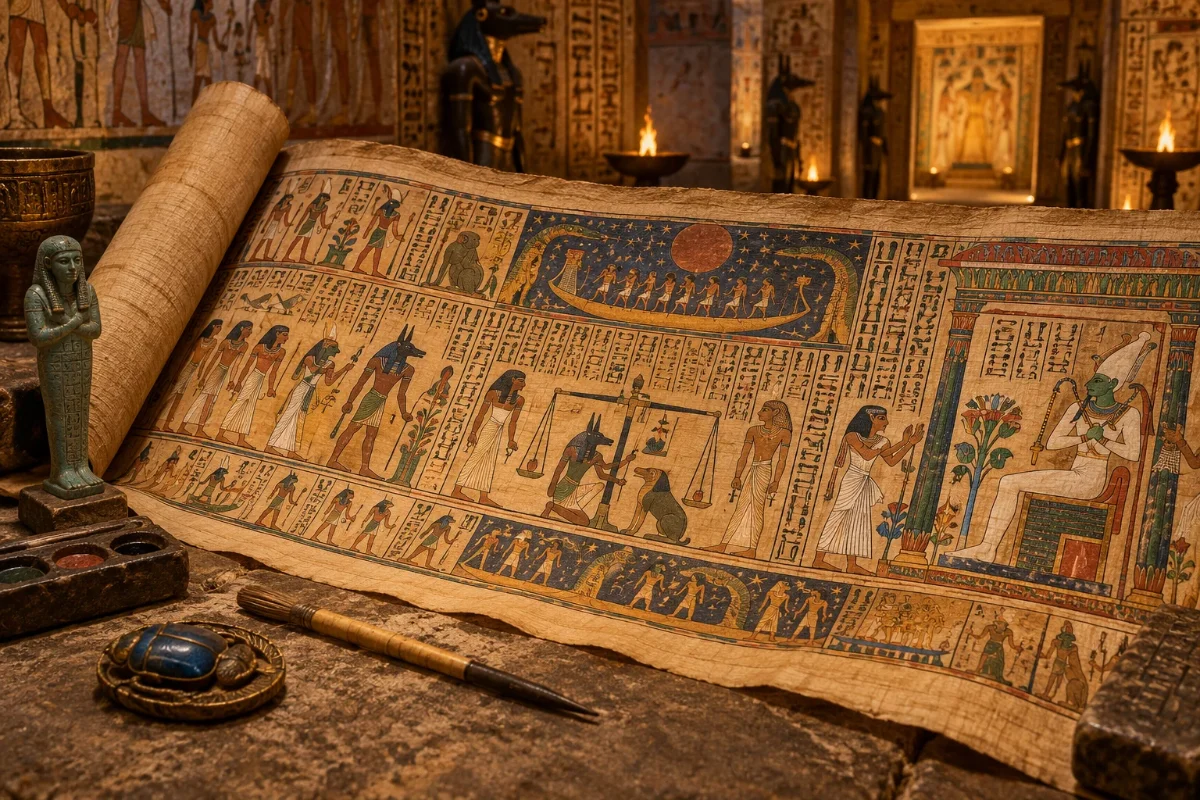
The Book of the Dead is a set of funerary texts and spells meant to help the deceased reach the afterlife safely. It was used from the start of the New Kingdom, around 1550 BC, until the late periods of ancient Egyptian religion.
It was not a single fixed book. Each copy was a personal scroll, written for one owner, with a selection of spells chosen from about 200 known texts. No surviving copy contains them all.
The spells gave the dead power over the dangers of the Duat, the underworld, including monsters, demons, fiery lakes and guarded gates. They also prepared the soul to face the judgment of the dead and to live forever in the Field of Reeds.
The Book of Going Forth by Day
The ancient Egyptians never called it the Book of the Dead. Its Egyptian title, rw nw prt m hrw, is usually translated as "Spells of Coming Forth by Day" or "The Book of Going Forth by Day."
"Going forth by day" meant that the blessed dead could leave the tomb, move freely in the world of the living and return to the realm of the dead. The modern name comes from the German Todtenbuch, used by Egyptologist Karl Richard Lepsius in the nineteenth century.
Is There an Actual Egyptian Book of the Dead?
Yes. Hundreds of real Book of the Dead manuscripts and fragments survive. Some are short selections of spells, while elaborate papyrus rolls could extend for many meters.
One of the most famous examples is the Papyrus of Ani, created around 1250 BC for a Theban scribe and now held by the British Museum. In 2023, Egyptian archaeologists also announced the discovery of a papyrus around 16 meters long at Saqqara, near the Step Pyramid of Djoser.
Who Wrote the Book of the Dead?
The Book of the Dead has no single author. Priests and scribes composed, copied and revised its spells over many centuries, while drawing on much older Egyptian funerary traditions.
The Egyptians associated some sacred writings with Thoth, the god of writing and wisdom. The rubric of Spell 30B even attributes the discovery of the spell to Hordjedef, a son of King Khufu, during the reign of Menkaure.
Copies were produced in scribal workshops. Some were personalized from the beginning, while others appear to have been prepared with spaces where the owner's name could later be inserted.
Is the Book of the Dead Older Than the Bible?
In its surviving written tradition, yes. Book of the Dead papyri were in use from around 1550 BC, while the Pyramid Texts from which some of its ideas developed date back to the third millennium BC.
The Hebrew Bible was composed and edited over a long period, mainly during the first millennium BC. Some early Western writers therefore described the Book of the Dead as an "Egyptian Bible", but that comparison is misleading. It was not scripture in the same sense; it was a collection of funerary spells intended to help the dead.
What Was the Purpose of the Book of the Dead?
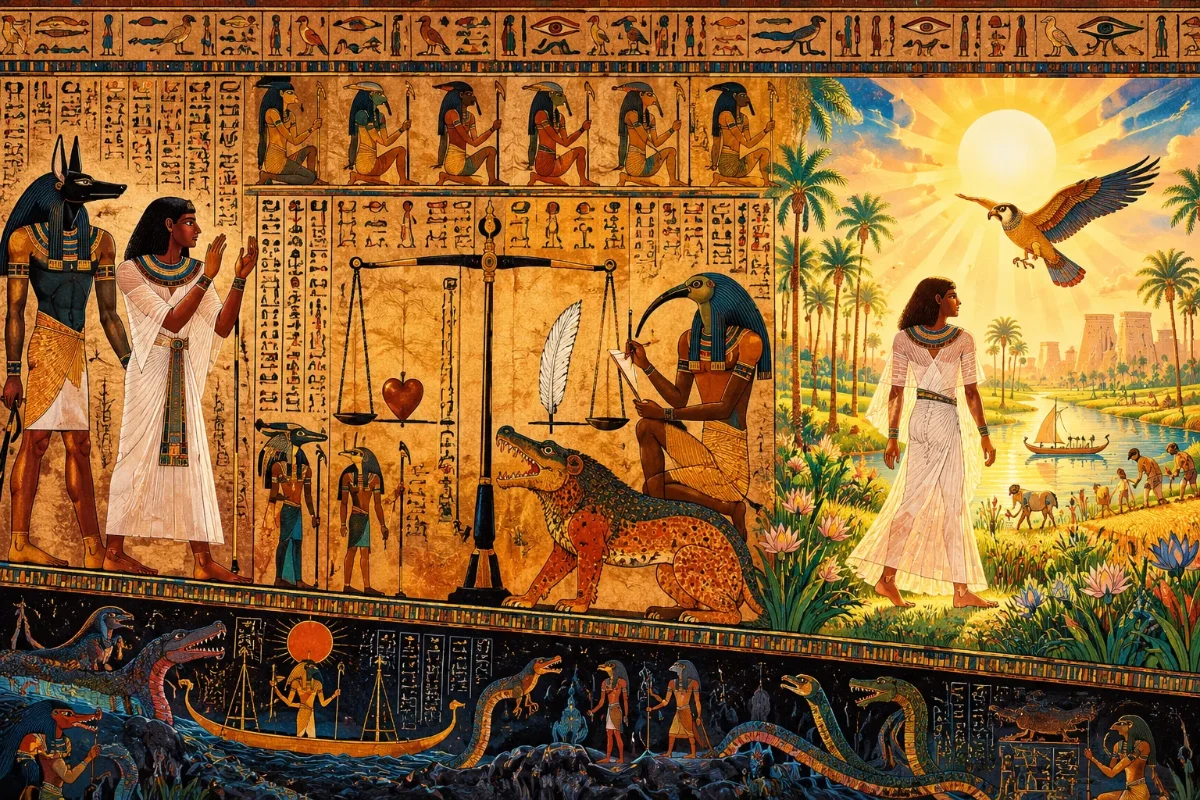
The purpose of the Book of the Dead was to help the deceased survive death and achieve eternal life. Its spells protected the soul in the underworld, helped it pass judgment before Osiris and gave it the magical knowledge needed to overcome dangers on the journey.
What Was the Book of the Dead Used For?
The Book of the Dead was used as a funerary guide and source of protective magic. A papyrus could be placed in the tomb, inside or near the coffin, among mummy wrappings or sometimes within funerary figures associated with Osiris.
Its spells could:
-
Restore the deceased person's ability to speak, breathe, eat and move.
-
Protect the heart, head and body from destruction.
-
Reveal the names of supernatural gatekeepers so the soul could pass.
-
Allow the deceased to transform into sacred creatures or divine forms.
-
Reunite different parts of the personality, such as the ba, with the body.
-
Help the deceased survive the Weighing of the Heart before Osiris.
The texts were also connected to rituals performed by the living. Funerary ceremonies, offerings and spoken spells helped maintain the relationship between the dead and their families.
Why Was the Book of the Dead Important?
The Book of the Dead was important because eternal life was not considered automatic. The deceased needed knowledge, magical protection and moral justification to overcome the dangers of the afterlife.
Spell 125 contains what modern Egyptologists call the Negative Confession, in which the deceased denies committing a series of wrongdoings before divine judges. Among the declarations are:
-
I have not stolen.
-
I have not been violent.
-
I have not done wrong.
-
I have not destroyed food offerings.
-
I have not told lies.
-
I have not reduced measures.
-
I have not stolen the property of the gods.
-
I have not discussed secrets.
-
I have not had intercourse with a married woman.
-
I have not disputed the king.
-
I have not caused anyone to weep.
-
I have not robbed a parcel of land.
-
I have not transgressed the law.
-
I have not struck terror.
-
I have not waded in the water.
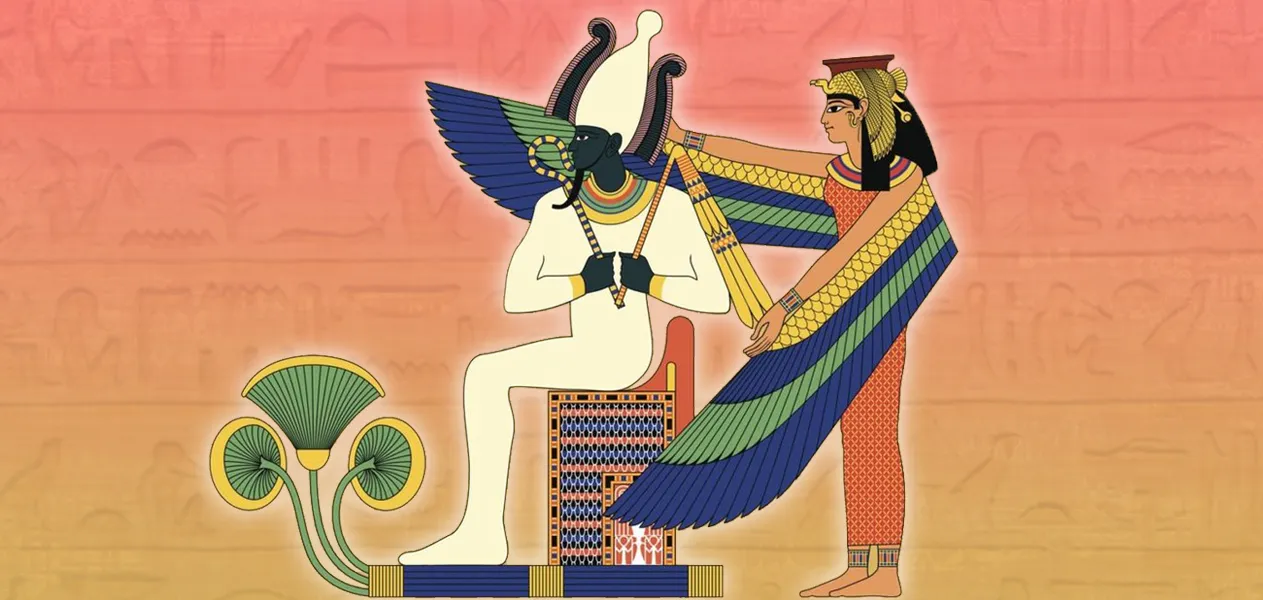
Osiris, ruler of the realm of the dead, presided over the judgment that determined whether the deceased could enter a blessed afterlife.
The Role of the Book of the Dead in Ancient Egyptian Religion
For ancient Egyptians, life should be lived according to Maat, the principle of truth, order, justice and balance. The Book of the Dead connected this moral ideal with the journey after death.
The heart was normally left inside the body during mummification because Egyptians believed it preserved a person's memory, character and actions. A justified soul could enter Aaru, the Field of Reeds, while a person who failed divine judgment was denied the blessed afterlife.
The Development of the Book of the Dead
The Book of the Dead took shape around the beginning of the New Kingdom, but its roots stretch back more than a thousand years. Its spells developed from older Egyptian funerary traditions that first appeared on pyramid walls and later on coffins.
Book of the Dead During the Old Kingdom of Egypt
The oldest ancestor of the Book of the Dead is the Pyramid Texts, carved inside royal burial chambers during the Old Kingdom of Egypt.
These texts first appear extensively inside the Pyramid of King Unas, the last ruler of the Fifth Dynasty, who reigned around 2375 to 2345 BC. Their spells were intended to help the king rise into the sky and join the gods.
Earlier pyramids did not contain such funerary inscriptions. Even the Great Pyramid of Giza contains no comparable religious texts carved on its chamber walls.
Book of the Dead During the Middle Kingdom of Egypt
During the Middle Kingdom of Egypt, funerary texts expanded beyond royal pyramids and appeared on the inner surfaces of coffins.
These Coffin Texts included material derived from the Pyramid Texts as well as many new spells. Wealthy officials could now use texts that had once been primarily associated with kings, reflecting a wider access to funerary beliefs.
Book of the Dead During the New Kingdom of Egypt
In the New Kingdom, funerary spells were increasingly written on papyrus scrolls.
By this period, kings no longer built Egyptian pyramids as their principal tombs. Royal burials had shifted to rock-cut tombs in Thebes.
Papyrus allowed scribes to produce longer, more portable and richly illustrated collections. Spell 125 and its judgment scene are known from the reigns of Queen Hatshepsut and Thutmose III in the Eighteenth Dynasty.
An Explanation of Dates of the Book of the Dead
The table below shows important dates in the development and modern study of the Book of the Dead.
|
Date |
Event |
|
About 3100 BC |
Early Egyptian writing appears on labels and objects in royal tombs at Abydos |
|
About 3000 BC |
Egypt's early dynastic period begins |
|
About 2350 BC |
Pyramid Texts appear inside the Pyramid of Unas |
|
About 2100 BC |
Coffin Texts spread on wooden coffins |
|
About 1600 BC |
Early Book of the Dead material appears on the coffin of Queen Mentuhotep |
|
About 1550 BC |
Papyrus copies become established during the early New Kingdom |
|
About 650–600 BC |
A more standardized ordering of spells develops during the Saite Period |
|
First century BC |
The Book of the Dead becomes much less commonly used |
|
Roman Period |
Some late examples continue to be produced |
|
1798 |
Vivant Denon acquires an Egyptian funerary papyrus during Napoleon's campaign |
|
1805 |
Jean Marcel Cadet publishes an early European copy |
|
1822 |
Jean-François Champollion announces his breakthrough in deciphering hieroglyphs |
|
1842 |
Karl Richard Lepsius publishes a Book of the Dead papyrus and numbers its spells |
Abydos later became one of the most important centers of the cult of Osiris. The Temple of Seti I at Abydos preserves important scenes of the king before the gods.
The rise of the dynastic state also established the religious framework associated with the Egyptian pharaohs, whose funerary traditions shaped later texts.
Rediscovery and Translation
Early European collectors who encountered papyri from ancient Egyptian tombs could not initially read them. Scholarly study expanded after Champollion's decipherment of hieroglyphs in 1822.
In 1842, Karl Richard Lepsius published a Ptolemaic papyrus in Turin and introduced a numbering system for its spells. Samuel Birch published an important English translation in 1867.
Between 1875 and 1886, Édouard Naville produced a major three-volume edition covering 186 spells. Later translations by scholars including E. A. Wallis Budge and Raymond Faulkner made the material accessible to wider audiences.
The Main Sections of the Book of the Dead
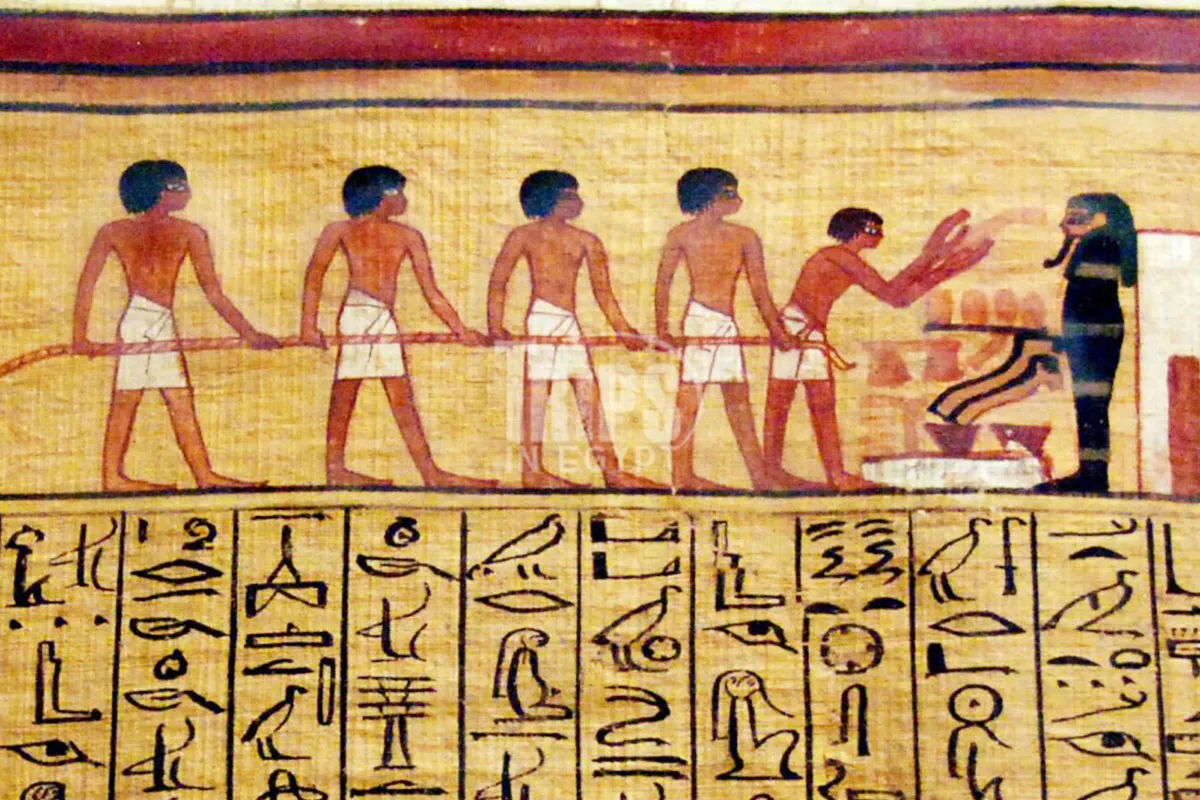
Modern scholars often organize the standardized later form of the Book of the Dead into broad groups of spells that follow the deceased from burial and entry into the underworld through judgment and transformation. Individual manuscripts, however, could arrange and select their spells differently.
The Egyptian Book of the Dead Summary
The Book of the Dead describes a spiritual journey rather than one continuous story. The deceased enters the tomb, regains the powers of the body, travels through the underworld, encounters gods and dangerous beings, faces judgment before Osiris and hopes to emerge as a blessed spirit.
The spell numbers commonly used today derive from modern Egyptological classification. Ancient copies did not necessarily contain the spells in the same order, and owners selected the texts they wanted.
Chapters 1–16: Entering the Tomb
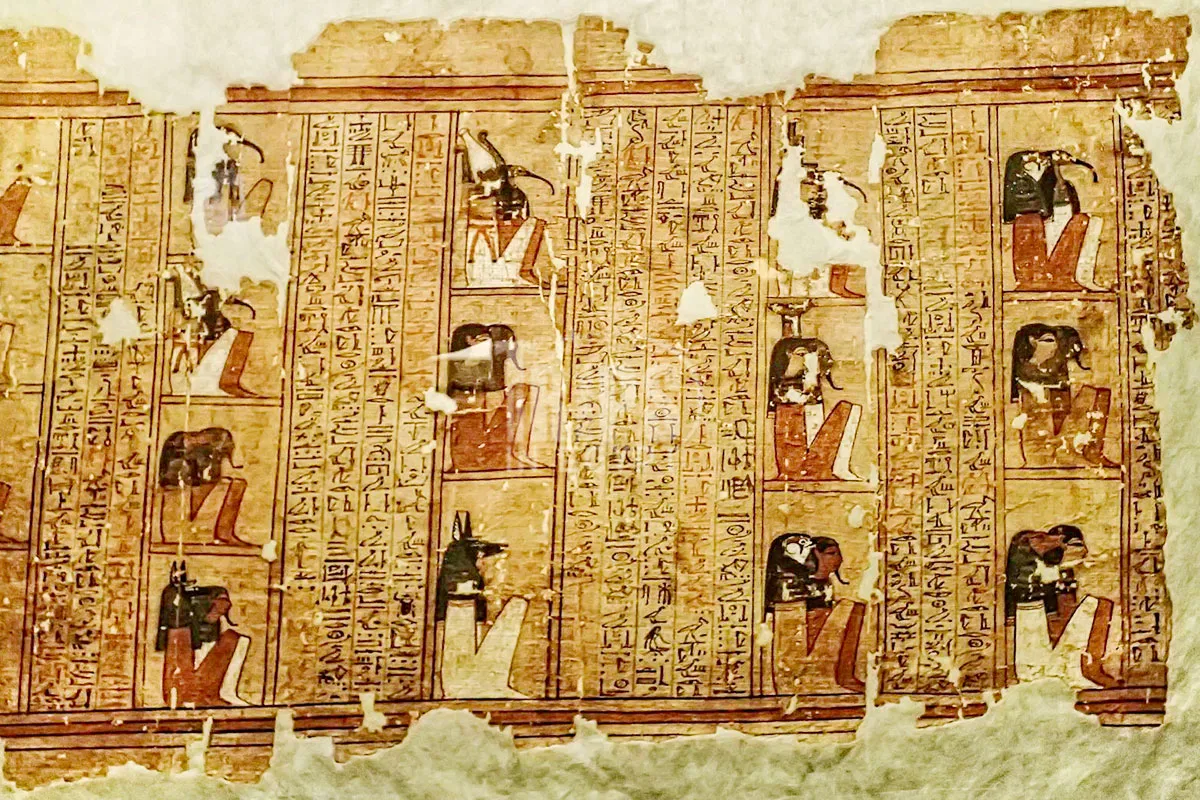
These early spells focus on the funeral, entering the tomb and restoring the deceased's ability to move and act.
-
Spell 1: Used in connection with the funeral and burial procession.
-
Spell 1B: A recitation associated with the day of burial.
-
Spell 6: Associated with shabti figures, which were expected to perform agricultural labor for the deceased in the afterlife.
-
Spell 7: Protection against dangerous creatures.
-
Spell 9: Identifies the deceased with Horus and asks for a path to Osiris. One version includes the words: "I open the Netherworld that I may see my father Osiris."
Chapters 17–63: Myths and Rebirth
This group contains explanations of the gods, the cosmos and the places of the underworld. Spell 17 includes complex material connected to the Egyptian creation myth and solar theology.
-
Spell 26: Helps preserve and restore the heart.
-
Spells 29A and 29B: Protect the heart from being taken away.
-
Spell 30B: Tells the heart not to testify against its owner during judgment and was commonly associated with heart scarabs.
-
Spell 42: Identifies different parts of the body with gods, including the declaration: "my hair is Nu; my face is Ra."
-
Spell 43: Protects the deceased from beheading and includes the line: "The head of Osiris shall not be taken from him."
-
Spell 59: Gives access to air and water and addresses a sacred sycamore connected with Nut.
-
Spells 63A and 63B: Protect the deceased while drinking water in the underworld.
Chapters 64–129: Travel With the Sun and Judgment
These spells concern movement through the divine world, identification with the sun god, transformation and judgment before Osiris.
-
Spell 68: Helps the deceased come forth by day and gain spiritual power.
-
Spell 72: Concerns coming forth by day and opening the tomb.
-
Spell 89: Allows the ba, often depicted as a human-headed bird, to reunite with the body.
-
Spell 112: Names sacred beings associated with Pe, Nekhen and Heliopolis.
-
Spell 125: Contains the judgment before Osiris, including the Negative Confession and the Weighing of the Heart.
-
Spell 127: Gives knowledge needed to approach supernatural guardians.
Chapters 130–189: Becoming a Blessed Spirit
The final group focuses on the vindicated deceased living among the gods, obtaining food and protection and participating in the divine world.
-
Spell 144: Names the guardians of seven gates. Knowing their names allows the deceased to pass them.
-
Spell 151: Uses imagery of the burial chamber to surround the mummy with magical protection.
-
Spells 153A and 153B: Protect against a supernatural net intended to trap souls.
-
Spell 182: Calls on Thoth to protect and restore the deceased.
-
Spell 185: A hymn addressed to Osiris.
What Is Spell 72 in the Book of the Dead?
Spell 72 is concerned with coming forth by day and opening the tomb, one of the central ideas behind the Egyptian title of the Book of the Dead.
The deceased speaks as an akh, a blessed and effective spirit, and asks for the way to be opened. The spell promises freedom of movement and access to offerings for those who successfully use its knowledge.
Its associated vignette can show the deceased emerging from the tomb or appearing before divine beings.
What Does the Egyptian Book of the Dead Say?
The Book of the Dead often speaks in the first person, as though the deceased is reciting the spells directly.
Some passages identify the speaker with gods such as Ra or Horus. Others give the names of supernatural guardians, praise Osiris and Ra, request food and water, or explain how to use magical objects.
Instructions known as rubrics could specify how a spell should be written, what amulet should accompany it or what benefit the deceased would receive.
The Weighing of the Heart
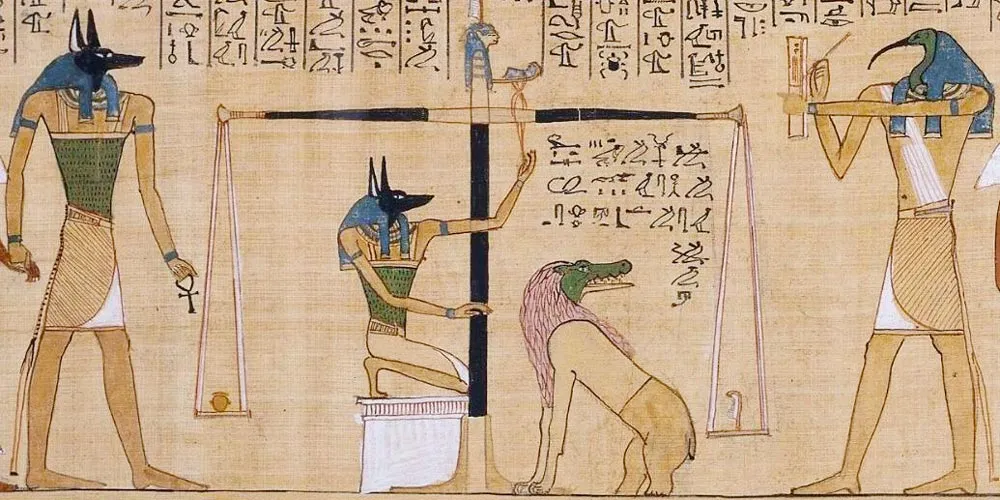
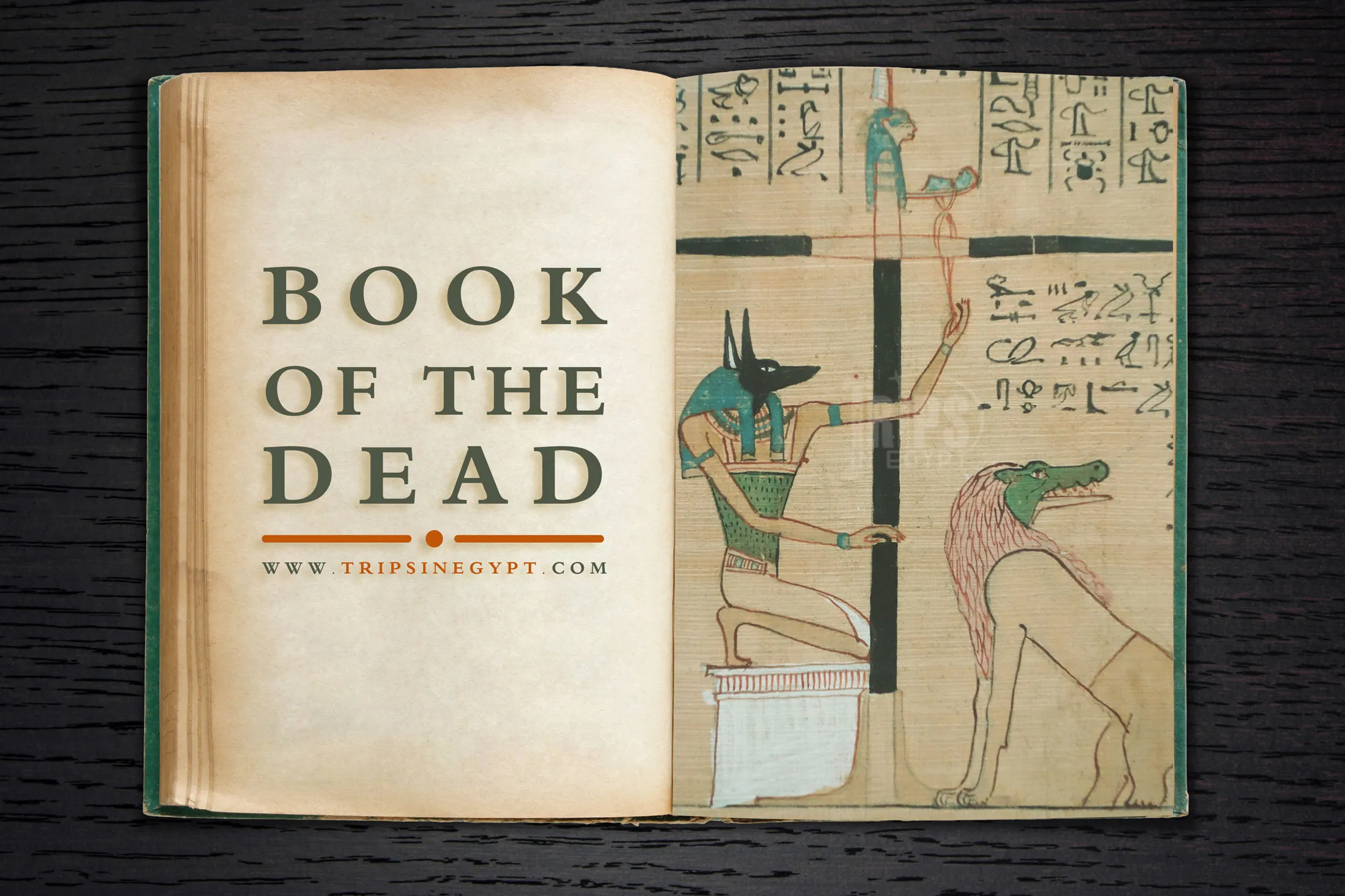
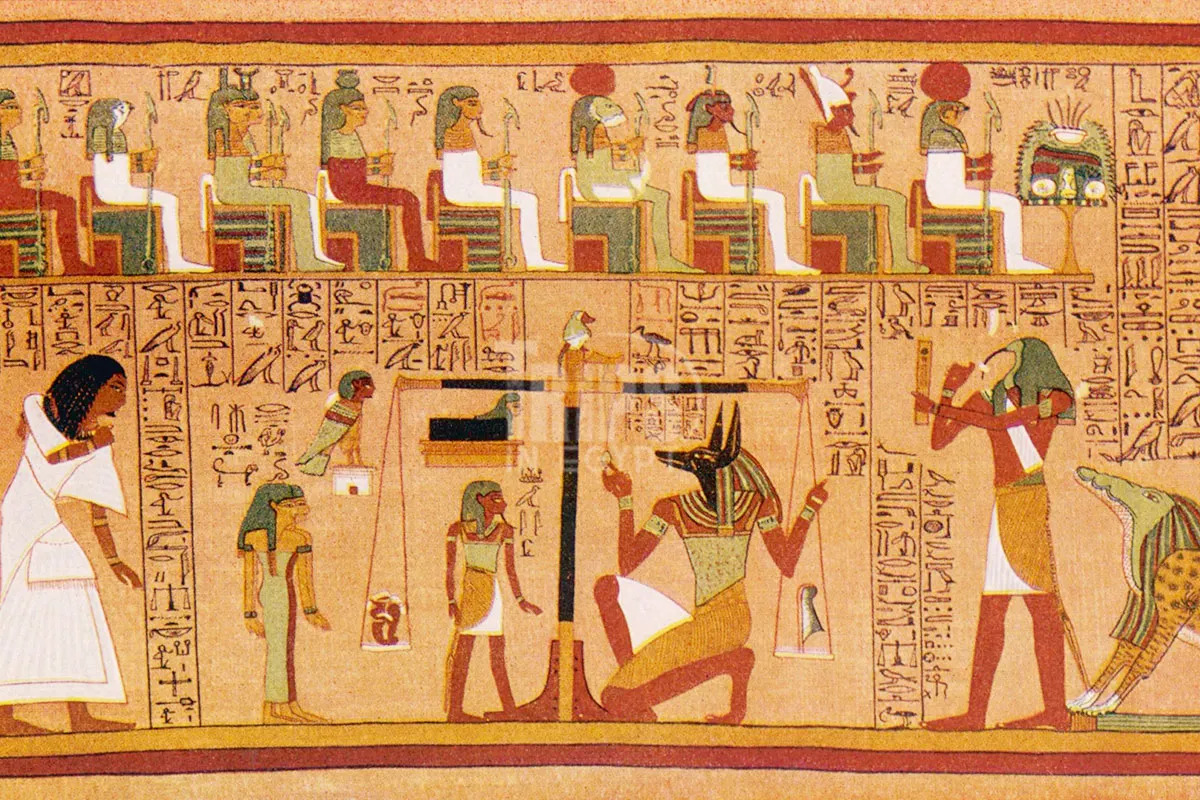
The Weighing of the Heart, described in Spell 125, is the most famous judgment scene associated with the Book of the Dead. It tested whether the deceased had lived according to Maat and could join Osiris in the blessed afterlife.
The Heart and the Feather of Maat
Ancient Egyptians regarded the heart as the center of thought, memory, character and emotion. It therefore represented the record of a person's life.
During judgment, the heart was placed on one side of a balance. On the other was the feather or symbol of Maat, representing truth, order, justice and cosmic balance.
A heart that successfully passed the test showed that the deceased had lived in harmony with Maat.
Anubis, Thoth and Ammit
Anubis, the jackal-headed god associated with embalming and cemeteries, supervised the weighing. Thoth, the god of writing and knowledge, recorded the result.
The deceased also addressed 42 divine judges through the Negative Confession. Near the balance waited Ammit, the "Devourer", a terrifying composite being with features of a crocodile, big cat and hippopotamus.
A person who failed judgment was denied the blessed afterlife, a fate later descriptions often express through the heart being devoured by Ammit.
The Field of Reeds
If the deceased was declared justified, they could enter the Field of Reeds, an idealized version of Egypt filled with fields, waterways, food and agricultural abundance.
Osiris presided over this blessed realm. The story of Osiris and Isis explains how Osiris became closely associated with resurrection and the dead.
The Role of Women in the Book of the Dead
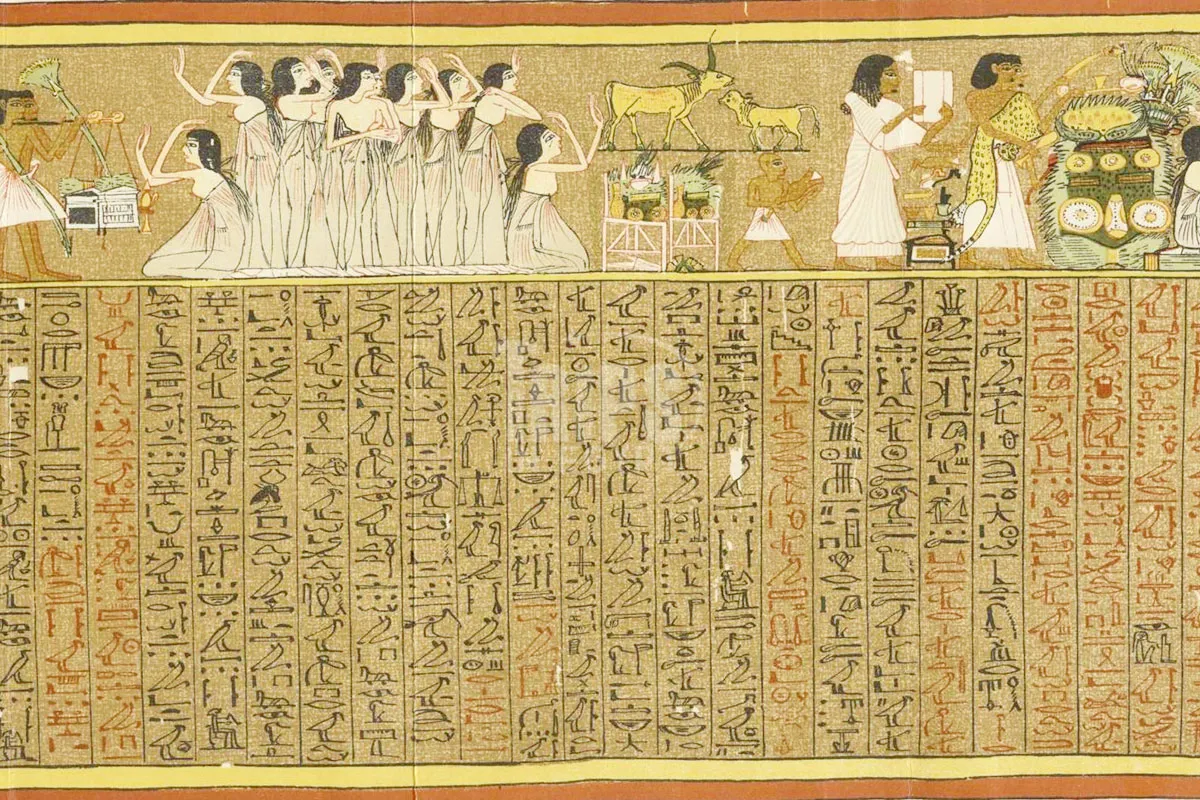
Goddesses play central roles throughout the Book of the Dead. Maat, daughter of the sun god Ra, represents truth and cosmic order and is depicted with a feather on her head.
Isis and Nephthys appear as protectors and mourners, while Hathor and Nut welcome and sustain the deceased.
Women could also own Book of the Dead manuscripts. Several surviving examples belonged to women, including priestesses and chantresses associated with the cult of Amun, showing that these texts were not restricted to male owners.
The Art and Illustrations of the Book of the Dead
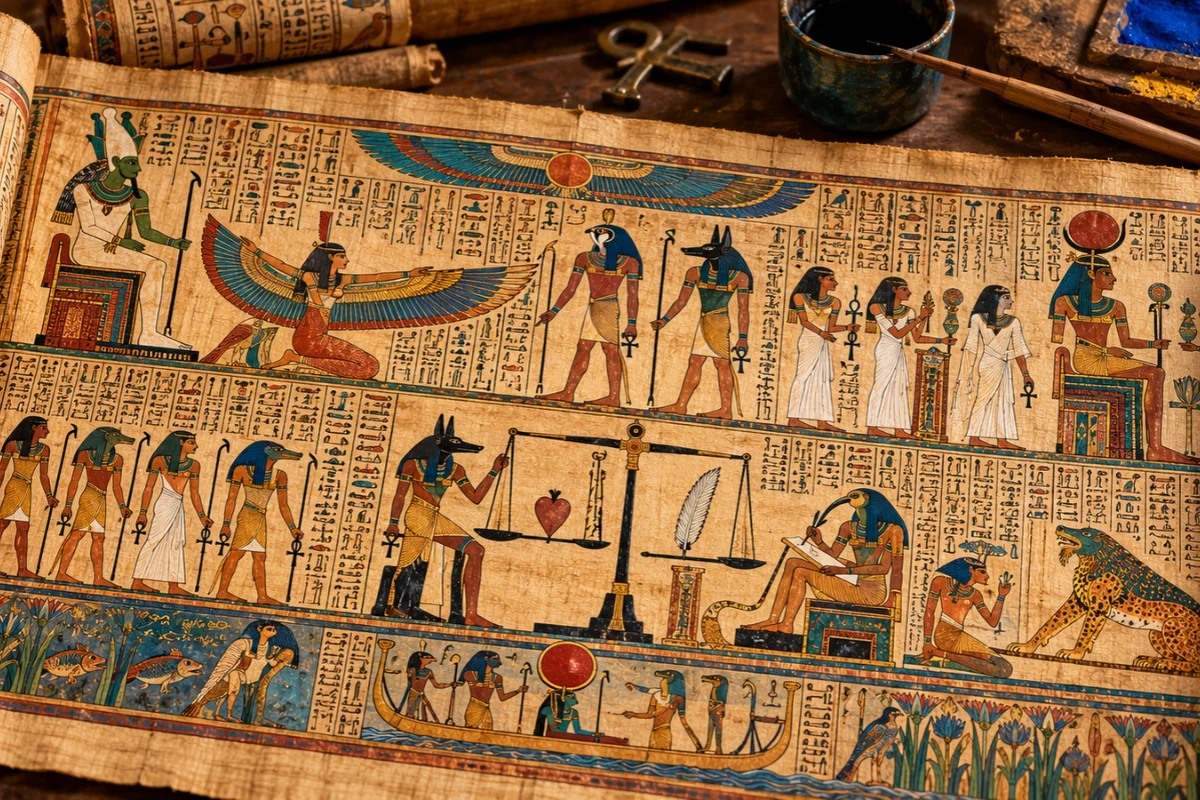
The Book of the Dead is as famous for its illustrations as for its spells. Scenes of gods, funerals, supernatural beings, transformations and divine judgment helped explain and reinforce the magical meaning of the written texts.
Vignettes, Colors and Inks
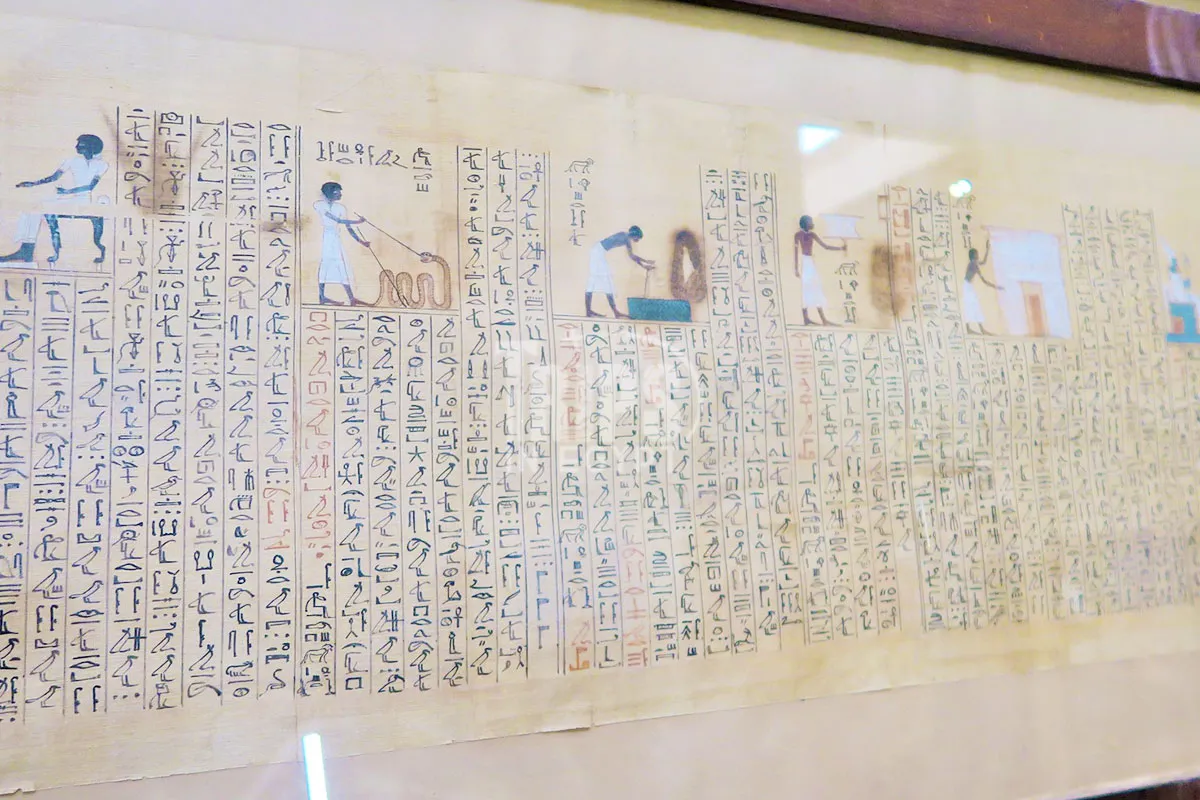
Illustrations accompanying spells are known as vignettes. They could show the deceased worshipping gods, traveling through the underworld, working in the Field of Reeds or standing before Osiris.
Some of the finest manuscripts were painted in vivid colors and filled with recognizable ancient Egyptian symbols.
Scribes commonly used black carbon-based ink for the main text and red ink for headings, instructions and important or potentially dangerous names.
Scripts and Layout
Many New Kingdom papyri were written in cursive hieroglyphs arranged in columns, often with images above or between the texts.
Later manuscripts increasingly used hieratic, a faster cursive script suited to writing with ink. Manuscript layouts varied greatly according to date, workshop, wealth and the number of spells selected.
Some elaborate copies required the work of several scribes and artists, while simpler papyri were shorter and less heavily illustrated.
Translations You Can Read Today
Modern readers can access the Book of the Dead through several English translations. Raymond Faulkner's translation remains widely used in Egyptology, while illustrated editions of the Papyrus of Ani reproduce many of its famous scenes.
The Penguin Classics edition is based on the older translation of E. A. Wallis Budge, with an introduction by John Romer. Budge was enormously influential, but modern Egyptologists generally prefer newer translations because scholarship on the Egyptian language has advanced considerably.
The J. Paul Getty Museum also preserves Book of the Dead papyri and mummy wrappings, while the British Museum holds famous examples including the Papyrus of Ani and the Papyrus of Hunefer.
Where to See Book of the Dead Art in Egypt
In Cairo, the Egyptian Museum preserves papyri, funerary figures, heart scarabs and other objects connected with Egyptian beliefs about the afterlife.
South of Cairo, Saqqara preserves the Pyramid of Unas, whose Pyramid Texts represent an important ancestor of the later Book of the Dead.
The Half-Day Tour to Memphis, Saqqara and Dahshur from Cairo, From $100, explores the region with an Egyptologist guide.
In Luxor, the West Bank preserves tombs decorated with vivid scenes from Egyptian funerary religion. The Valley of the Kings contains royal tombs decorated with related funerary compositions, while tombs at Deir el-Medina preserve scenes closely connected with Book of the Dead beliefs.
The Full Day Tour to Luxor West Bank, From $60, visits the Valley of the Kings, Hatshepsut Temple and the Colossi of Memnon.
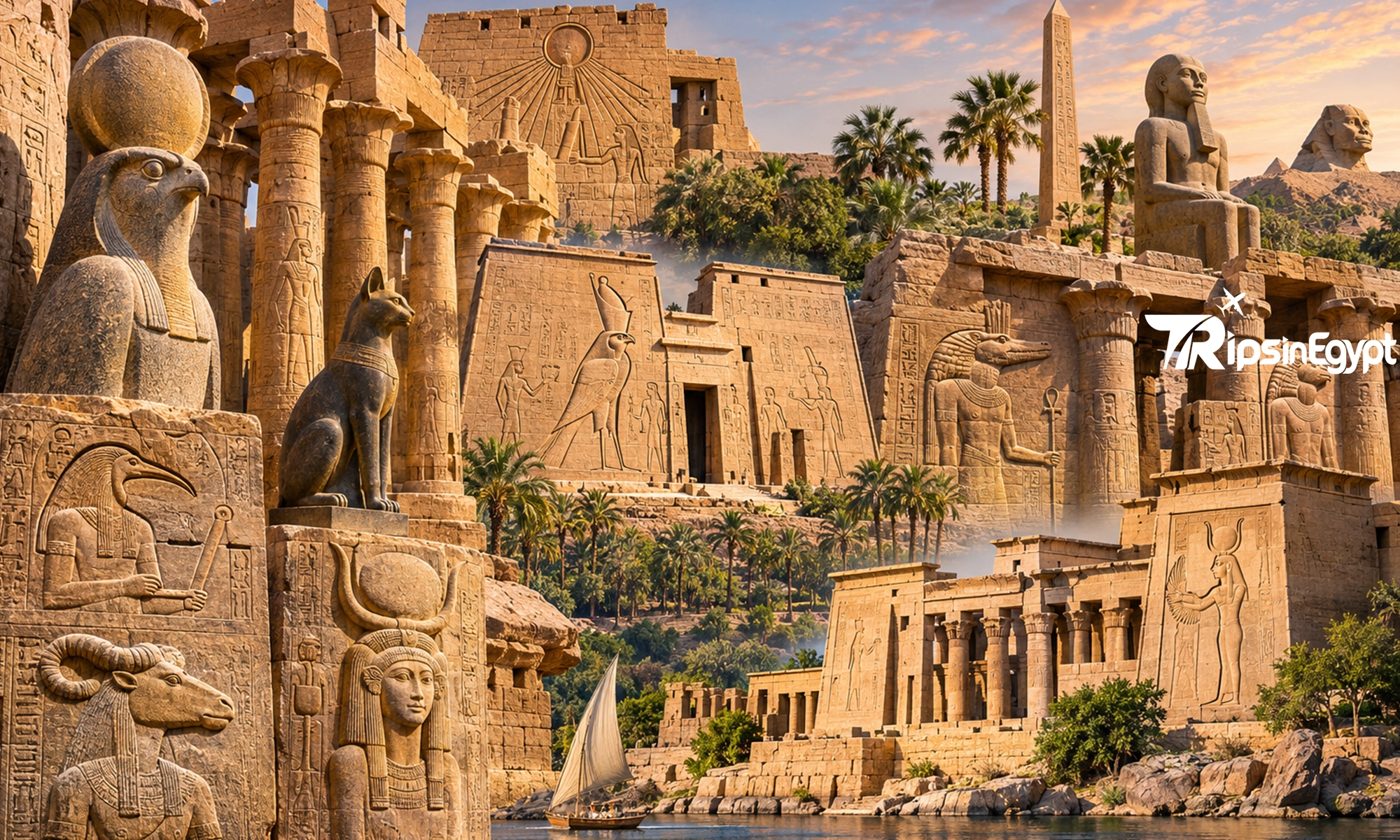
Trips in Egypt offers Egypt tour packages that connect Cairo's museums and pyramids with the temples and tombs of Upper Egypt.
Many travelers also explore Luxor and Aswan on one of our Nile cruises, where ancient funerary beliefs can be understood alongside the monuments themselves.
The Egyptian Book of the Dead was more than a collection of spells. It was a map of the afterlife, a moral guide and a promise that the soul could live forever. Its words and pictures still reveal how the ancient Egyptians thought about death, justice and the heart. To read its spells is to hear a voice from the tombs, still asking quietly to come forth by day.

5 Days Cairo And Hurghada Trip
Amazing 4 Nights Cairo and Hurghada Trip Itinerary 5 Days Cairo and Hurghada trip wil...
- Duration 5 Days / 4 Nights
- Location Cairo & Hurghada
- Type Historical & Recreational Tour
From$690/per person
View Tour
6 Days Cairo, Alexandria & Faiyum Tour
Unforgettable Cairo, Alexandria & Faiyum Adventure in Six Days 6 Days Cairo, Alex...
- Duration 6 Days / 5 Nights
- Location Cairo - Alexandria - Fayum
- Type Historical Tour
From$720/per person
View Tour
10 Days Cairo, Faiyum & Nile Cruise Holiday
Breathtaking 10 Days Journey of A Lifetime in Egypt 10 Days Cairo, Faiyum & Nile...
- Duration 10 Days / 9 Nights
- Location Cairo, Luxor, Aswan & Faiyum
- Type Classic Tour
From$1350/per person
View Tour SOLD OUT
Ultimate 7-Day Egypt Solar Eclipse Experience with Hurghada 2027
Enjoy a 7-Day Egypt Solar Eclipse Tour with Hurghada 2027 6 Nights Egypt Solar Ecli...
- Duration 7 Days / 6 Nights
- Location Cairo / Giza / Luxor / Hurghada
- Type Astronomical Tour
Sold Out
View Details