




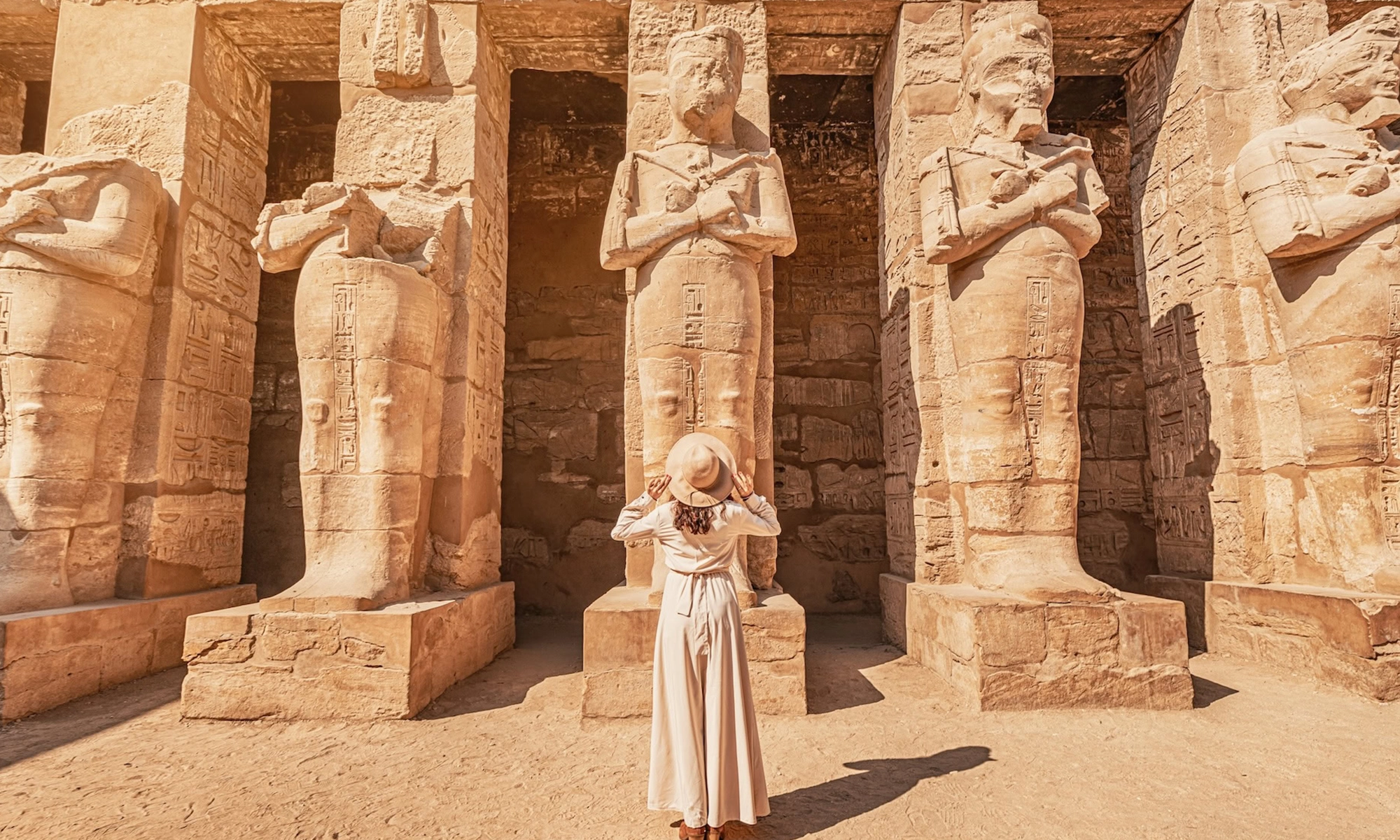
Karnak Temple is a stone forest domain with priceless structures and artifacts that reveal how the ancient Egyptian honored their gods and kings across thousands of years. It is by far the largest temple complex of ancient Egypt, and the most common question we hear about it is a practical one: how much time do you need? Built and rebuilt by kings for about 2,000 years, it is a place where every gateway opens onto another century.
This guide gives you a clear answer for every kind of traveler, then shows you exactly how to use that time, with routes for one, two, and three hours, a half-day plan, opening hours, ticket prices, and the best time to go. Here are all the things you need to know about how long to visit Karnak Temple and the time needed:

How Long to Visit Karnak Temple: The Short Answer
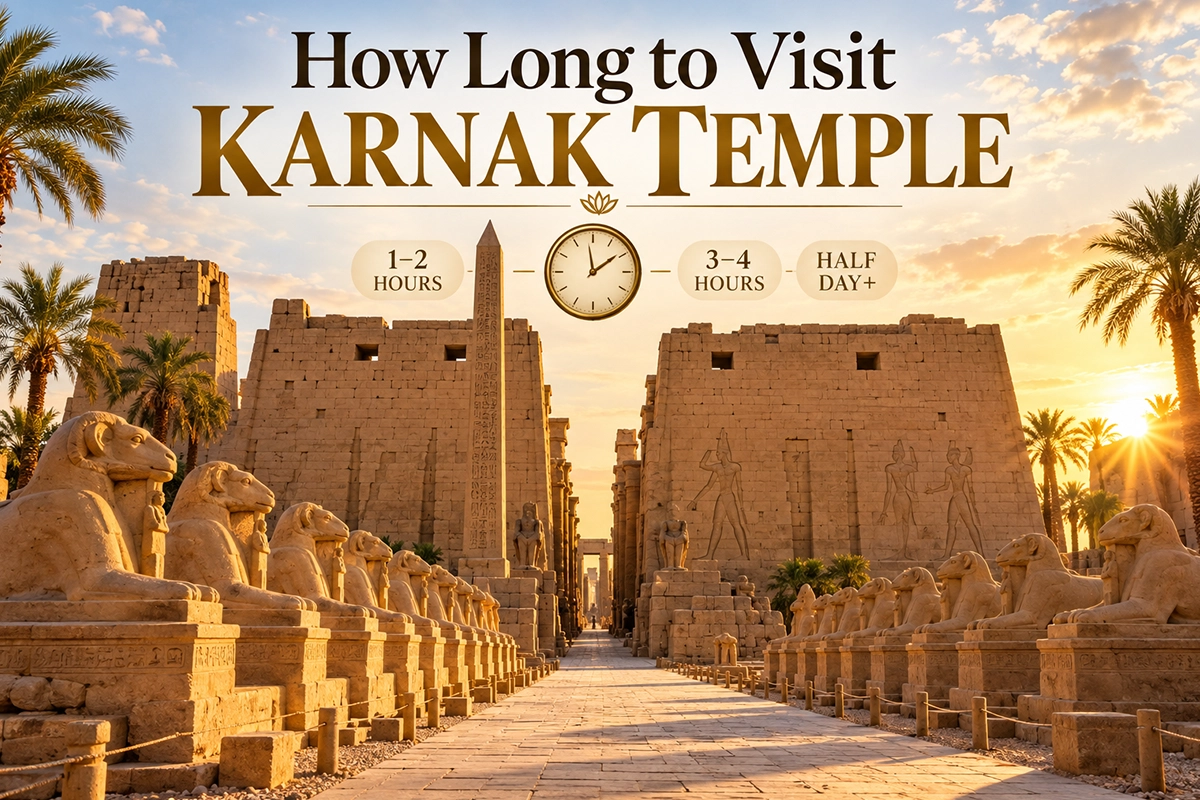
Plan two to three hours for a first visit. That is enough to see the main highlights with a guide, at a comfortable pace, with time for photos and a rest in the shade.
| Type of visit | Time needed | What you will see |
|---|---|---|
| Quick stop | 1 hour | First Pylon, Hypostyle Hall, obelisks |
| Standard visit | 2 to 3 hours | All main highlights plus the Sacred Lake |
| In-depth visit | 4 hours or a half day | Festival Hall of Thutmose III, Temple of Khonsu, Open Air Museum |
| Evening only | About 1 hour | The Sound and Light Show |
Karnak sits on the east bank of the Nile in Luxor, about 3 km north of the city center. The complex grew over some 2,000 years, from the Middle Kingdom to the Roman period, and the Precinct of Amun-Re alone covers about 25 hectares. Read our full guide to Karnak Temple for its history.
What Decides How Long You Need at Karnak
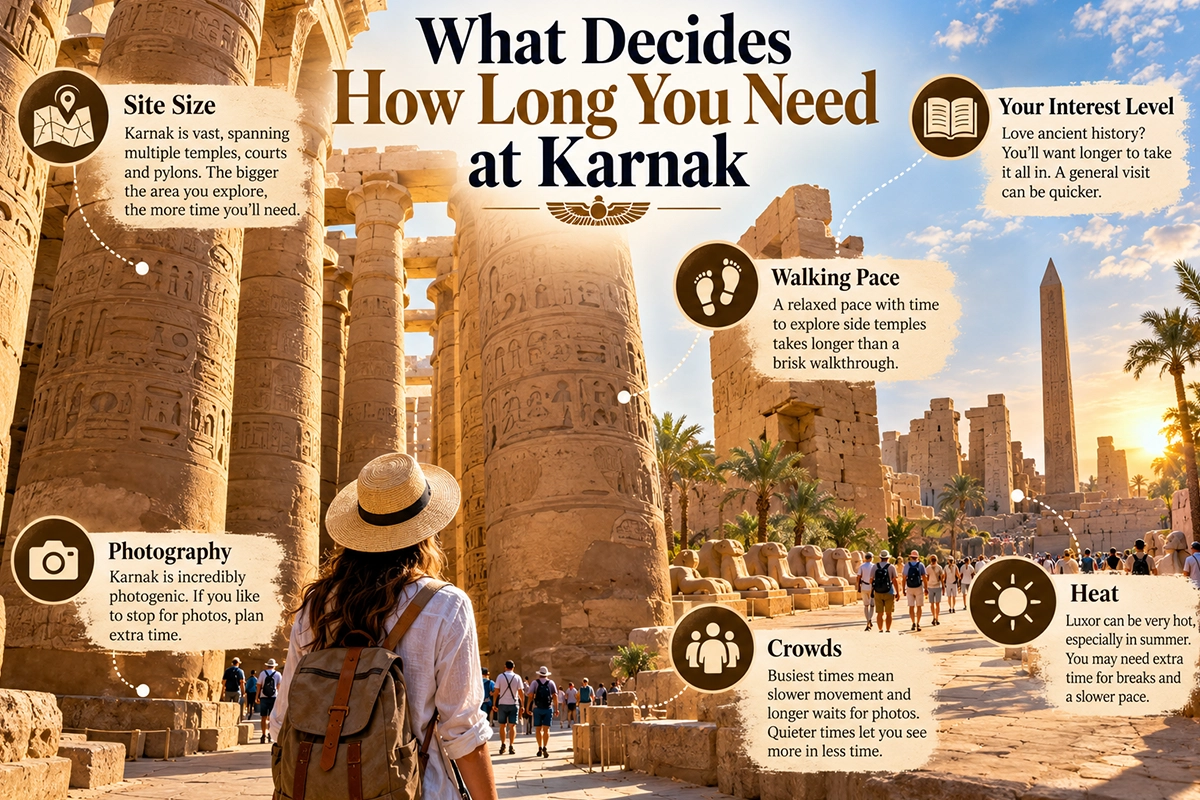
The same temple can take one hour or five, depending on a few simple factors.
- A guide or no guide: Karnak has very little signage. An Egyptologist guide explains what you see and leads you straight to the best spots, so a guided visit is usually more rewarding in the same time.
- The season: From May to September, temperatures in Luxor often pass 40°C, and most visitors tire after about two hours in the open courts. Check the weather in Luxor before you plan.
- Photography: Photographers often stay an extra hour, waiting for light and empty frames in the Hypostyle Hall.
- Your interest in history: Reading cartouches and comparing reliefs from different kings can easily fill a morning.
- Your group: Families with young children and travelers with limited mobility should allow more time for breaks, as the ground is uneven and shade is limited.
Karnak Temple Opening Hours and Tickets
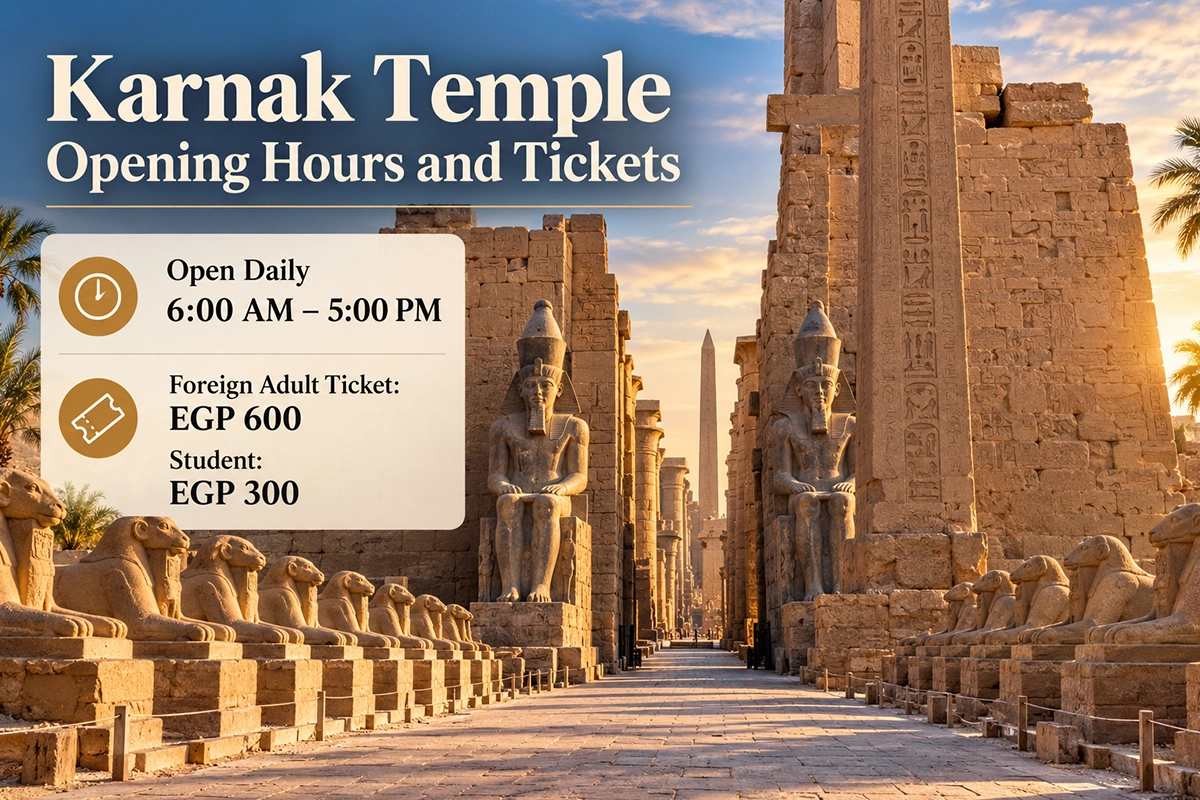
Knowing the hours helps you plan the time around your visit.
| Detail | Information |
|---|---|
| Opening time | 6:00 am, every day |
| Last entry | Around 4:00 pm, with the site closing at about 5:00 pm |
| Foreign adult ticket | EGP 600 |
| Foreign student ticket | EGP 300 (with a valid student card) |
| Photography | Phone and camera photos are allowed |
| Sound and Light Show | Separate evening ticket |
Prices and hours change from time to time, so check the official Egyptian monuments website, egymonuments.com, shortly before your trip. The Open Air Museum, on the north side of the Great Court, has its own ticket in older guides, and some recent sources say the main ticket now covers it, so ask at the ticket office.
A One-Hour Route: The Highlights Only
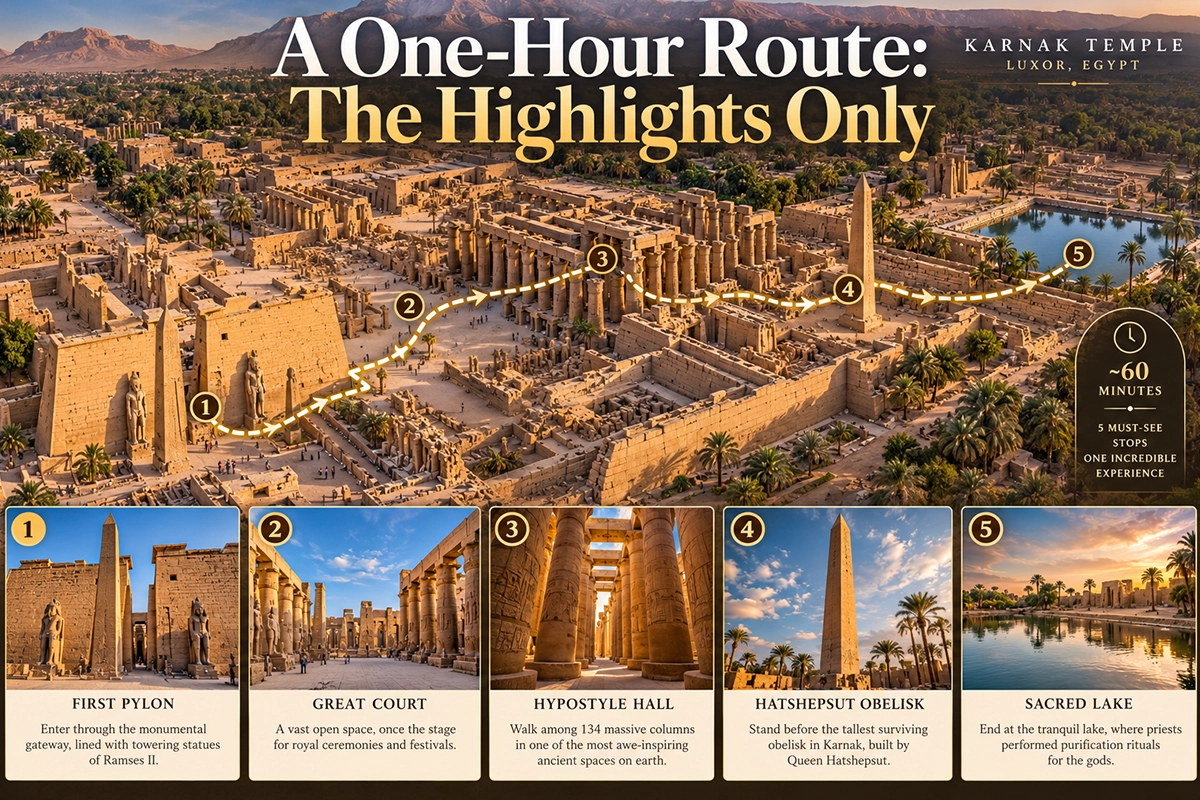
If you only have one hour, perhaps between a Nile River cruise stop and a flight, focus on the core of the temple.
- First Pylon and the Avenue of Ram-Headed Sphinxes (10 minutes): the giant unfinished gateway and the rams that guard it.
- Great Hypostyle Hall (25 minutes): 134 sandstone columns, the 12 central ones about 21 meters tall. Built by Seti I and decorated by Ramses II, it is the one place you must not rush.
- The obelisks (15 minutes): the standing obelisk of Thutmose I and the obelisk of Queen Hatshepsut, almost 30 meters tall and carved from a single piece of granite from the same Aswan quarries as the Unfinished Obelisk.
- Return to the exit (10 minutes).
A Two to Three-Hour Route: The Classic Visit
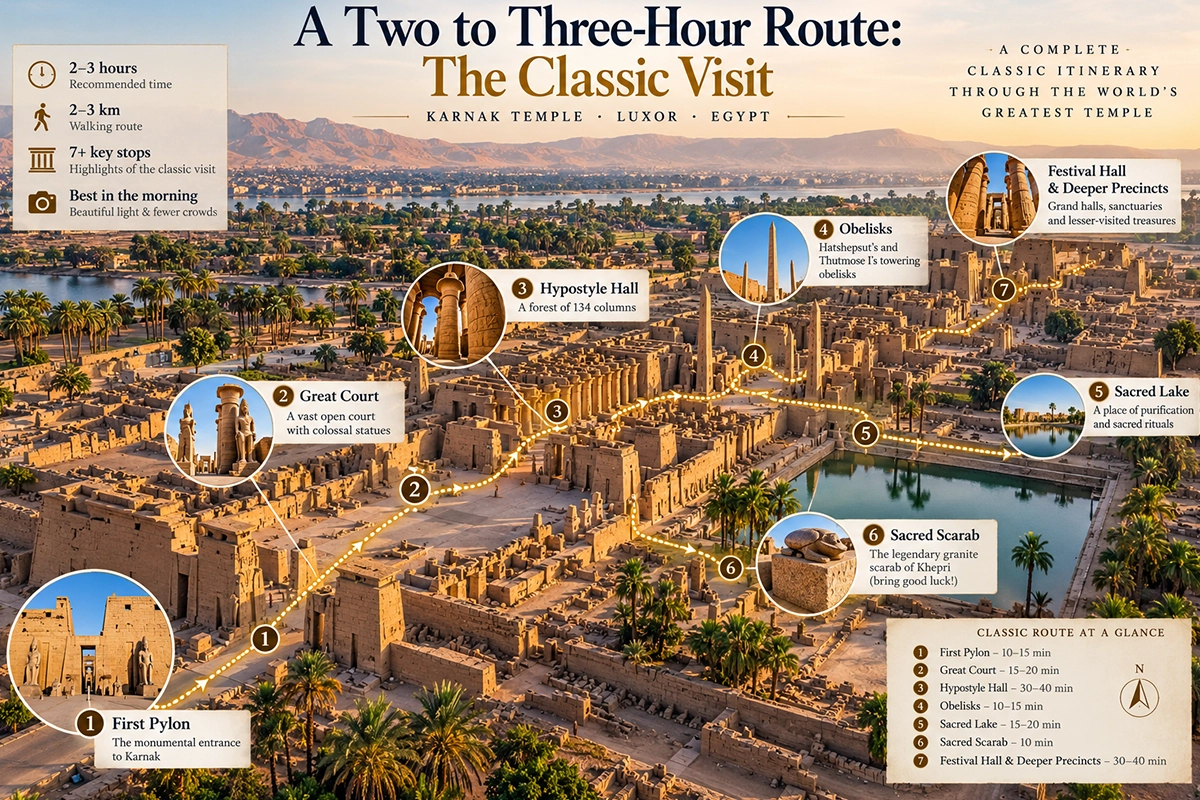
This is the route most of our guests follow, and it answers the question of Karnak Temple time needed for a typical first visit.
- First Pylon and Great Court (20 minutes): see the Temple of Ramesses III, a complete small temple inside the court, and the single standing column of the Kiosk of Taharqa.
- Great Hypostyle Hall (30 to 40 minutes): walk the central aisle, then the side aisles, and look up at the painted capitals and clerestory windows.
- Obelisks of Thutmose I and Hatshepsut (15 minutes).
- Sanctuary of the sacred boat (15 minutes): the granite shrine built for Philip Arrhidaeus, half-brother of Alexander the Great, on the site of the ancient sanctuary.
- Sacred Lake and the Scarab of Amenhotep III (20 minutes): the lake where priests purified themselves, and the granite scarab that visitors walk around for luck, a modern custom rather than an ancient one.
- The Seventh to Tenth Pylons (20 minutes, if open): the southern axis toward the Precinct of Mut.
- Rest and photos (15 to 20 minutes).
On the way south, you pass the court in front of the Seventh Pylon, where the Karnak Cachette of hundreds of buried statues was discovered in 1903.
A Half-Day Route: For History Lovers and Photographers
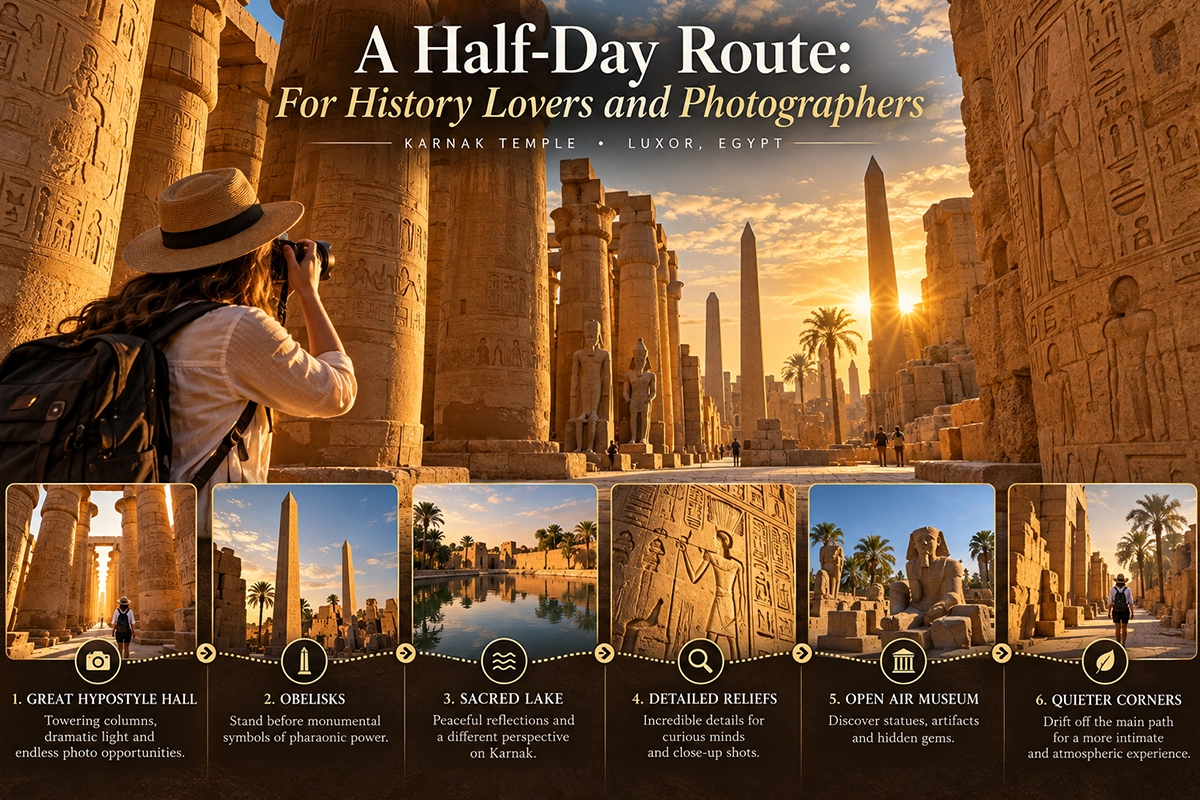
With four hours or more, add the quieter corners that most groups miss.
- Festival Hall of Thutmose III (Akh-menu): famous for its columns shaped like tent poles and the "Botanical Garden," a room carved with foreign plants and animals.
- Temple of Khonsu: in the southwest corner, a well-preserved temple to the moon god, son of Amun and Mut.
- Open Air Museum: the reassembled White Chapel of Senusret I and the Red Chapel of Hatshepsut, among the finest reliefs in Egypt.
- The outer walls of the Hypostyle Hall: the battle reliefs of Seti I on the north wall and Ramses II on the south.
Our article on the Temple of Amun describes each part of the precinct in more detail.
The Best Time to Visit Karnak Temple

Time of day: arrive at 6:00 am. For the first hour, the temple is quiet, the air is cool and the low sun lights the columns from the side. Large tour groups usually arrive from about 8:30 am. Early afternoon can be calmer in winter, but avoid midday in summer, when the stone radiates heat.
Season: October to April is the most comfortable period, with daytime temperatures of about 20°C to 28°C. See our guide to the best time to visit Luxor.
Special days: around the winter solstice in late December, the rising sun aligns with the main east-west axis of the temple, and early visitors gather to watch it.
A Sunrise Visit, Hour by Hour
| Time | Plan |
|---|---|
| 5:30 am | Hotel pickup on the East Bank |
| 6:00 am | Enter as the gates open; walk to the eastern end for sunrise |
| 6:30 am | Hypostyle Hall in soft, empty light |
| 7:30 am | Obelisks, sanctuary and Sacred Lake |
| 8:30 am | Leave as the first large groups arrive |
How to Combine Karnak With Other Luxor Sites

Karnak rarely stands alone among the Luxor tourist attractions in an itinerary. These are the combinations we plan most often.
Karnak and Luxor Temple (4 to 5 hours): visit Karnak in the morning and Luxor Temple in the late afternoon, when it is lit up after dark. The 2.7 km Avenue of Sphinxes links the two temples, but walking it in the heat is not advised.
A full East Bank day: Karnak at sunrise, the Luxor Museum in the late morning, a rest at your hotel, then Luxor Temple at sunset.
East and West Bank in one day (8 to 9 hours): pair a two-hour visit to Karnak with the Valley of the Kings, the Temple of Hatshepsut and the Colossi of Memnon. Seeing Hatshepsut's temple first adds meaning to her obelisk at Karnak.
Sunrise from the sky: start the day with a Luxor hot air balloon ride, then visit Karnak once you land.
For more ideas, read Luxor in 48 hours and our list of things to do in Luxor.
Is the Karnak Sound and Light Show Worth the Time?

Yes, as an evening extra. The Karnak Temple Sound and Light Show lasts about an hour, beginning with a walk through the lit pylons and Hypostyle Hall and ending with seats beside the Sacred Lake. Shows run in different languages on different nights. It does not replace a daytime visit, because you see only part of the complex. Our guide to things to do in Luxor at night has more evening ideas.
Practical Tips to Make the Most of Your Time
- Wear closed walking shoes; the ground is uneven and dusty.
- Bring a hat, sunscreen and at least one liter of water per person, as shade is scarce outside the Hypostyle Hall.
- There are restrooms near the entrance and a small café at the visitor center.
- Carry small notes for restrooms and tips; see our guide to tipping in Egypt.
- Pack light layers for a winter sunrise; our guide on what to pack for an Egypt vacation helps.
See Karnak at the Right Pace With Trips In Egypt
Karnak rewards those who give it time, and the morning light between its columns is a memory that lasts long after the trip. With the right plan, two or three hours are enough to understand this golden house of Amun.
Our Day Trip to Luxor East Bank covers Karnak and Luxor Temple with a professional Egyptologist guide and private air-conditioned transport. You can also browse all our Luxor day tours, explore our Egypt tour packages, or let us plan your days in Luxor with our tailor-made tours. Book with us as soon as possible or contact our operation department today.