



Hero of Alexandria was an engineer, mathematician and inventor who worked in Alexandria about 2,000 years ago, and who described machines that would not be seen again until the modern age. His books include a spinning steam engine, a coin-operated vending machine, a robot cart that followed a programmed route, temple doors that opened by themselves, and jugs that poured water or wine at the touch of a finger. Reading them today feels like opening a sketchbook from the future, written by hand in the golden city of the Ptolemies.
This guide explains who Hero was, when and where he lived, how his most famous inventions worked, what he gave to mathematics, and why his steam engine never started an industrial revolution. Here are all things you need to know about Hero of Alexandria:

Discover Hero of Alexandria's Name, Birth and Death
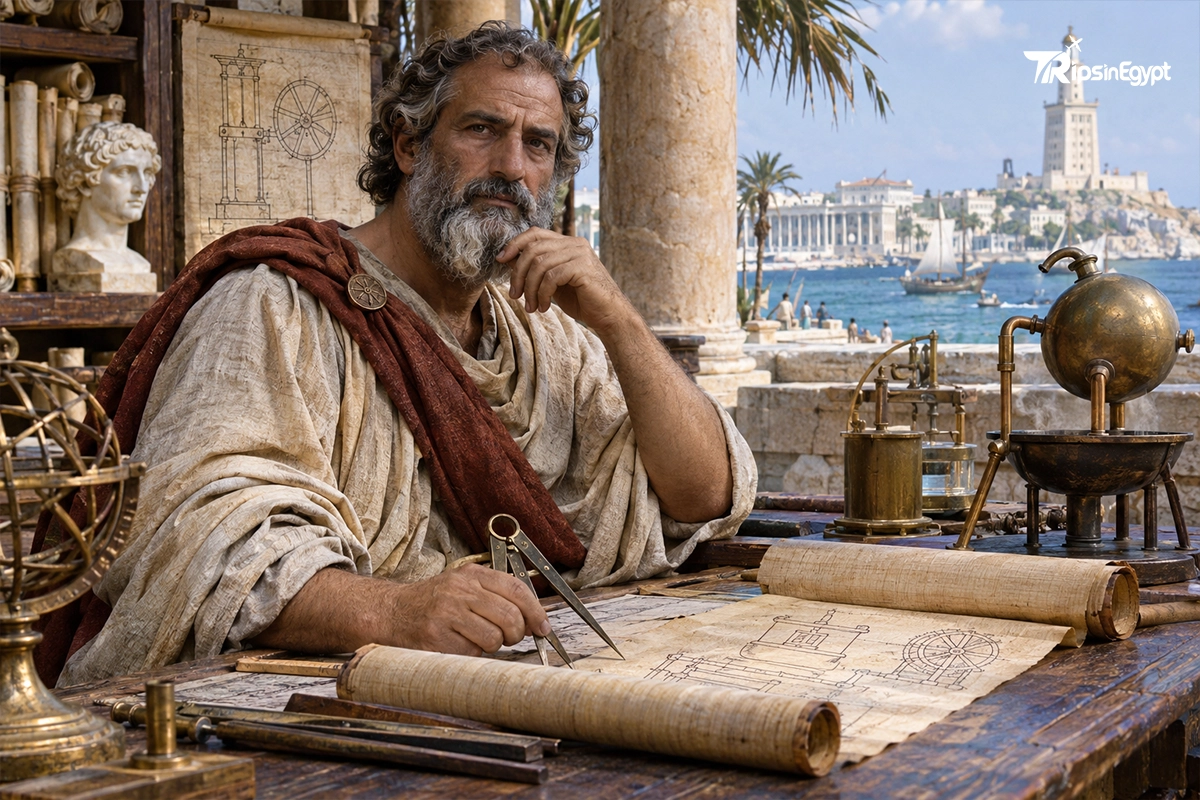
Hero of Alexandria real name. In Greek, his name was Hērōn (Ἥρων), and he is often called Heron of Alexandria in English. "Hero" is simply the Latin form of the same name, so both are correct, and no other personal name for him is known. Later writers sometimes called him Mechanicus, "the machinist."
Where was Hero of Alexandria born? He is always linked to Alexandria, then the capital of Roman Egypt, and most reference works list it as his birthplace. In truth, almost nothing is known about his family or background. The historian Carl Boyer suggested Greek and Parthian influences in his work, but there is no firm evidence about his origins.
Hero of Alexandria birth and death. No ancient source records the dates. The best clue is in his book Dioptra, where he describes a lunar eclipse seen "in Alexandria in the 5th hour of the night" and two hours earlier in Rome. In 1938, the historian Otto Neugebauer matched it to the eclipse of AD 62. Scholars once placed Hero anywhere from 150 BC to AD 250, but most now agree he flourished in the 1st century AD.
When Hero of Alexandria died is unknown. A common estimate puts his birth around AD 10 to 20 and his death between AD 70 and 100, though some writers simply say he lived "around AD 60."
| Hero of Alexandria facts | Details |
|---|---|
| Name | Hērōn of Alexandria, also Heron or Hero |
| Lived | Probably 1st century AD, active around AD 62 |
| Place | Alexandria, Roman Egypt |
| Fields | Mechanics, pneumatics, mathematics, optics, surveying |
| Main works | Pneumatica, Automata, Mechanica, Metrica, Dioptra |
| Best-known inventions | Aeolipile, holy water vending machine, automata |
Hero's Alexandria: A City Built for Engineers
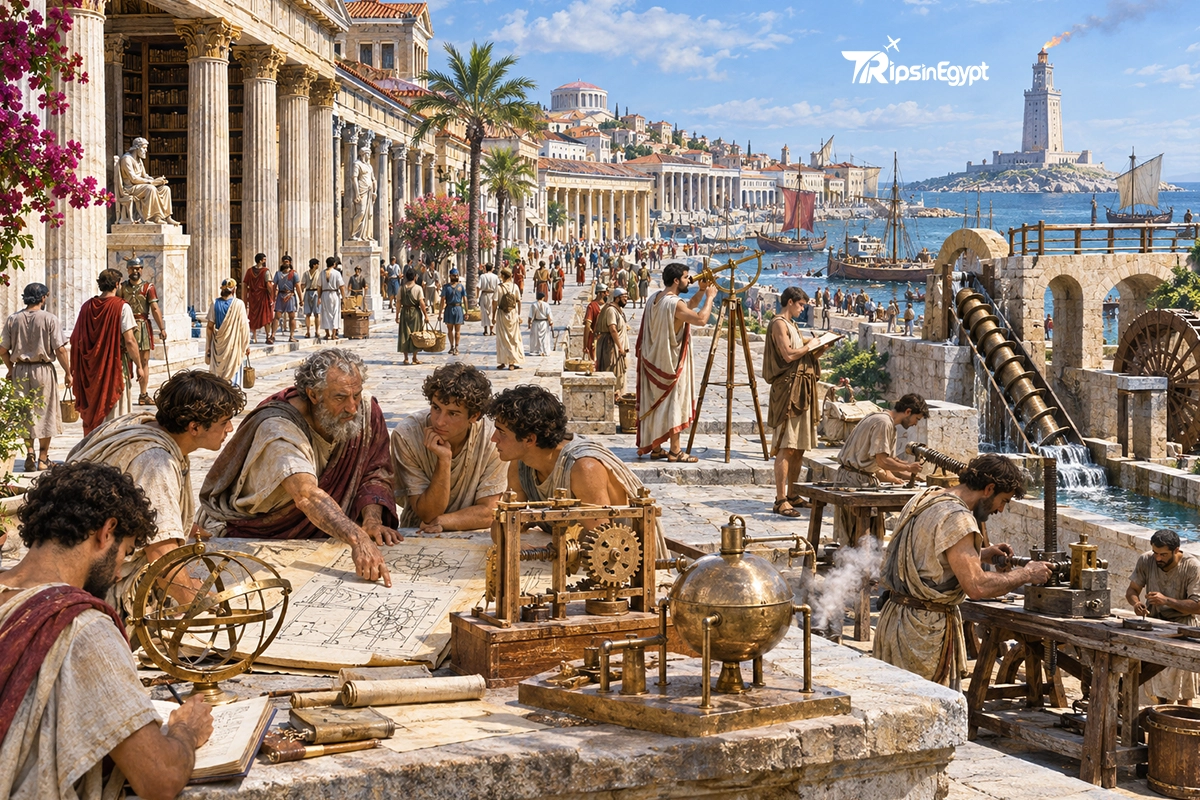
Hero worked in a city that had been a capital of science for more than three centuries. Founded by Alexander the Great in 332 BC, Alexandria was home to the Mouseion, a royal research institute that included the famous Library of Alexandria. His books read like lecture notes for students, so many historians believe he taught there.
He followed a long Alexandrian tradition of engineering. In the 3rd century BC, Ctesibius invented the force pump and the water organ in the same city, and Philo of Byzantium wrote on pneumatics and siege machines. Hero openly built on their work, collecting, improving and explaining their devices.
The city itself was a showcase of engineering. The great Lighthouse rose on the island of Pharos, beside today's Citadel of Qaitbay, and the temple of Serapis stood on the hill now crowned by Pompey's Pillar. Behind it all stood an older Egyptian tradition of building in stone, from the ancient Egyptian inventions of the pharaohs to the methods used in how the pyramids were built.
Hero of Alexandria Steam Engine: The Aeolipile
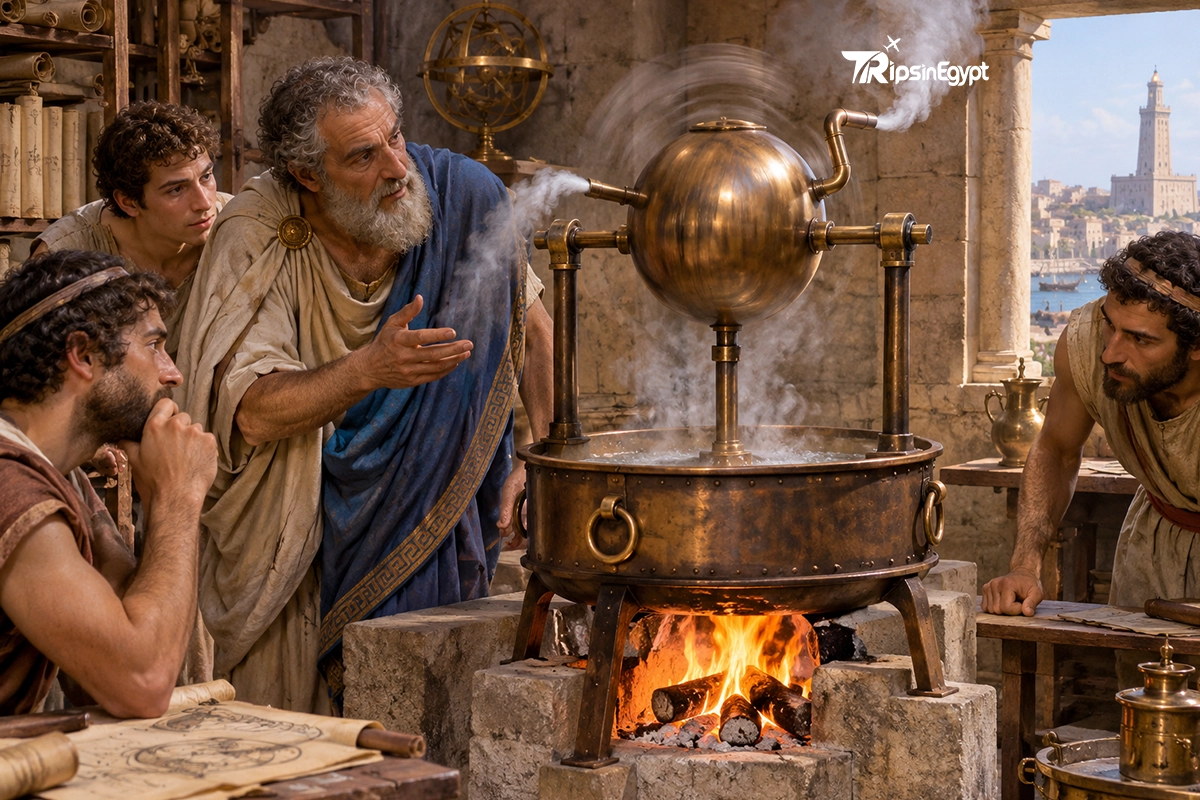
Hero's most famous machine is the aeolipile, or "ball of Aeolus," named after the Greek god of the winds. It is the first recorded steam engine in history.
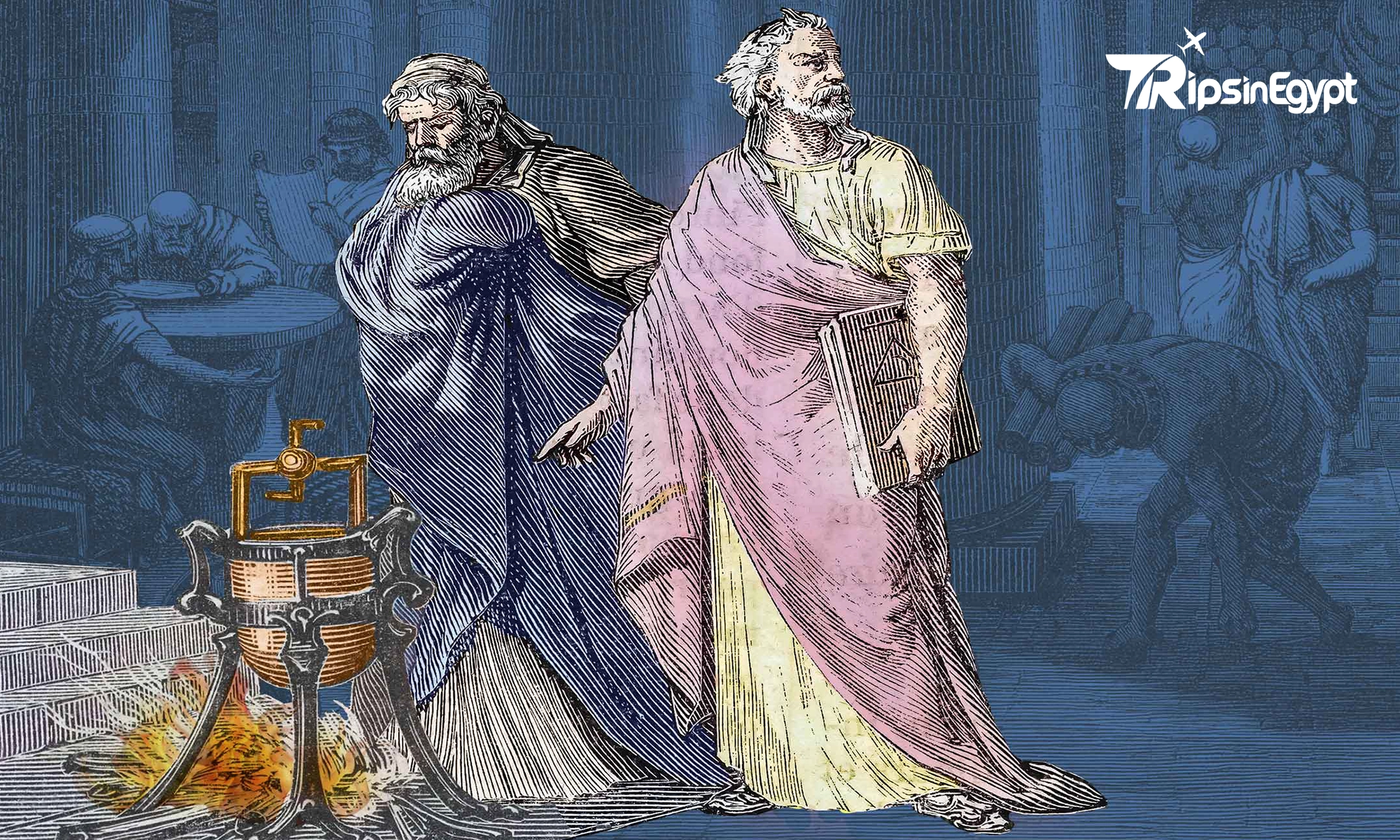
The design was simple. Water was heated in a sealed cauldron, and the steam rose through two hollow pipes into a metal sphere that could turn freely between them. Two bent nozzles stuck out from opposite sides of the sphere. As steam rushed out of the nozzles, it pushed the sphere around, spinning it at high speed. This is the same principle of reaction used by modern jet engines and rockets.
The aeolipile, however, did no useful work. As the Linda Hall Library's historian put it, it "just spins and pleases." Hero presented it as a wonder, not a labor-saving machine. Historians suggest several reasons why no one developed it further: cheap slave labor, the lack of precise metalworking to build strong boilers, and a culture that valued engineering more for spectacle than for industry.
A similar idea appears in his temple doors. When a priest lit a fire on the altar, the heated air in a hidden chamber pushed water into a bucket. The bucket grew heavy and pulled ropes that swung the doors open, revealing the statue of the god, much as priests had staged the appearance of the ancient Egyptian gods and goddesses in temples such as Karnak for centuries. When the fire went out, the process reversed and the doors closed again. To worshippers, it looked like a miracle, and it was in fact one of the earliest heat engines.
Hero of Alexandria Robot and Automation
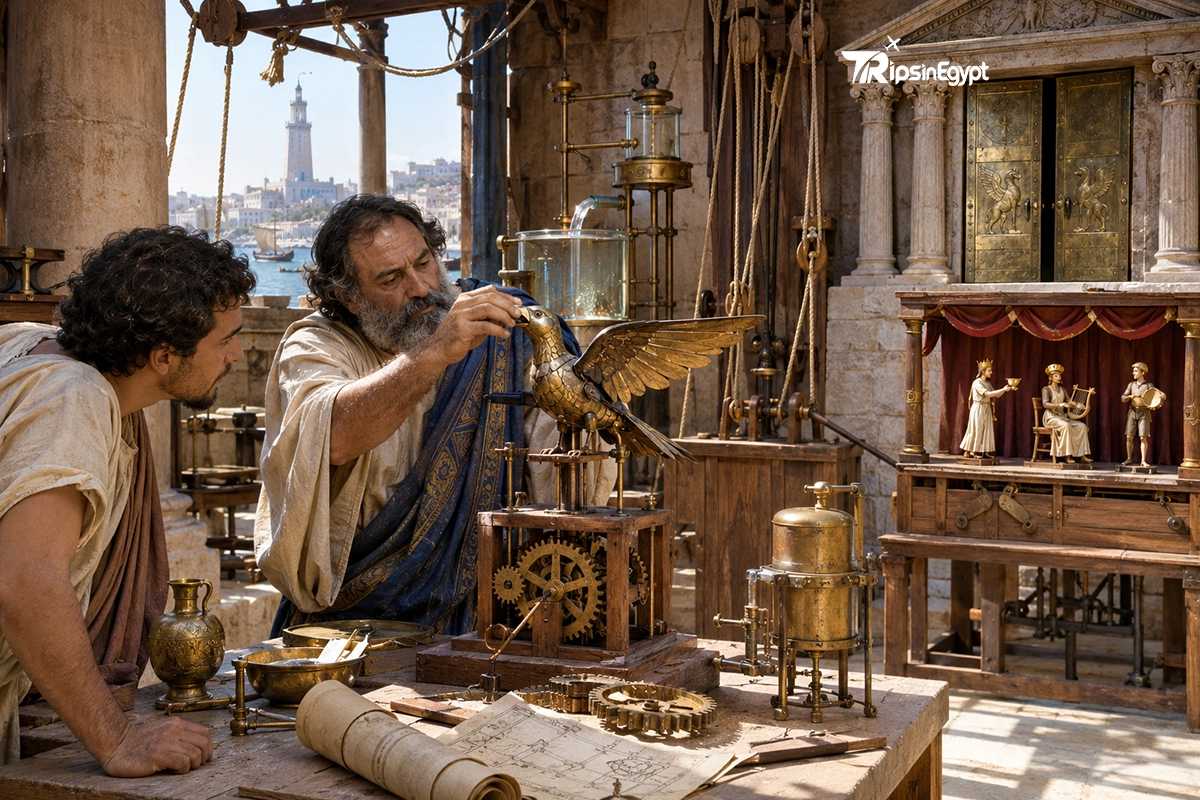
Hero wrote a whole book, Automata, about machines that moved by themselves. These devices are why he is often called the father of robotics.
The programmable cart. One of his machines was a small cart that could move forward, stop, turn and move again with no one touching it. Its power came from a falling weight inside a tube, attached to a string wrapped around the axle. By winding the string in different directions and around pegs, Hero could set the path in advance. Many engineers consider it the first programmable machine, and some compare its string program to simple computer code.
The mechanical theater. Hero built a self-running puppet theater that performed a play of almost ten minutes. A system of ropes, knots and rotating drums moved the figures, opened and closed doors, and changed the scenery. For the sound of thunder, metal balls dropped onto a hidden drum at the right moment.
Singing birds and moving statues. Using running water and air, Hero made bronze birds that whistled and turned on their perches, and figures that seemed to pour wine or play pipes.
These machines were built for temples, theaters and banquets, to amaze audiences. Yet the ideas behind them, stored programs and self-regulating systems, are the foundations of modern automation.
The Vending Machine and Other Hero of Alexandria Inventions
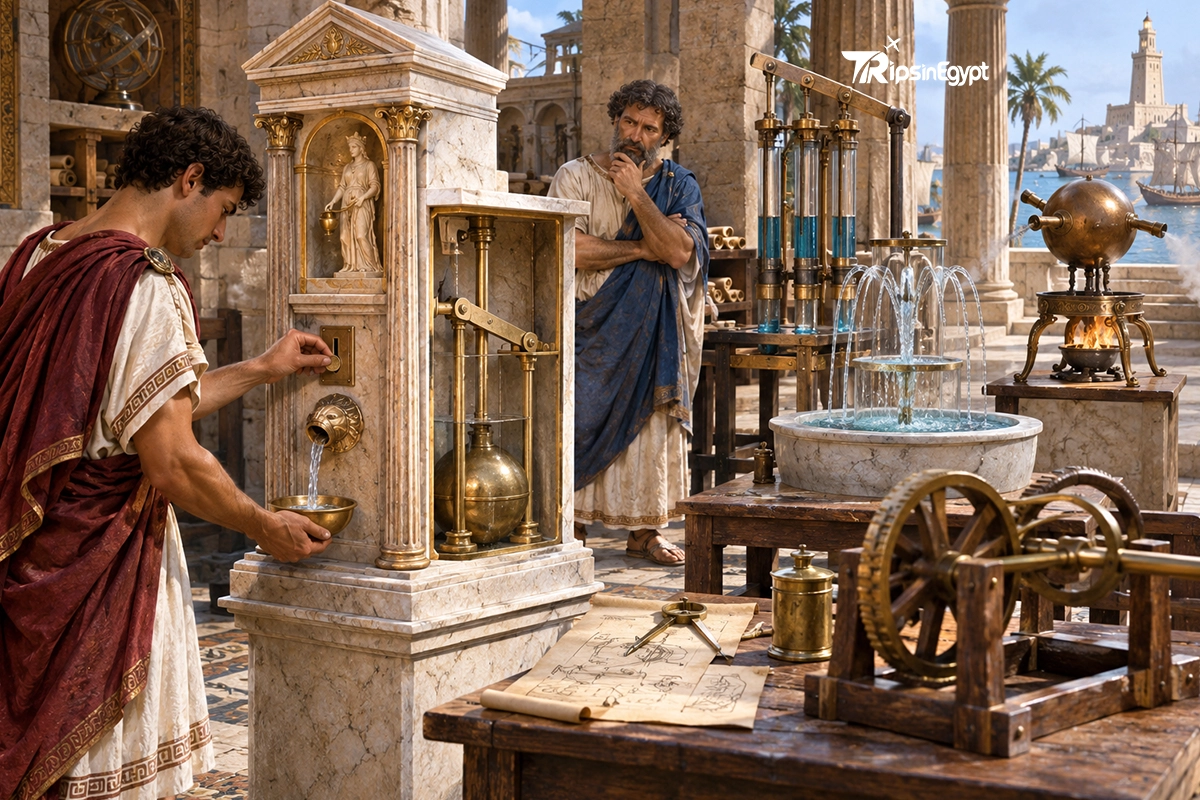
Hero of Alexandria vending machine. In one of his books, Hero described a machine that dispensed holy water in temples. A worshipper dropped a coin through a slot at the top. The coin fell onto a small pan at the end of a lever. Its weight tipped the lever, opening a valve, and water flowed out. As the pan tilted, the coin slid off, a counterweight pulled the lever back, and the valve shut. The result was a fixed amount of water for each coin, making it the first known vending machine.
The magical jugs. Hero also designed trick jugs for entertainment. Inside, hidden compartments, siphons and tiny air holes let the person pouring control what came out. By covering or uncovering a hole with a finger, he could make the same jug pour water, then wine, then a mixture. In Hero's words, it would "discharge at one time pure water, at another time unmixed wine."
Many of his other inventions were just as clever:
| Invention | How it worked | Modern relative |
|---|---|---|
| Wind-powered organ | A windmill drove a pump that pushed air through organ pipes | Wind turbine |
| Force pump | Two pistons pushed water through a nozzle, used in a fire engine | Fire hose |
| Hero's fountain | Air and water pressure made water rise above its source | Hydraulic systems |
| Dioptra | A sighting instrument for measuring angles and heights | Theodolite |
| Odometer | Gears dropped a pebble into a box after a set distance | Car odometer |
| Self-filling bowl | A float valve kept wine at the same level | Toilet cistern valve |
The wind organ is especially important. It is the first known machine to harness wind power on land.
Hero the Mathematician and His Legacy
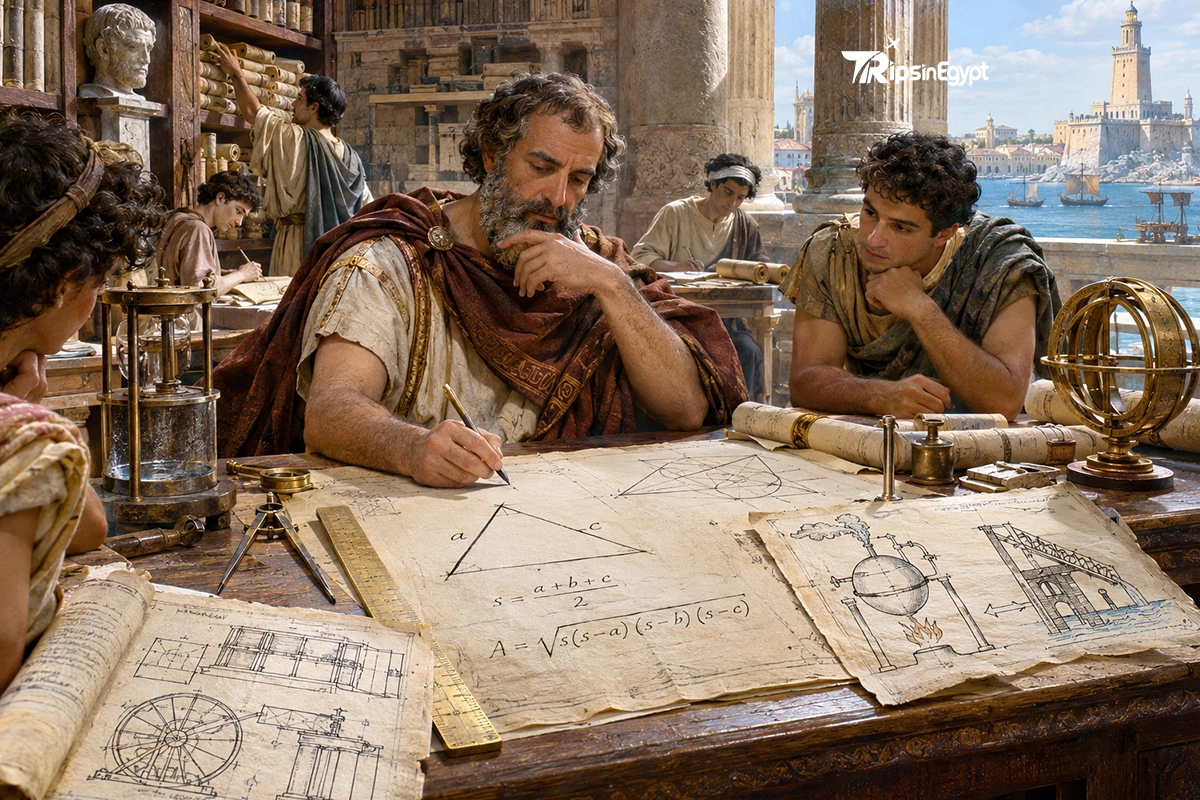
Hero was also an accomplished mathematician. In his book Metrica, he explained how to calculate areas and volumes, including Heron's formula, which finds the area of a triangle using only the lengths of its three sides. He also gave Heron's method, a step-by-step way of finding square roots that computers still use in modern forms.
In optics, he showed that light reflected from a mirror always takes the shortest path, an idea later developed by Ibn al-Haytham and by Pierre de Fermat in 1662.
His books. Hero's main works are Pneumatica (machines run by air, water and steam), Automata, Mechanica (lifting heavy loads, surviving in Arabic), Metrica, Dioptra, Belopoeica (war machines) and Catoptrica (mirrors). Many survived in Byzantine copies and were translated into Latin in 16th century Italy. Federico Commandino's Latin edition of Pneumatica in 1575 inspired engineers across Europe, and an English edition appeared in 1851.
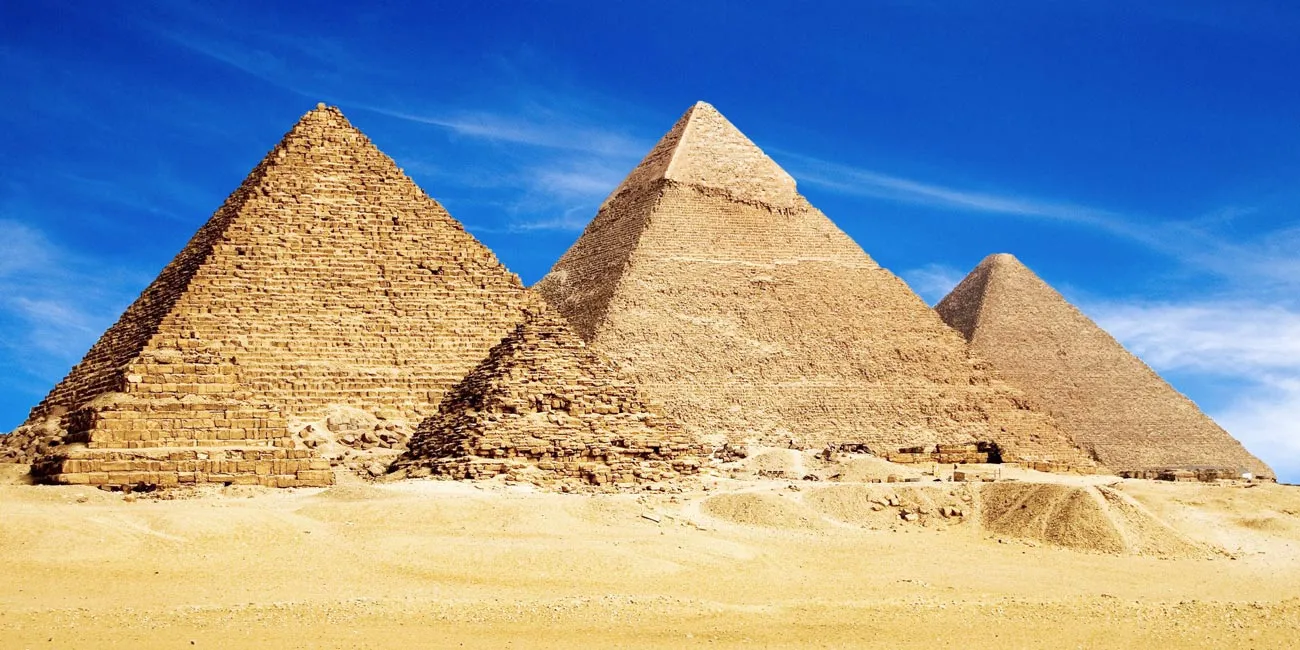
Where to explore ancient engineering in Egypt. Little of Hero's city survives, but you can stand at the site of the Pharos and the Serapeum, and visit the modern Bibliotheca Alexandrina, which houses museums of science and manuscripts. In Cairo, the Grand Egyptian Museum and the Great Pyramid of Giza show the skill of earlier Egyptian builders, while the Unfinished Obelisk in Aswan reveals how granite giants were cut. For modern feats, see the Aswan High Dam and the relocation of Abu Simbel. More collections are listed in our guide to the museums of Egypt. Plan your visit with our Alexandria travel guide, our list of Alexandria tourist attractions and the best things to do in Alexandria.
Discover the Genius of Alexandria With Trips In Egypt
The city that gave the world Hero's machines still hums with the memory of its scholars, from the harbor of the Pharos to the halls of its modern library. Explore it with our expert guides on our day tour to Alexandria from Cairo, our Alexandria city tour from Alexandria Port, or our 4 days Cairo and Alexandria holiday, which also takes in the wonders of the capital. Witness all our Egypt trip packages or design your own adventure with our tailor-made tours.

5 Days Cairo And Hurghada Trip
Amazing 4 Nights Cairo and Hurghada Trip Itinerary 5 Days Cairo and Hurghada trip wil...
- Duration 5 Days / 4 Nights
- Location Cairo & Hurghada
- Type Historical & Recreational Tour
From$690/per person
View Tour
6 Days Cairo, Alexandria & Faiyum Tour
Unforgettable Cairo, Alexandria & Faiyum Adventure in Six Days 6 Days Cairo, Alex...
- Duration 6 Days / 5 Nights
- Location Cairo - Alexandria - Fayum
- Type Historical Tour
From$720/per person
View Tour
10 Days Cairo, Faiyum & Nile Cruise Holiday
Breathtaking 10 Days Journey of A Lifetime in Egypt 10 Days Cairo, Faiyum & Nile...
- Duration 10 Days / 9 Nights
- Location Cairo, Luxor, Aswan & Faiyum
- Type Classic Tour
From$1350/per person
View Tour SOLD OUT
Ultimate 7-Day Egypt Solar Eclipse Experience with Hurghada 2027
Enjoy a 7-Day Egypt Solar Eclipse Tour with Hurghada 2027 6 Nights Egypt Solar Ecli...
- Duration 7 Days / 6 Nights
- Location Cairo / Giza / Luxor / Hurghada
- Type Astronomical Tour
Sold Out
View Details