



Hypatia of Alexandria was a mathematician, astronomer and philosopher who taught in the greatest city of Roman Egypt, and whose murder in 415 AD became one of the most famous events of antiquity. She edited the works of the great Greek scientists, advised the governor of Egypt, and walked the streets in a philosopher's cloak explaining Plato to anyone who would listen. Sixteen centuries later, her name still shines like a star over the Mediterranean shore where she lived.
This guide covers who Hypatia was, when she was born and what her name means, what she is known for, which books she worked on, how and why she died, and how her legacy has been shaped and reshaped ever since. It ends with the places in Alexandria where you can still trace her story. Here are all things you need to know about Hypatia of Alexandria:

The Identity of the Scholar Hypatia of Alexandria
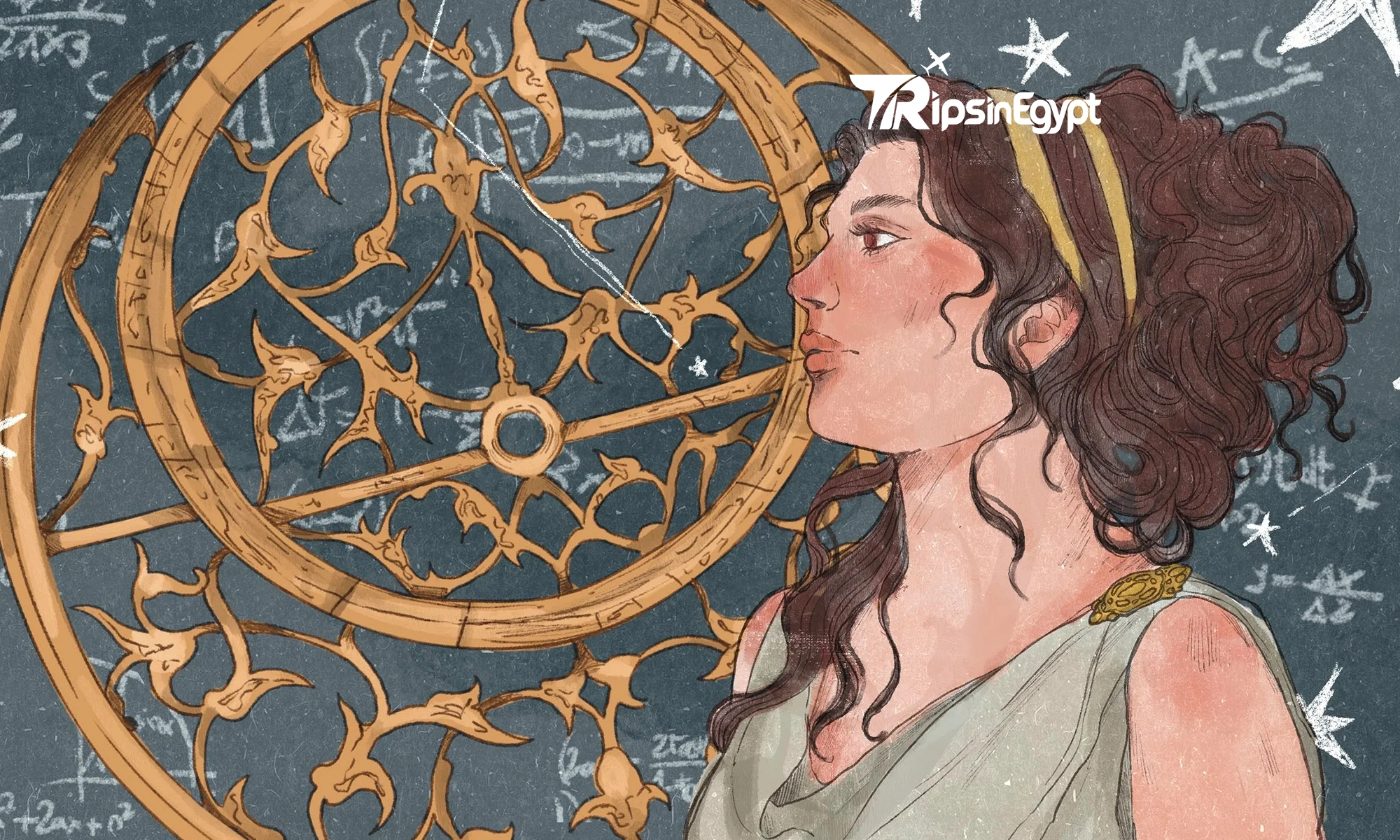
Hypatia was a Neoplatonist philosopher who also taught mathematics and astronomy. She is often called the first female mathematician whose life is reasonably well recorded, although she was not the first woman to study the subject. An earlier Alexandrian mathematician named Pandrosion is mentioned in the 4th century.
When was Hypatia of Alexandria born? No ancient source gives the year, so historians work backward from clues. Many follow the German scholar Richard Hoche, who placed her birth around 370 AD, because the later writer Damascius describes her as young and beautiful in the reign of Emperor Arcadius (395 to 408). Others prefer a date closer to 350, because the chronicler John Malalas calls her an old woman at her death. Encyclopaedia Britannica gives about 355 AD.
Hypatia meaning. The name comes from the Greek word hypatos, meaning "highest" or "supreme." Many writers have found it fitting for a woman who spent her life studying the heavens.
| Hypatia facts | Details |
|---|---|
| Born | About 350 to 370 AD, Alexandria |
| Died | March 415 AD, Alexandria |
| Father | Theon of Alexandria, mathematician |
| School | Plotinian Neoplatonism |
| Main fields | Mathematics, astronomy, philosophy |
| Best-known student | Synesius of Cyrene, later a bishop |
| Main ancient sources | Socrates Scholasticus, Damascius, John of Nikiu |
Her mother is not named in any surviving source. Ancient writers describe Hypatia as unmarried all her life, and Damascius tells the story of a student who fell in love with her and was sent away with a blunt lesson on the limits of physical desire.
Hypatia's Alexandria: Theon, the Mouseion and a Changing City
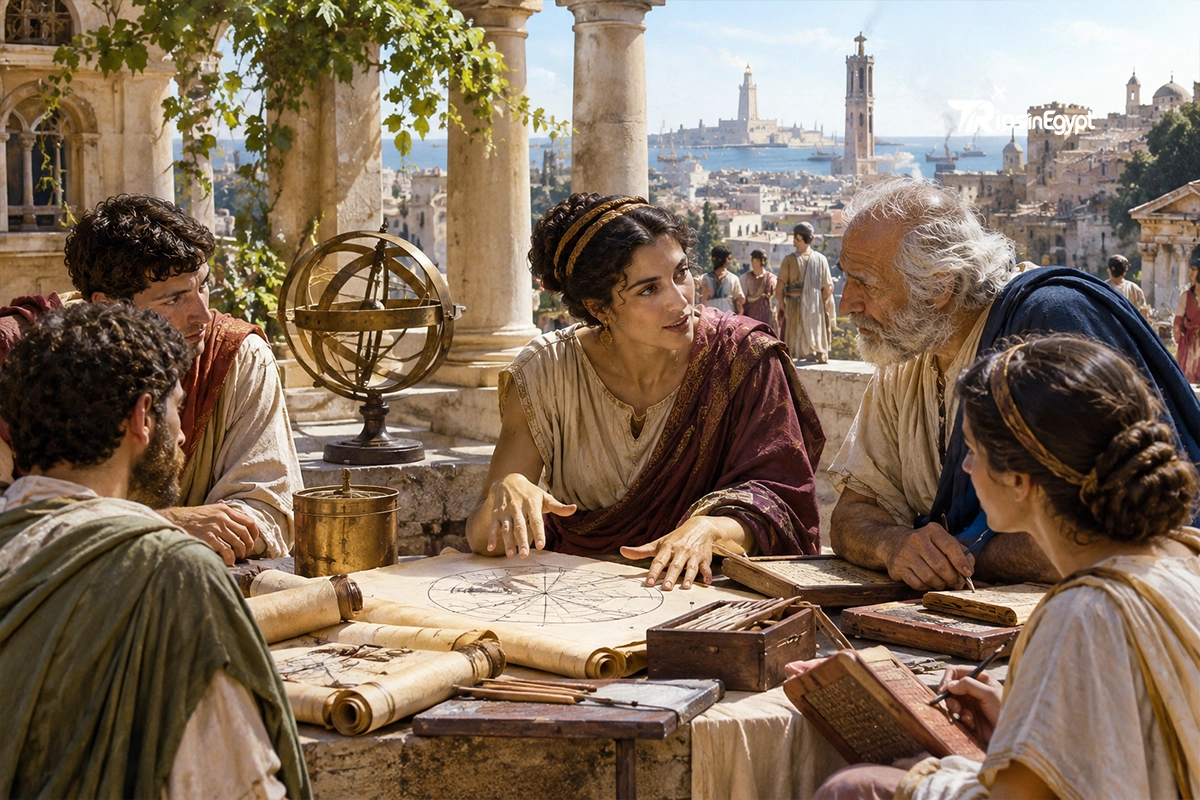
The Alexandria of Hypatia was already more than 700 years old. Founded by Alexander the Great in 332 BC, it had been the capital of the Ptolemies and of Queen Cleopatra, and was still second only to Athens as a center of philosophy.
Her father, Theon of Alexandria, was the best-known mathematician of the city. His great achievement was a new edition of Euclid's Elements, which became so popular that it almost replaced every other version and shaped how the book was read for centuries. Theon led a school that he called the Mouseion, after the famous research institute of the Ptolemies, although the original Mouseion had ceased to exist by the 260s AD.
The great Library of Alexandria, which modern historians link to the old Mouseion, no longer existed in Hypatia's lifetime, so she never worked in it and did not die defending it.
The city itself was changing fast. Christianity had become the dominant faith of the empire, and in 391 Bishop Theophilus led the destruction of the Serapeum, the great temple of Serapis, a god who blended Osiris with Greek deities (see our guide to ancient Egyptian gods and goddesses), beside what is now Pompey's Pillar. Pagan, Christian and Jewish communities lived side by side, often in tension, and the city was famous for its street riots. The story of the church in this period continues in our guide to Coptic sites in Egypt.
Hypatia Fame, Teaching and Books
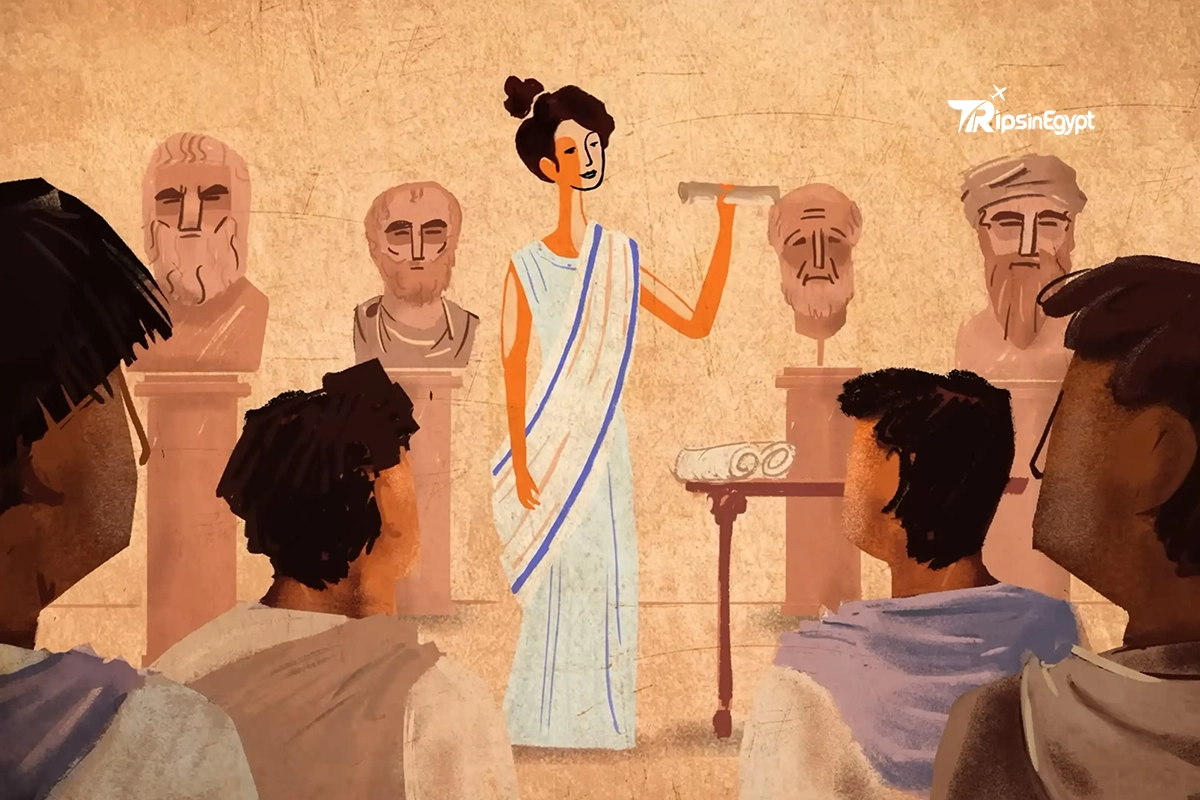
Hypatia is known above all as a teacher. She taught the philosophy of Plato and Aristotle, and the moderate form of Neoplatonism founded by Plotinus, which saw mathematics as a path toward understanding the divine order of the universe. Damascius says she wore the tribon, the rough cloak of the philosophers, and gave public lectures in the heart of the city.
Her students came from wealthy families across the eastern Mediterranean, and every one of those known by name was Christian. The most famous was Synesius of Cyrene, who later became bishop of Ptolemais in what is now eastern Libya. Seven of his letters to her survive, though none of her replies do. In one he calls her "mother, sister, teacher," and in another he asks her to help him build a hydrometer, an instrument for measuring the density of liquids. She also built astrolabes, though she did not invent either instrument.
Hypatia of Alexandria books. No complete work written by Hypatia survives under her own name, but ancient sources and modern study connect her to three major texts:
- Diophantus' Arithmetica. A commentary on this 13-volume work of algebra. Some scholars believe parts of her commentary survive, mixed into the text of Diophantus itself.
- Apollonius' Conics. A commentary on the classic study of curves such as the ellipse and parabola. It is lost.
- Ptolemy's Almagest. Theon's commentary on Book III carries a note saying it was "revised by my daughter Hypatia, the philosopher." Most scholars now think she edited the text of the Almagest itself, and she may have produced the "astronomical table" that later sources credit to her.
The overall picture is of a careful editor and gifted teacher rather than an inventor of new theories. That work helped carry Greek science to the Byzantine and Arab scholars who came after her.
The Death of Hypatia: How Old Was She When She Died?
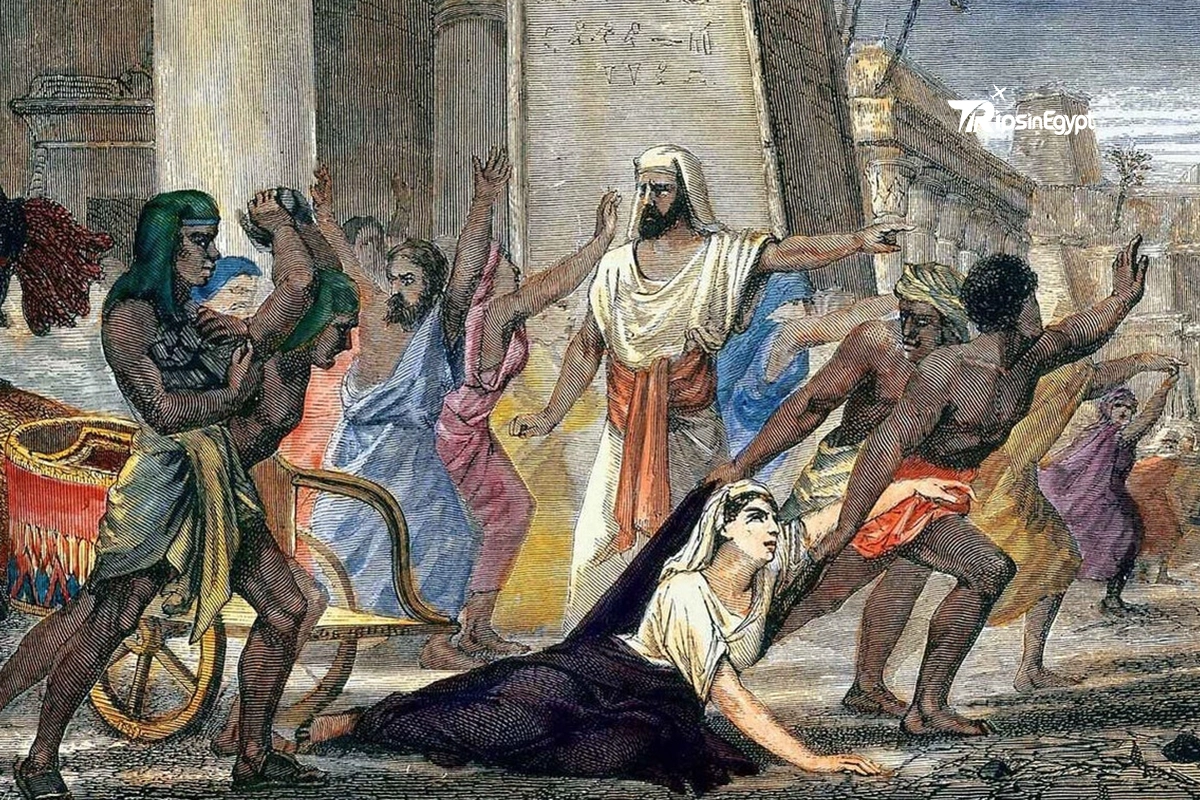
Hypatia moved in the highest circles of Alexandria. Governors and officials visited her for advice, and she was a close friend of Orestes, the Roman prefect of Egypt. That friendship placed her at the center of a deadly political struggle.
In 412, Cyril, the nephew of Theophilus, became bishop of Alexandria. He soon clashed with Orestes over who held real power in the city. After a massacre of Christians blamed on part of the Jewish community in 414, Cyril drove many Jews from the city, which outraged the prefect. Monks attacked Orestes in the street, and one of them, Ammonius, hit him with a stone and was then tortured to death on the prefect's orders.
Rumors spread that Hypatia was the one preventing peace between the two men. In March 415, during Lent, a mob led by a church reader named Peter stopped her carriage, dragged her into the Caesareum, a former temple of the emperors turned into a church, and killed her with ostraka, roof tiles or pottery shards. Her body was torn apart and burned outside the city.
How old was Hypatia when she died? It depends on her birth date. If she was born around 370, she was about 45. If she was born around 350, she was about 65. Historians remain divided, so any single age you read is an estimate.
No evidence proves that Cyril ordered the killing, although many people at the time believed he was responsible. The Christian historian Socrates Scholasticus, writing a few decades later, blamed political jealousy and said the murder was "far from the spirit of Christianity." In 416, the emperors limited the parabalani, the bishop's band of attendants, to 500 men, but Cyril had the restriction lifted within two years.
Hypatia's Legacy: Saint, Martyr and Icon

Each age has rewritten Hypatia to fit its own concerns. In the Byzantine world, she was remembered with respect, and some historians think her story helped shape the legend of Saint Catherine of Alexandria, the learned young woman martyred in the same city, whose name is carried by the Monastery of Saint Catherine in Sinai. The Coptic bishop John of Nikiu, writing in the 7th century, took the opposite view and accused her of witchcraft.
During the Enlightenment, writers such as John Toland, Voltaire and Edward Gibbon made her a martyr of reason against religious fanaticism. In 1853, Charles Kingsley published the novel Hypatia, calling her one of the last of the Hellenes. In the 20th century, she became a feminist icon, and the academic journal Hypatia, devoted to feminist philosophy, was founded in her honor.
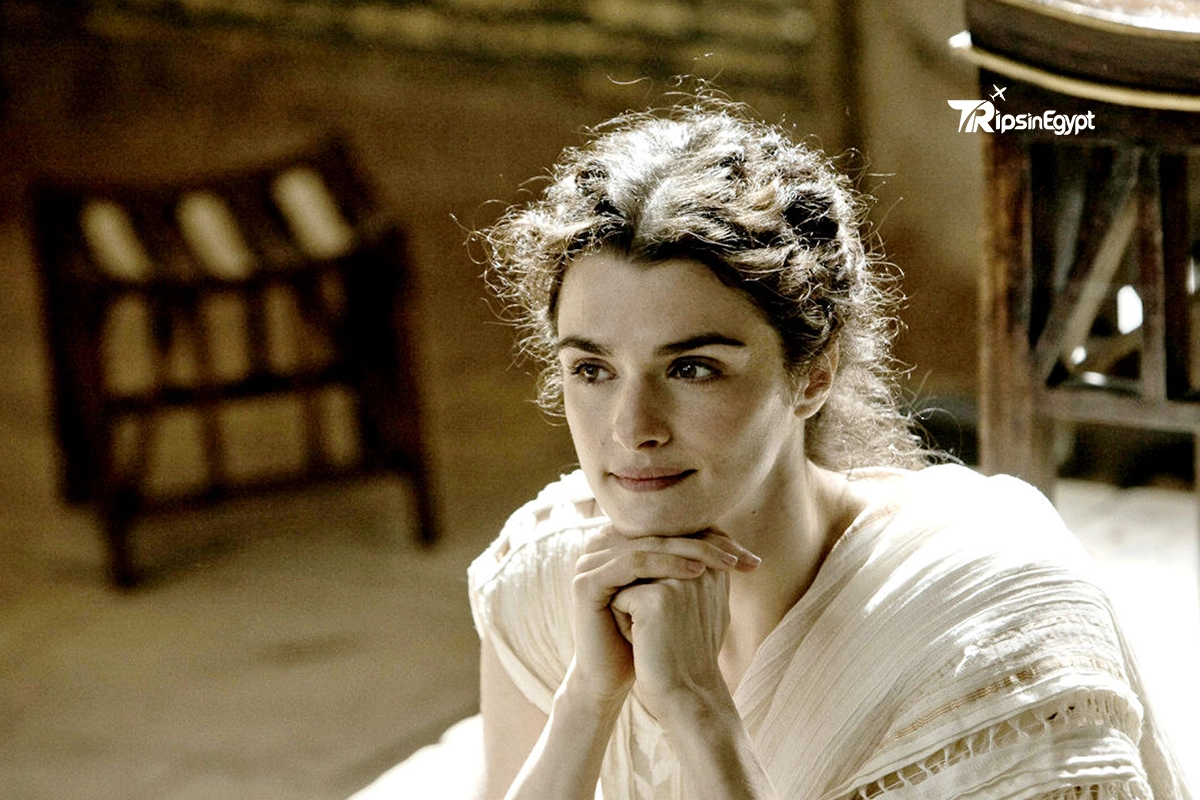
Today her name is carried by the asteroid 238 Hypatia, discovered in 1884, and by a crater on the Moon. The 2009 film Agora, starring Rachel Weisz, brought her to a global audience, though it takes many liberties with the facts. For the wider story of learned women on the Nile, see our guide to the role of women in ancient Egypt.
Following Hypatia's Footsteps in Alexandria Today
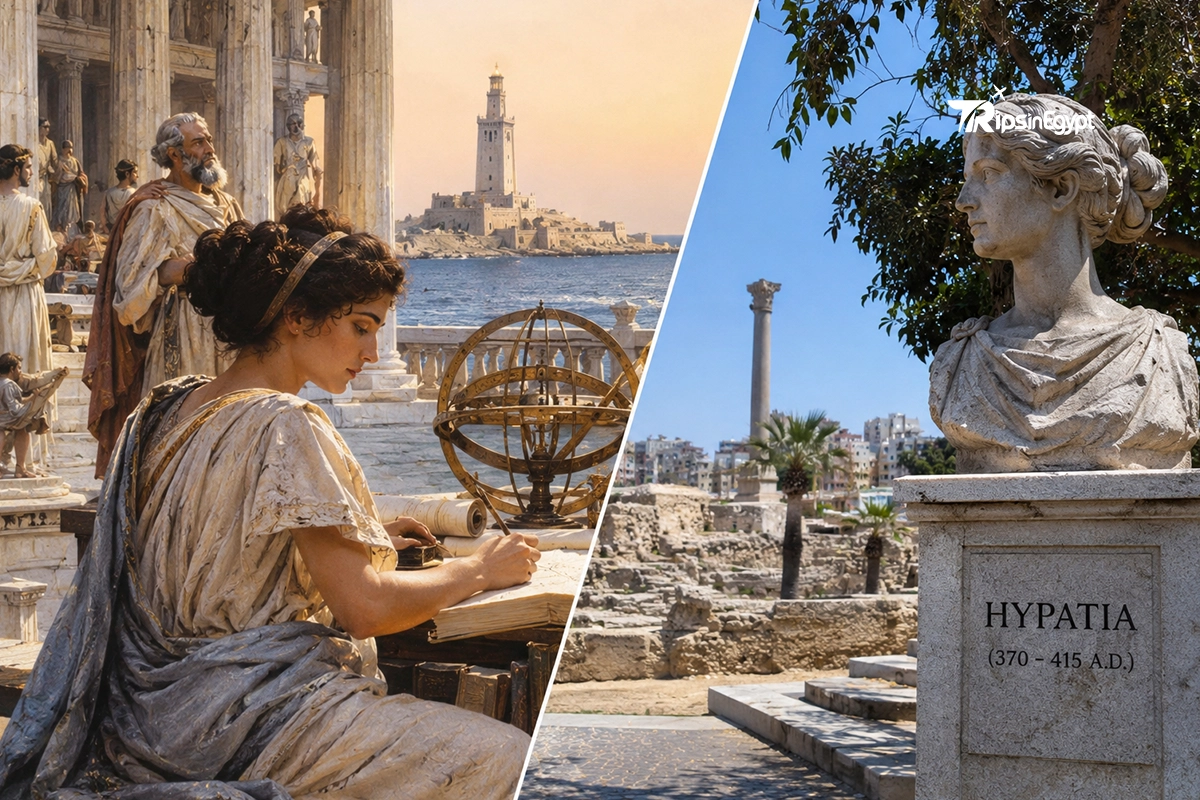
Little of Hypatia's Alexandria stands above ground, but several sites help you picture her world. Most can be seen in a single day, even on a trip from Cairo, as described in our Alexandria travel guide.
Kom el-Dikka. This excavated quarter in the center of the city holds a small Roman theater and the remains of about 20 lecture halls from the late Roman period. They are slightly later than Hypatia, but they are the clearest picture anywhere of the kind of rooms where philosophers of her tradition taught.
Pompey's Pillar and the Serapeum. The 27 m column of red Aswan granite stands on the hill of the Serapeum, whose destruction in 391 shaped the city she lived in. Nearby are the Catacombs of Kom el-Shoqafa, which blend Egyptian, Greek and Roman art.
The Caesareum site. The temple where Hypatia was killed stood near today's Raml Station, close to the seafront. Its two obelisks, known as Cleopatra's Needles, were moved to London and New York in the 19th century.
The Bibliotheca Alexandrina. Opened in 2002, the modern library honors the city's scholarly tradition with exhibitions on ancient science and manuscripts.
The Graeco-Roman Museum, reopened after restoration, holds statues, coins and objects from the city of the Ptolemies and Romans, and more collections are listed in our guide to the museums of Egypt. Add the Citadel of Qaitbay and more Alexandria tourist attractions, or browse the best things to do in Alexandria. The best time to visit Alexandria is spring or autumn, when walking between sites is most comfortable.
Walk Through Hypatia's Alexandria With Trips In Egypt
Hypatia's city still lives in the stones of Kom el-Dikka, the hill of the Serapeum and the sea breeze along the old harbor, waiting for curious travelers to hear its story. Our expert guides bring it to life, whether you join our day tour to Alexandria from Cairo, arrive by ship on our Alexandria city tour from Alexandria Port, or spend longer with our 4 days Cairo and Alexandria holiday. Explore more of the country with our Egypt tour packages, or design your own route with our tailor-made tours.

5 Days Cairo And Hurghada Trip
Amazing 4 Nights Cairo and Hurghada Trip Itinerary 5 Days Cairo and Hurghada trip wil...
- Duration 5 Days / 4 Nights
- Location Cairo & Hurghada
- Type Historical & Recreational Tour
From$690/per person
View Tour
6 Days Cairo, Alexandria & Faiyum Tour
Unforgettable Cairo, Alexandria & Faiyum Adventure in Six Days 6 Days Cairo, Alex...
- Duration 6 Days / 5 Nights
- Location Cairo - Alexandria - Fayum
- Type Historical Tour
From$720/per person
View Tour
10 Days Cairo, Faiyum & Nile Cruise Holiday
Breathtaking 10 Days Journey of A Lifetime in Egypt 10 Days Cairo, Faiyum & Nile...
- Duration 10 Days / 9 Nights
- Location Cairo, Luxor, Aswan & Faiyum
- Type Classic Tour
From$1350/per person
View Tour SOLD OUT
Ultimate 7-Day Egypt Solar Eclipse Experience with Hurghada 2027
Enjoy a 7-Day Egypt Solar Eclipse Tour with Hurghada 2027 6 Nights Egypt Solar Ecli...
- Duration 7 Days / 6 Nights
- Location Cairo / Giza / Luxor / Hurghada
- Type Astronomical Tour
Sold Out
View Details