




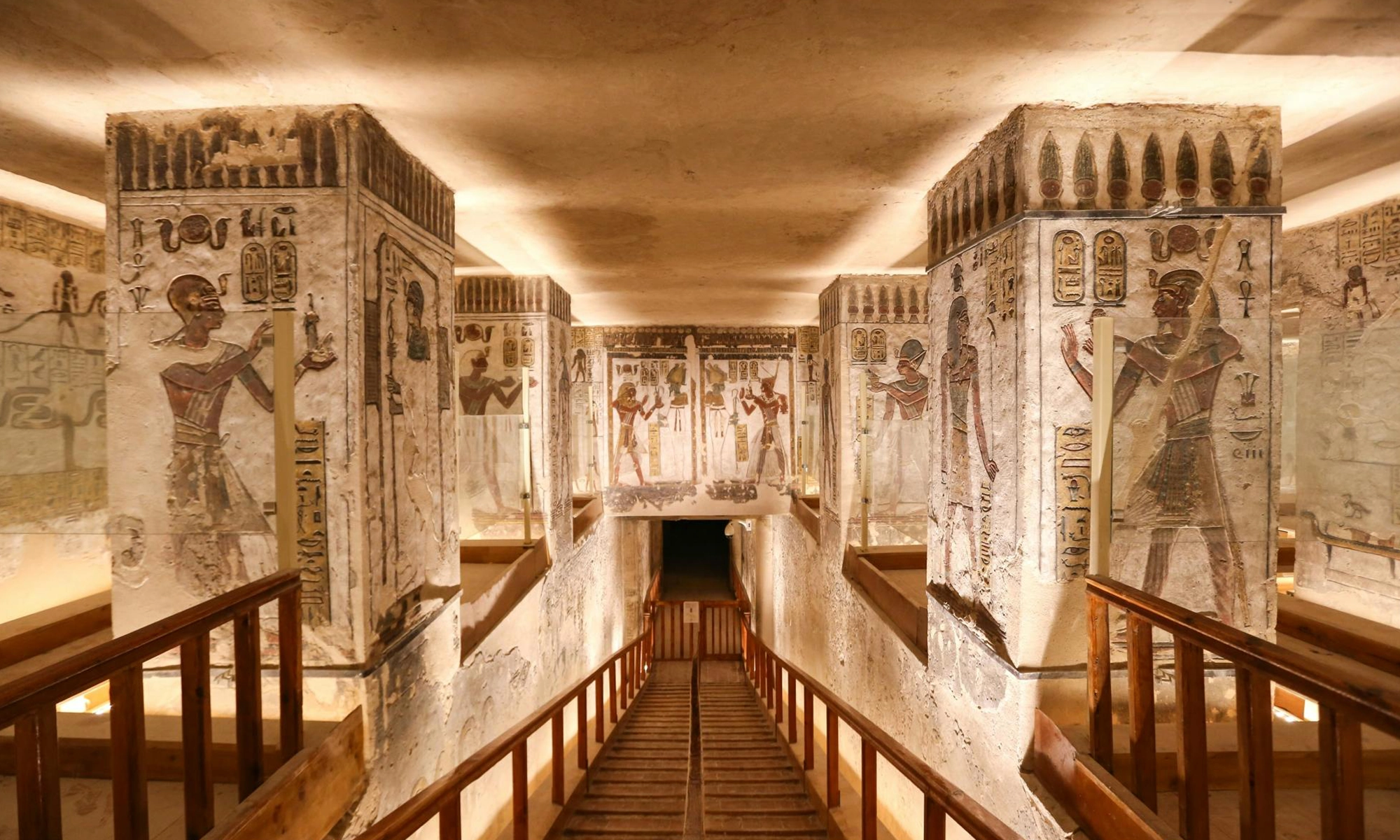
A tour to the Valley of the Kings offers a gateway to the belly of ancient Egypt, where everyone can explore the secrets, ancient sacred knowledge, treasures, and the true nature of the gods and kings who established a truly immortal civilization worthy of traveling to and discovering in the greatest detail. Hidden behind the cliffs of the West Bank of Luxor, the Valley of the Kings is where the pharaohs of the New Kingdom chose to wait for eternity, far from the eyes of robbers and under a mountain shaped like a natural pyramid.
For nearly 500 years, from about 1539 to 1075 BC, the rulers of Egypt cut their tombs deep into this dry limestone wadi, covered the walls with guides to the afterlife, and sealed them with gold. Our main Valley of the Kings article tells the full history of the site; this guide is the practical one.
Everyone will learn how many tombs there are, what you will see inside, who was buried there, what a tour costs, and how to get there from Cairo, Hurghada, and the other Red Sea resorts. Here are all the things you need to know about touring the Valley of the Kings:

How Many Tombs Are in the Valley of the Kings?
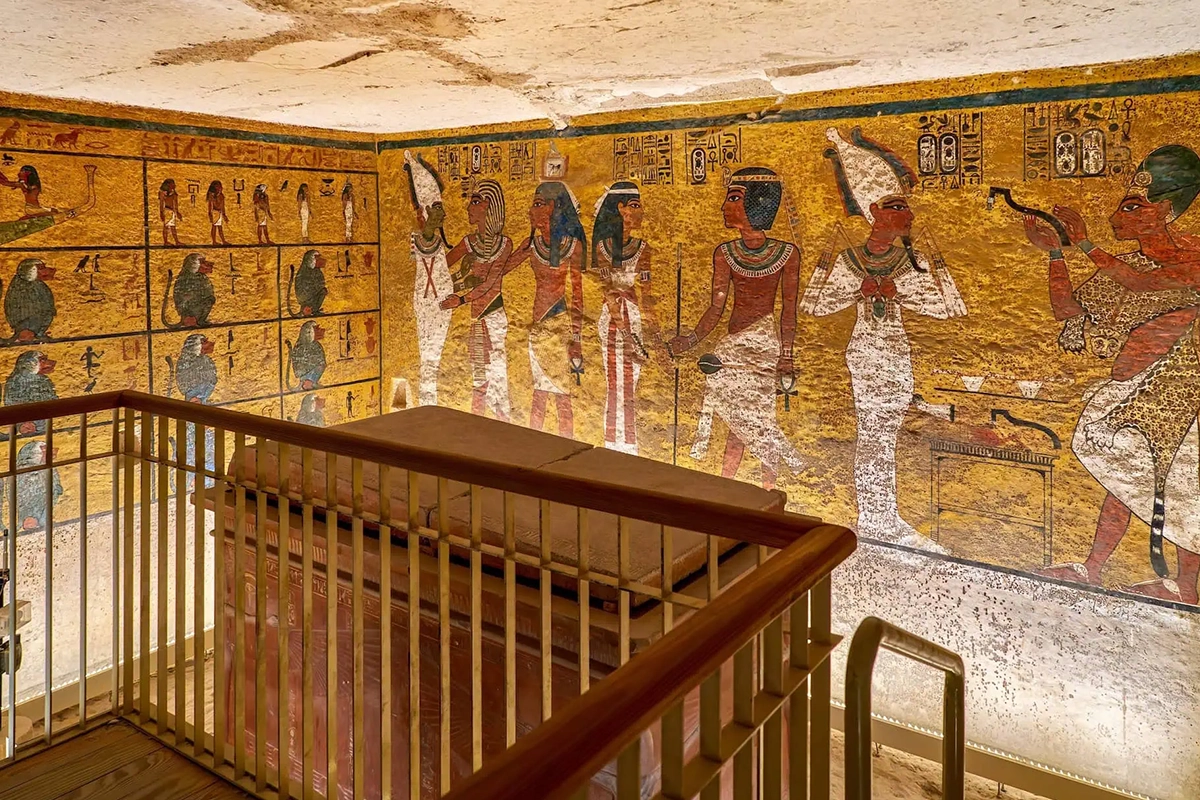
Archaeologists have numbered 65 tombs and pits in the Valley of the Kings, labeled KV1 to KV65, where "KV" simply stands for "Kings' Valley." The numbers follow the order in which each tomb was recorded, not the order in which it was built, so KV1 (Ramesses VII) is far younger than KV20 (Hatshepsut).
Not all of these are royal tombs. Fewer than half were made for kings; the rest belonged to queens, princes, high officials, and favored nobles, and several are simple pits used to store embalming material. The tombs range from KV54, a small pit, to KV5, the vast tomb of the sons of Ramses II, which has more than 120 chambers.
The valley has two branches:
- The East Valley holds almost all the tombs and is the part every tour visits.
- The West Valley (Wadi el-Gurud, the "Valley of the Monkeys") holds only a few, including WV22 of Amenhotep III and WV23 of King Ay.
New discoveries still happen. KV63, a storage chamber full of coffins and embalming jars, was found in 2005, and KV64 followed in 2011. In February 2025 a joint Egyptian-British mission announced the tomb of Thutmose II in the Western Wadis about two kilometers away, the first royal tomb found in the Theban hills since Tutankhamun's in 1922.
How Many Tombs Can You Visit?
Only about 18 tombs open to visitors at any time, and the Ministry of Tourism and Antiquities rotates them to protect the paintings from the humidity and breath of about 4,000 to 5,000 daily visitors. Your standard ticket lets you enter three of the open tombs, and you choose which three at the entrance.
Tour Inside the Valley of the Kings: What Is Inside?
Your visit begins at the visitor center, where a large model of the valley and a transparent model of Tutankhamun's tomb show how the tombs run into the rock. A small electric tram then carries you up the slope to the tomb entrances, which saves a hot walk of about 500 meters.
Inside, each royal tomb follows the same basic plan: a sloping corridor cut straight into the mountain, a series of halls and side rooms, a deep shaft meant to stop robbers and floods, and finally the burial chamber with its stone sarcophagus. Early 18th Dynasty tombs, such as that of Thutmose III, turn at a sharp angle; later Ramesside tombs run in one long straight line.
The Walls: A Map of the Afterlife
What makes the tombs unforgettable is not treasure, which robbers took in antiquity, but the painted walls. They are illustrated copies of the funerary books that guided the king through the twelve hours of the night, until he was reborn with the sun at dawn:
- The Amduat ("That Which Is in the Underworld") fills the early tombs, drawn like a stick-figure papyrus unrolled on the wall.
- The Book of Gates appears from the tomb of Horemheb onward, with a gate guarded by a serpent for every hour of the night.
- The Book of Caverns and the Book of the Earth cover the later Ramesside tombs.
- The Litany of Re praises the sun god in 75 forms, and the Book of the Heavens spreads the sky goddess Nut across the ceilings.
These texts grew from the same ideas as the Egyptian Book of the Dead, and our guide to ancient Egyptian afterlife beliefs explains the journey they describe. You will also meet many of the ancient Egyptian gods and goddesses, from Osiris and Anubis to Ra in his ram-headed night form.
The Best Tombs to See on Your Tour
Since your ticket covers three tombs, choosing well matters. These are the tombs our Egyptologist guides recommend most often, when they are open:
- KV62, Tutankhamun (extra ticket): small and plain compared with the others, but this is the tomb Howard Carter opened in November 1922, and the boy king's mummy still lies here in a climate-controlled case. Read the full Tutankhamun tomb discovery story and the life of King Tutankhamun before you go.
- KV17, Seti I (extra ticket): the longest and finest tomb in the valley, about 137 meters long, discovered by Giovanni Belzoni in 1817 and painted from top to bottom. Learn more about King Seti I.
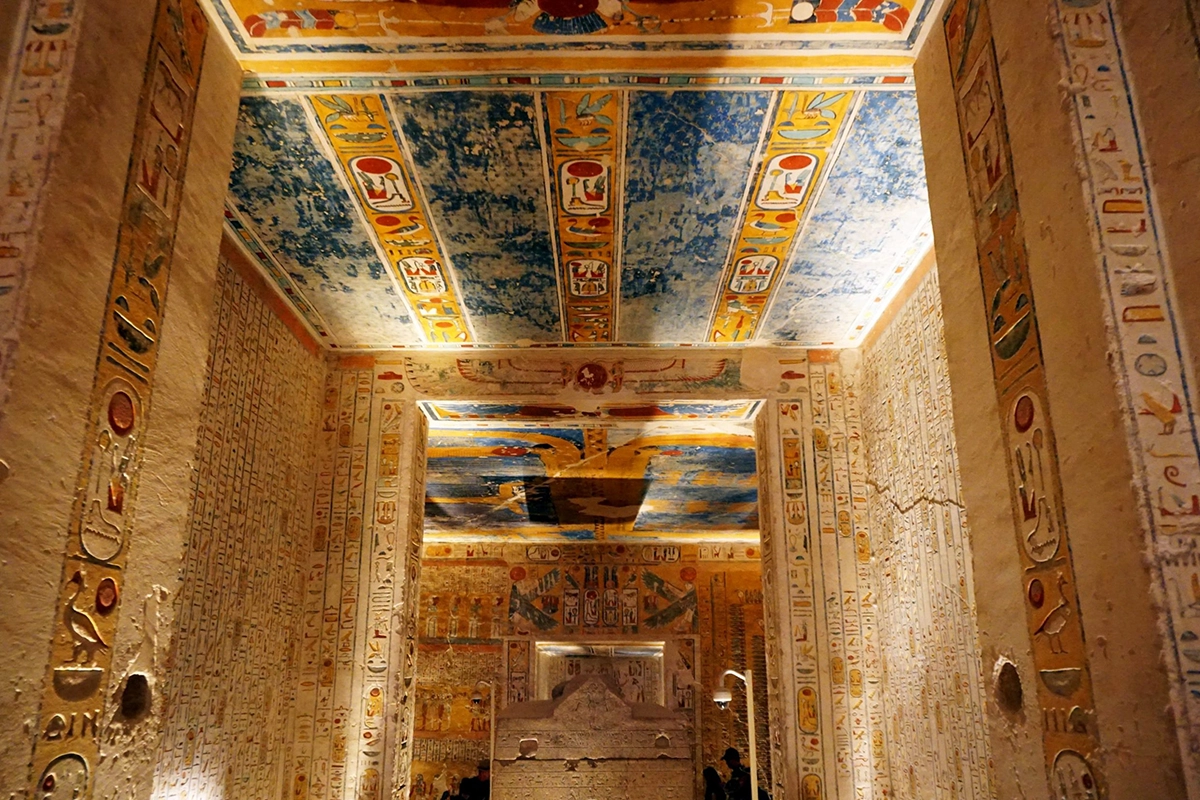
- KV9, Ramesses V and VI (extra ticket): famous for its ceiling, where the sky goddess Nut swallows the sun at night and gives birth to it at dawn. It also carries about 1,000 Greek and Latin graffiti left by ancient tourists.
- KV11, Ramesses III: known as the "Tomb of the Harpers" for its paintings of two blind harpists, with unusual side rooms showing kitchens, weapons and boats.
- KV8, Merenptah: the son and successor of Ramses II, with a corridor about 160 meters long and a huge granite sarcophagus lid carved with the king's image.
- KV2, Ramesses IV: wide, bright and easy to walk, with Coptic and Greek graffiti near the entrance. See our article on the tomb of Ramses IV.
- KV34, Thutmose III: reached by steep stairs high in a cleft of the cliff, with a cartouche-shaped burial chamber covered in the complete Amduat.
- WV22, Amenhotep III: reopened in October 2025 after decades of restoration by Japan's Waseda University, it is the newest major tomb on the visitor list.
Other tombs often on the rotation include KV1 (Ramesses VII), KV6 (Ramesses IX), KV14 (Tausret and Setnakht), KV15 (Seti II), KV16 (Ramesses I) and KV47 (Siptah).
The Graffiti and the Workers' Village
Tourism here is older than you might think. Visitors from the Greek and Roman world left more than 2,100 graffiti on the tomb walls, the earliest dated to 278 BC. The tombs themselves were cut and painted by a community of skilled craftsmen who lived in the village of Deir el-Medina, just over the hill. In the 29th year of Ramesses III, these workers staged one of the first recorded strikes in history over late grain rations, an event preserved in the Turin Strike Papyrus.
Who Was Buried in the Valley of the Kings?
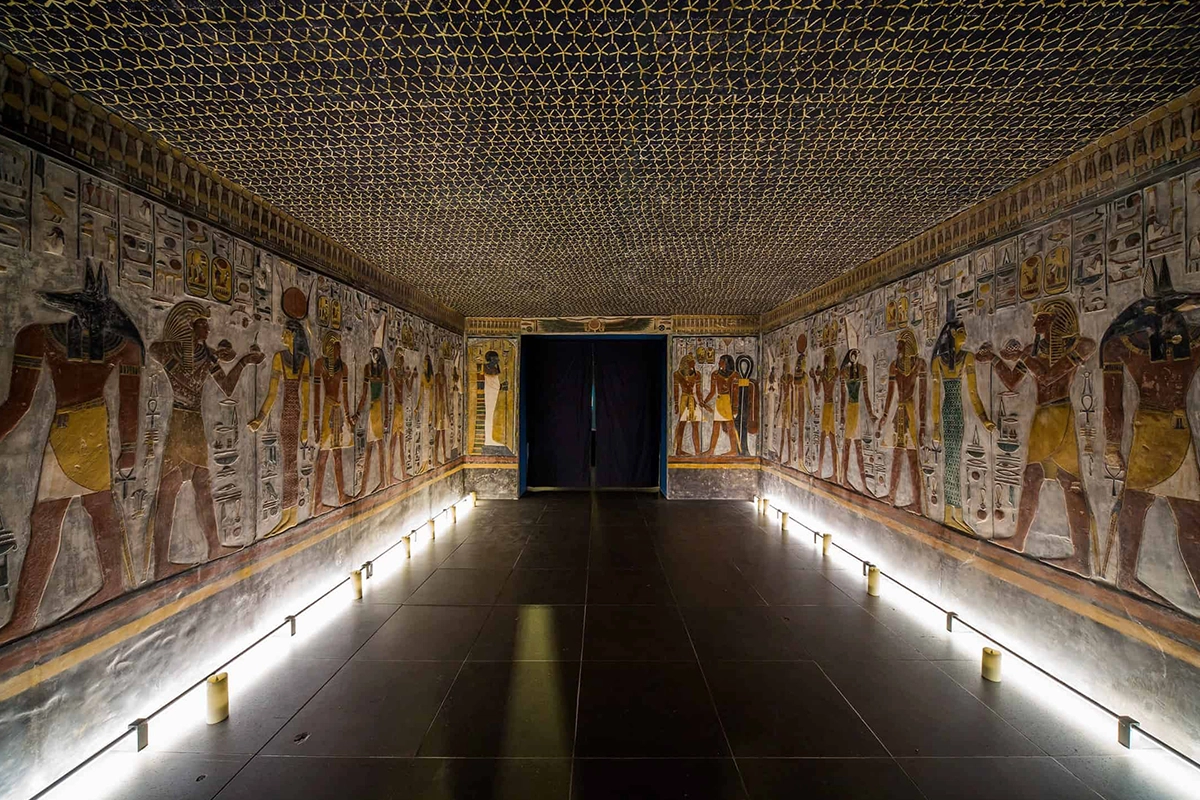
About 25 kings of the 18th, 19th and 20th Dynasties had tombs cut in the valley, along with queens, princes and a few nobles. The first royal burial here was most likely Thutmose I, and the last tomb was made for Ramesses XI, though he was probably never buried in it.
| Dynasty | Kings and their tombs |
|---|---|
| 18th Dynasty | Thutmose I (KV20, later KV38), Hatshepsut (KV20), Thutmose III (KV34), Amenhotep II (KV35), Thutmose IV (KV43), Amenhotep III (WV22), possibly Akhenaten (KV55), Tutankhamun (KV62), Ay (WV23), Horemheb (KV57) |
| 19th Dynasty | Ramesses I (KV16), Seti I (KV17), Ramses II (KV7), Merenptah (KV8), Amenmesse (KV10), Seti II (KV15), Siptah (KV47), Queen Tausret (KV14) |
| 20th Dynasty | Setnakht (KV14), Ramesses III (KV11), Ramesses IV (KV2), Ramesses V and VI (KV9), Ramesses VII (KV1), Ramesses IX (KV6), Ramesses X (KV18), Ramesses XI (KV4) |
A few names on this list deserve a closer look:
- Queen Hatshepsut ruled as a full pharaoh and extended her father's tomb, KV20, to more than 200 meters long and about 97 meters deep, so that she could rest beside him.
- Ramses II built KV7, one of the largest tombs in the valley, but floods ruined it; a Franco-Egyptian mission is still clearing it. His sons were buried in KV5 across the path.
- KV55 held a damaged mummy that DNA studies link to the family of Tutankhamun, and many scholars identify it as Akhenaten, the "heretic" king who moved the capital to Amarna.
- KV46 belonged to Yuya and Tjuyu, the parents of Queen Tiye, a rare non-royal couple granted a tomb here, found almost intact in 1905.
Where Are the Mummies Today?
Most of the kings are no longer in their tombs. Around 1000 BC, priests moved the royal mummies to protect them from robbers, hiding them in two caches: one in KV35, the tomb of Amenhotep II, and one at Deir el-Bahari near the Queen Hatshepsut Temple. Today those mummies rest in the Royal Mummies Hall of the National Museum of Egyptian Civilization in Cairo, while Tutankhamun's golden treasures are displayed at the Grand Egyptian Museum. Our guide to ancient Egyptian mummification explains how these bodies survived 3,000 years, and the Pharaohs' curse article separates the legend from the facts.
Grand Egypt Tour Valley of the Kings
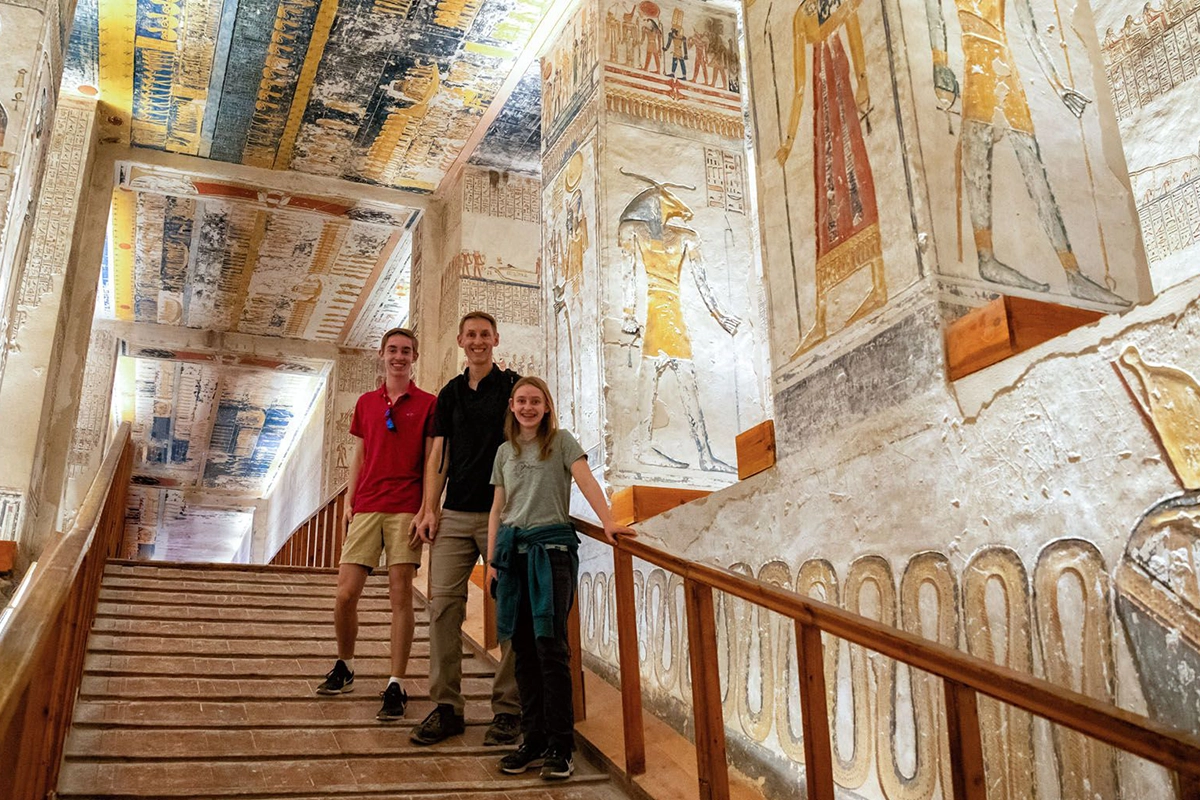
The Valley of the Kings is the centerpiece of almost every Egypt tour that includes Luxor, and the way you fit it in depends on how much time you have. Whatever you choose, the valley sits on the West Bank, so it pairs naturally with the other monuments of ancient Thebes on that side of the Nile River.
A Typical West Bank Day
Most tours follow the same efficient order, starting early to beat the heat and the crowds:
- Valley of the Kings at opening time (6:00 am), with three tombs plus any extra tickets.
- The terraced Hatshepsut Temple at Deir el-Bahari, just over the mountain from the valley.
- A photo stop at the Colossi of Memnon, two 18-meter statues of Amenhotep III.
- Lunch, then optional extras such as the Valley of the Queens, the Valley of the Nobles, Medinet Habu or the Ramesseum.
Our Full Day Tour to Luxor West Bank covers exactly this route, and the Out of Ordinary Luxor West Day Tour adds the quieter sites most visitors miss. If you want both banks in one day, the Luxor Sightseeing Day Tour combines the valley with Karnak Temple and Luxor Temple. You can browse every option on our Luxor day tours page.
Add a Sunrise Balloon Ride
The most memorable way to see the West Bank is from above. A Luxor hot air balloon ride lifts off before dawn and drifts over the fields, temples and the mountains that hide the valley, and you are back on the ground in time to reach the tombs as they open.
Visit on a Nile Cruise
Every Luxor-Aswan cruise includes a West Bank tour, usually on the first or last day. The 5 Days Nile Cruise from Luxor, the 4 Day Nile Cruise from Aswan and the 8 Days Round-Trip Nile Cruise from Luxor all stop here; see all Luxor and Aswan Nile cruises to compare ships.
Plan the Rest of Your Time in Luxor
If you stay a night or two, our things to do in Luxor list, the Luxor in 48 Hours itinerary, and the full Luxor tourist attractions guide will fill your days. The Luxor Museum and Mummification Museum Tour is the perfect companion to the tombs, and in the evening you can try the Karnak Temple Sound and Light Show or other things to do in Luxor at night.
Explore Valley of the Kings Tour Price
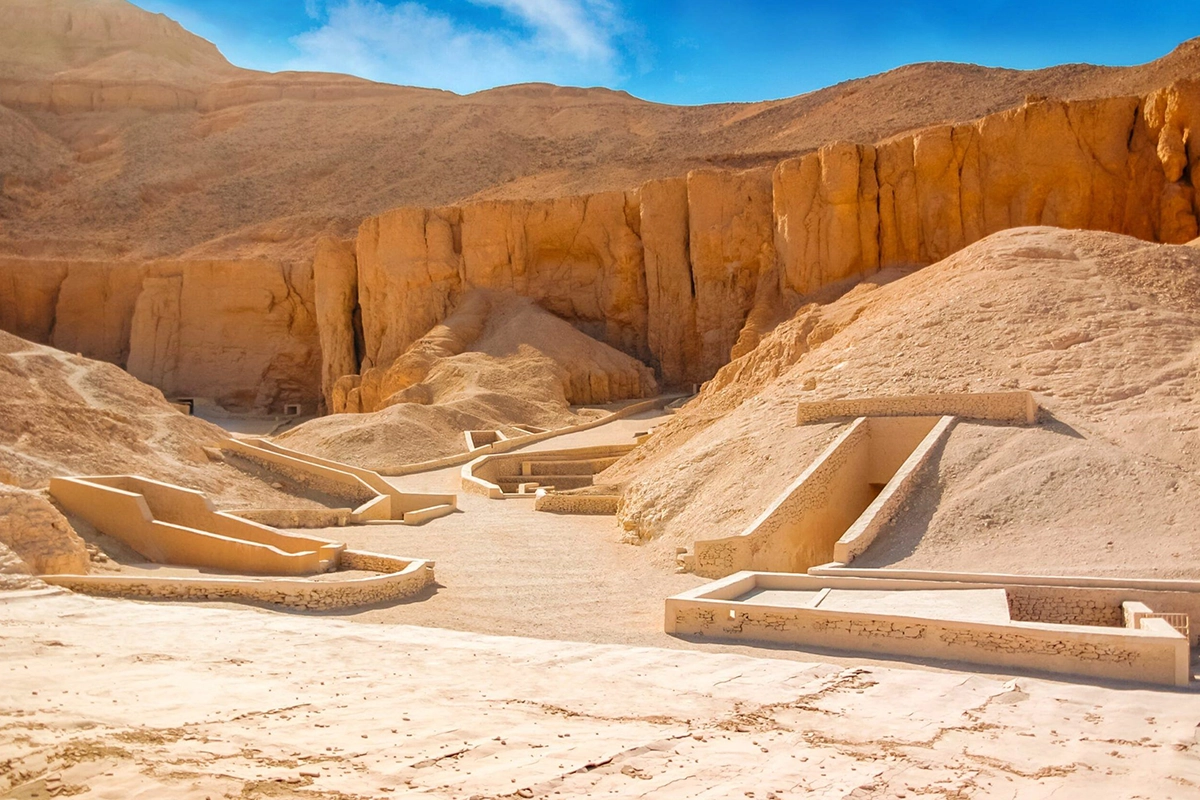
The price of your visit has two parts: the government entry tickets, and the tour itself (transport, guide and lunch). On Trips In Egypt tours, the entry fees for the listed sites are already included, but the extra-cost tombs are usually optional add-ons.
2026 Entry Ticket Prices (Foreign Visitors)
| Ticket | Adult | Student |
|---|---|---|
| Valley of the Kings (any 3 standard tombs) | EGP 750 | EGP 375 |
| Tomb of Tutankhamun (KV62) | EGP 700 | Half price |
| Tomb of Seti I (KV17) | EGP 2,000 | Half price |
| Tomb of Ramesses V and VI (KV9) | EGP 220 | Half price |
| Electric tram to the tomb entrance | EGP 20 | EGP 20 |
| Hatshepsut Temple | EGP 440 | Half price |
| Valley of the Queens (standard tombs) | EGP 220 | Half price |
| Medinet Habu, Ramesseum or Deir el-Medina (each) | EGP 220 | Half price |
| Valley of the Nobles | EGP 120 | Half price |
| Colossi of Memnon | Free | Free |
A few practical points on tickets:
- Ticket offices are now cashless. Pay by Visa or Mastercard at the gate, or buy e-tickets ahead on the official Egypt Monuments website or app.
- Student prices need a valid international student card (ISIC).
- Phone photography without flash is allowed in most tombs, and there is no longer a separate camera fee.
- The site opens daily from 6:00 am to 5:00 pm; the last entry is about an hour before closing.
- Prices are set by the Ministry of Tourism and Antiquities and change from time to time, so treat these as a guide and check the official site before you go.
Valley of the Kings Tour Packages and Prices
| Tour | Includes | Price from (per person) |
|---|---|---|
| Full Day Tour to Luxor West Bank | Valley of the Kings, Hatshepsut Temple, Colossi of Memnon, guide, lunch | $60 |
| Luxor Sightseeing Day Tour | East and West Banks in one day | $105 |
| Luxor Day Trip from Hurghada | Hotel pickup, both banks, guide, lunch | $120 |
| 2 Days Luxor Trips from Hurghada | Two-day Luxor tour with hotel night | $210 |
| 5 Days Nile Cruise from Luxor | Cruise with West Bank tour, full board | $450 |
| Luxor Day Tour from Cairo | Return flights, both banks, guide, lunch | $470 |
| 2 Days Luxor Tour from Cairo by Plane | Flights, hotel night, East and West Banks | $560 |
| 4 Days Cairo and Luxor Holiday Package | Cairo and Luxor highlights with hotels | $770 |
All our tours are private, with a professional Egyptologist guide and an air-conditioned vehicle. Prices drop as your group grows and rise in the peak Christmas and New Year season, so the final rate depends on your dates and the number of travelers.
How to Save on Your Visit
- Choose the three standard tombs carefully, and add only one extra-cost tomb if your budget is tight; Seti I is the one most guides call worth the price.
- Visit between May and September for the lowest tour rates, but start at 6:00 am, as midday temperatures in Luxor's weather often pass 40°C.
- Combine the valley with Cairo in one package rather than booking flights and tours separately.
Enjoy Cairo to Valley of the Kings Tour
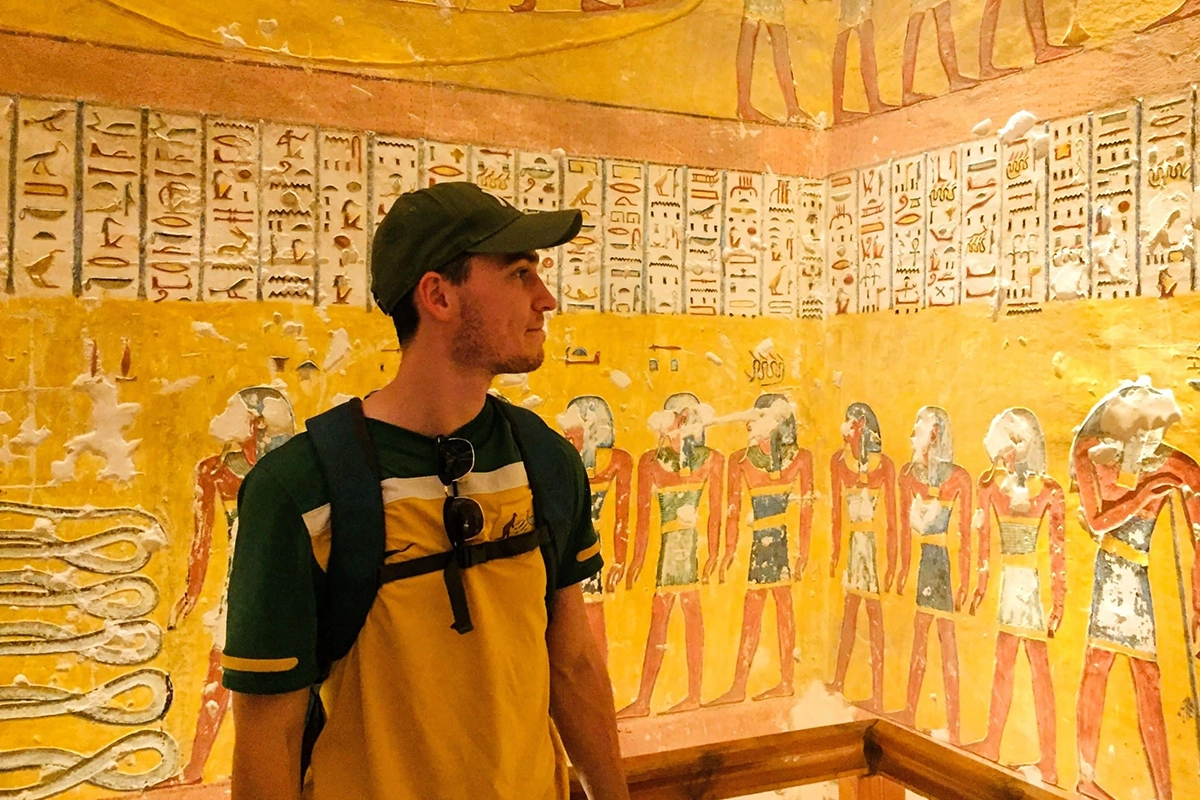
Luxor lies about 650 kilometers south of Cairo, so a Cairo to Valley of the Kings tour needs either a flight or an overnight train. The flight takes about one hour, which makes a full day trip possible.
Option 1: One-Day Tour by Plane
On our Luxor Day Tour from Cairo, you leave your Cairo hotel before dawn for an early domestic flight. Your Egyptologist meets you at Luxor Airport and takes you to the Valley of the Kings, the Hatshepsut Temple and the Colossi of Memnon, then to lunch at a Nile-view restaurant and Karnak Temple, before the evening flight back to Cairo. The price includes both flights, entry fees, the guide, lunch and all transfers. Staying in Luxor instead? The reverse Day Trip from Luxor to Cairo by Plane takes you to the pyramids.
Option 2: Two or More Days
A day trip is tiring, and an overnight stay lets you see the valley at a gentler pace. The 2 Days Luxor Tour from Cairo by Plane splits the East and West Banks across two days, while the 2 Days Luxor and Aswan Tours from Cairo and the 2 Days Tours from Cairo to Luxor and Abu Simbel add the south. For a full holiday, the Trip to Cairo and Luxor in 5 Days and the 4 Days Nile Cruise from Cairo are both popular.
Option 3: By Train
The overnight sleeper train from Cairo to Luxor takes about 10 hours and arrives in the morning, ready for a West Bank tour. It is slower but scenic and budget-friendly; read our guide to trains in Egypt for classes and booking tips.
Before your trip, the Egyptian Museum in Tahrir Square and the Grand Egyptian Museum make the perfect introduction, since many objects from the valley's tombs are displayed there. Our Half-Day Tour to the Grand Egyptian Museum fits easily into a Cairo stay.
Discover Valley of the Kings Tour From Hurghada
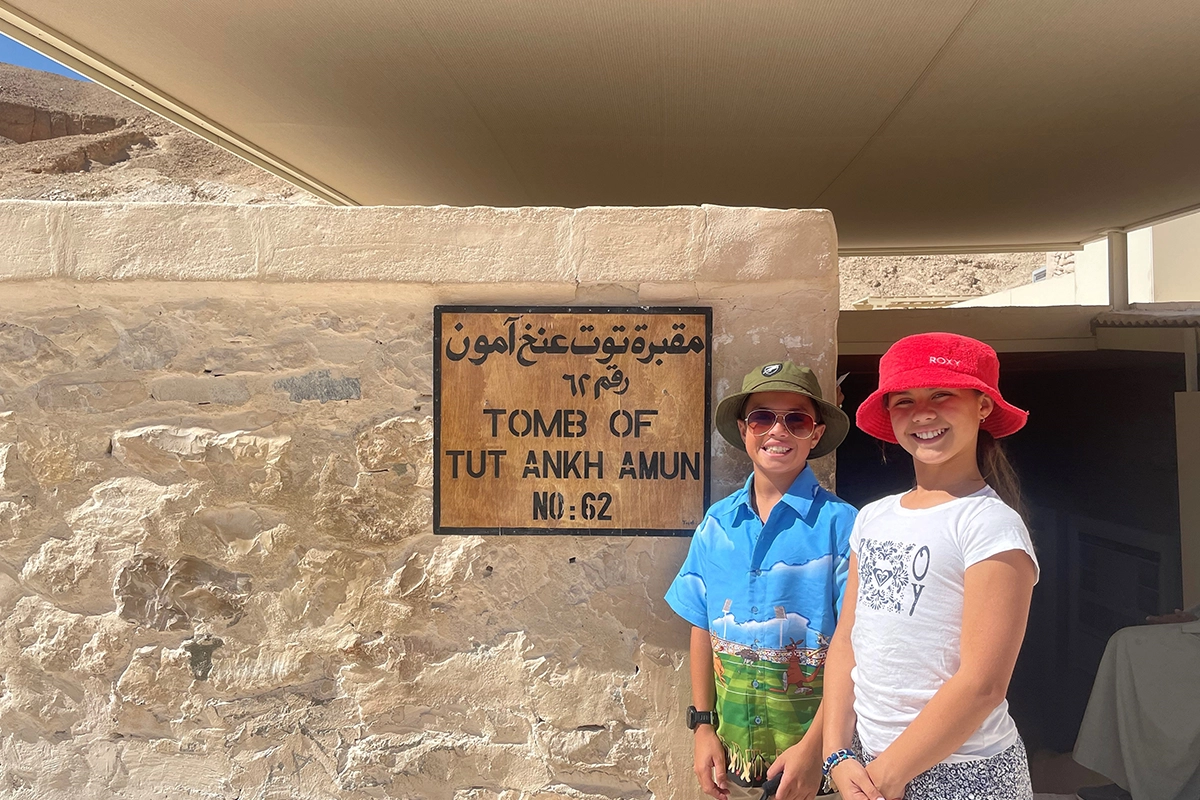
From Hurghada, the Valley of the Kings is about 300 kilometers and roughly four hours away by road, through Safaga and across the Eastern Desert to Qena and the Nile Valley. That makes it the most popular excursion from the Red Sea coast.
What the Day Looks Like
On our Luxor Day Trip from Hurghada, a private air-conditioned car collects you from your hotel in the early morning. You visit the Valley of the Kings, the Hatshepsut Temple and the Colossi of Memnon on the West Bank, have lunch at a local restaurant, and cross to Karnak Temple on the East Bank before driving back to Hurghada in the evening. Entry fees for the listed sites, a private Egyptologist guide, lunch and bottled water are included.
Hurghada Tour Tips
- Expect a long day of 14 to 16 hours, and bring a light jacket, as the desert drive is cool before sunrise in winter.
- If the drive sounds too much, the 2 Days Luxor Trips from Hurghada adds a night in Luxor, and the 2 Days Tours from Hurghada to Abu Simbel and Luxor or 2 Days Luxor and Aswan Trips from Hurghada go further south.
- For a week on the river, the Luxor and Aswan Nile River Cruise from Hurghada picks you up from your resort.
You will find more options on our Hurghada excursions page and in the Hurghada travel guide, and many holidays combine beach and temples, such as the 7 Days Cairo, Luxor and Hurghada Holiday.
From Other Red Sea Resorts and Ports
| Starting point | Tour | Price from |
|---|---|---|
| El Gouna | Luxor Day Trip from El Gouna or 2 Days Luxor Tours from El Gouna | $130 |
| Safaga | Day Tour from Safaga to Luxor or 2 Days Tours from Safaga Port to Luxor | $150 |
| Marsa Alam | Day Tour from Marsa Alam to Luxor | $190 |
| Sharm El Sheikh | Luxor Day Tour from Sharm El Sheikh by Plane | $485 |
Valley of the Kings vs Valley of the Queens
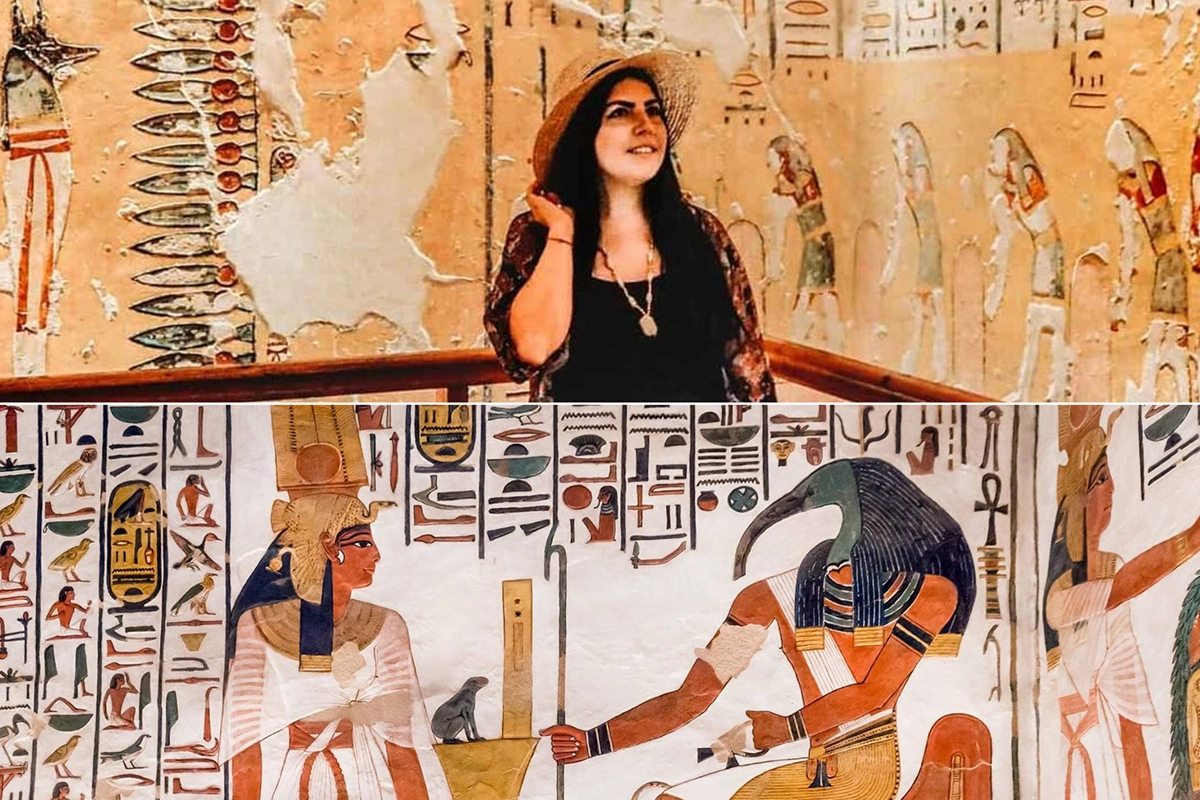
Just over the hills to the southwest of the Valley of the Kings lies its quieter neighbor. The ancient Egyptians called it Ta-Set-Neferu, often translated as "the Place of Beauty" or "the Place of the Royal Children," and it is where many royal wives and children were laid to rest.
| Valley of the Kings | Valley of the Queens | |
|---|---|---|
| Ancient name | Ta-sekhet-ma'at, "the Great Field" | Ta-Set-Neferu, "the Place of Beauty" |
| Who was buried there | Kings, a few queens, princes and nobles | Queens, princes, princesses and nobles |
| Number of tombs | 65 numbered tombs and pits | About 110 tombs |
| Period of use | About 1539 to 1075 BC (18th to 20th Dynasties) | Mainly the 19th and 20th Dynasties, with earlier 18th Dynasty shafts |
| Most famous tomb | Tutankhamun (KV62) and Seti I (KV17) | Nefertari (QV66) |
| Tomb style | Long, deep corridors with funerary books | Smaller tombs with bright, family scenes |
| Standard ticket (2026) | EGP 750 for 3 tombs | EGP 220 |
| Crowds | Busy, especially mid-morning | Usually calm |
What You Will See in the Valley of the Queens
The star is QV66, the tomb of Queen Nefertari, the beloved Great Royal Wife of Ramses II, whose paintings are often called the most beautiful in Egypt. It needs a separate ticket of EGP 2,000 and has opened and closed for conservation in recent years, so ask us about its status before you travel.
Even without it, the valley is worth a visit. The tombs of two sons of Ramesses III, Amenherkhepshef (QV55) and Khaemwaset (QV44), show the young princes being led by their father before the gods, in colors that still look freshly painted. The tomb of Queen Titi (QV52) is usually open as well.
Which One Should You Visit?
If you have time for only one, choose the Valley of the Kings: it is the larger site, with the more important tombs and the story of Tutankhamun. If you have a full day on the West Bank, see both, as the Valley of the Queens adds only about an hour and offers a calmer, more intimate experience. Our guide to ancient Egyptian tombs shows how both valleys fit into 3,000 years of burial customs, from mastabas to the Egyptian pyramids.
Book Your Valley of the Kings Tour as Soon as Possible
Few places on earth let you walk the same corridors a king's craftsmen painted 3,000 years ago, and the Valley of the Kings still keeps that golden silence beneath its mountain. Whether you fly in from Cairo, drive over from Hurghada, or step off a Nile cruise, the tombs reward an early start and a good guide.
At Trips In Egypt, we design every Luxor visit as a private tour, with your own Egyptologist, the best tombs open on the day, and all the logistics handled for you. For the complete experience, our 4 Days Cairo and Luxor Holiday Package pairs the Valley of the Kings with the pyramids of Giza. You can also explore all our Egypt tour packages and Nile River cruises, or build your own route with our tailor-made tours. Walk with the pharaohs by booking with us now or contact our operation department today.