



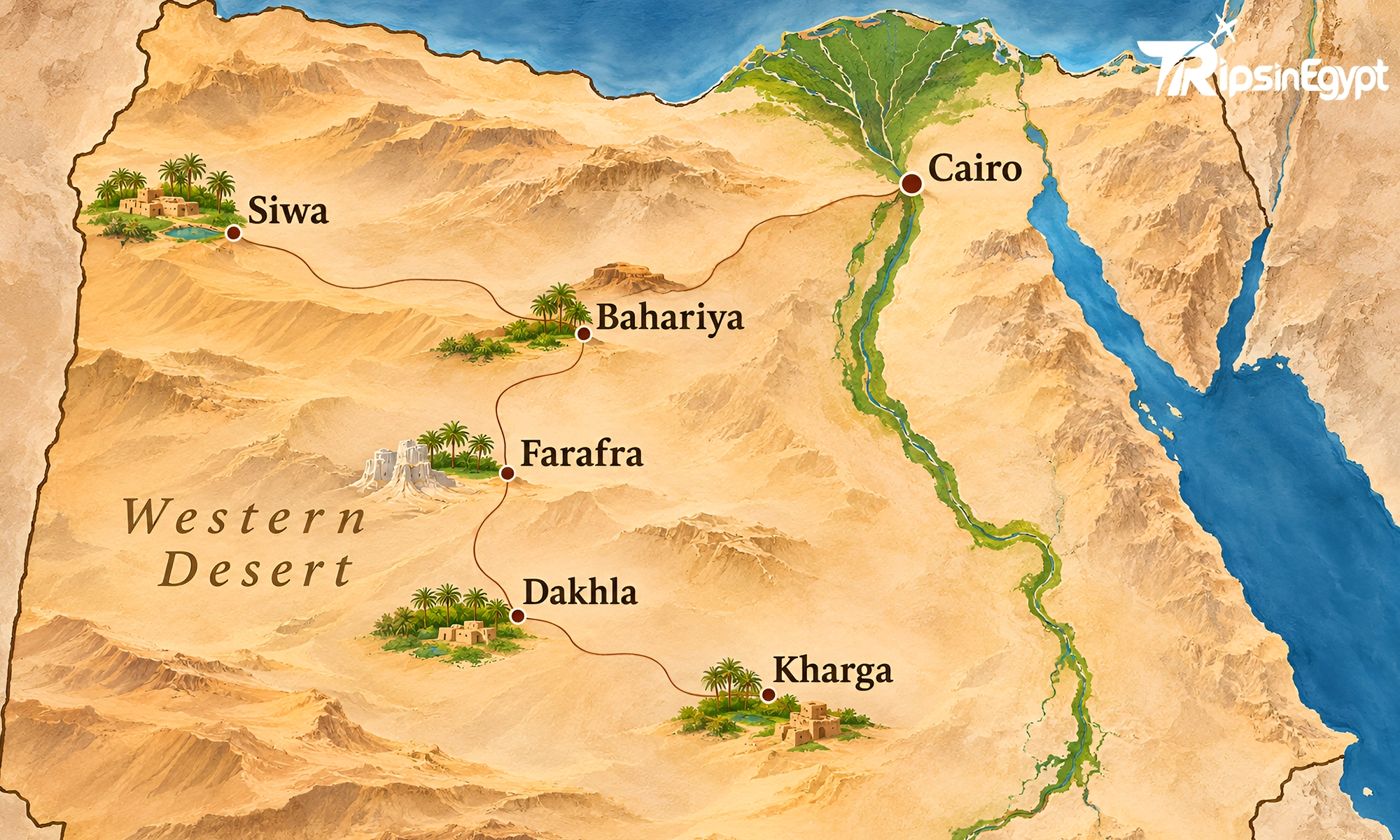
West of the Nile, the map of Egypt turns into a vast yellow space with almost no roads or towns. Scattered across it lie five green islands, Siwa, Bahariya, Farafra, Dakhla and Kharga, where springs, palm groves and villages have survived in the heart of the Sahara for thousands of years. Seeing them on a map is the first step toward one of the most memorable journeys in Egypt.
This guide reads the Egypt oasis map oasis by oasis. It explains where each one lies, the roads and distances that link them, what to see in each, and how to plan a trip by season and length. Here are all things you need to know about the oases of Egypt's Western Desert:

Where Egypt's Oases Are: Reading the Western Desert Map
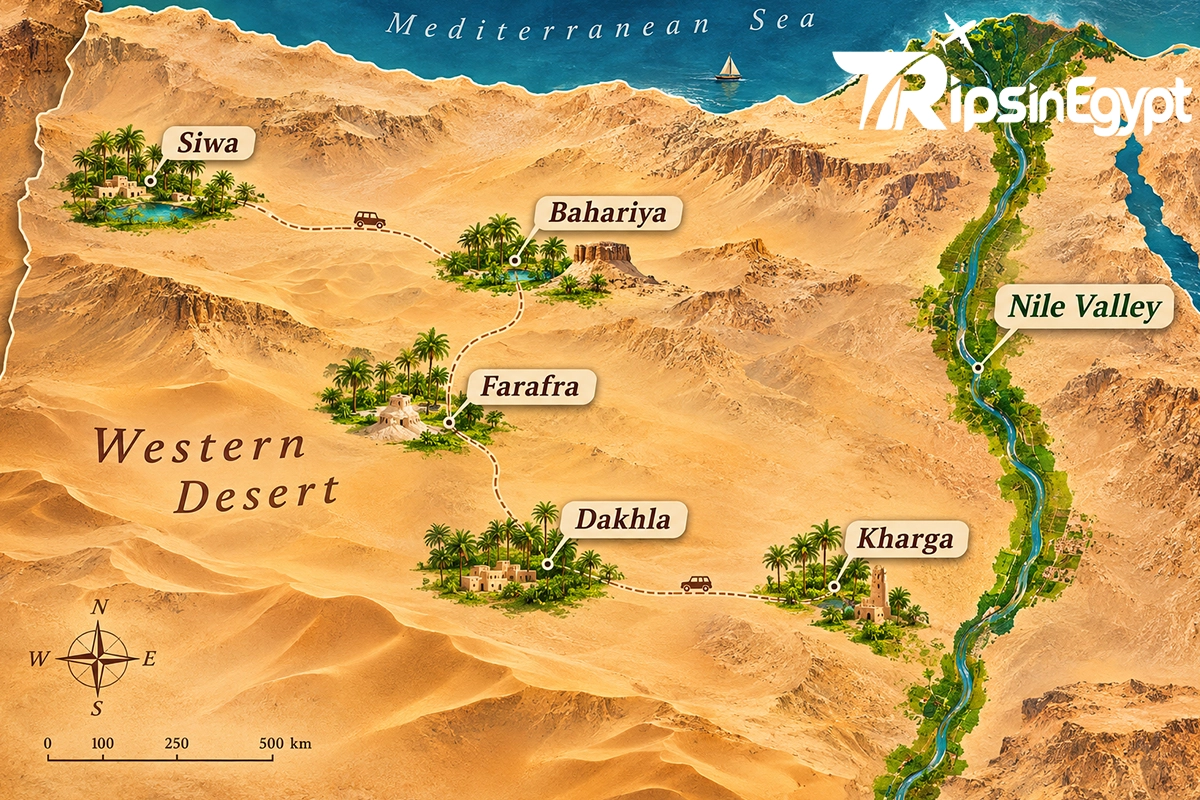
The Western Desert covers about 680,000 square kilometers, roughly two-thirds of Egypt, and runs from the Mediterranean to the Sudanese border. It is mostly a high limestone plateau, broken by a series of deep basins called depressions. Wherever these depressions cut down close to the Nubian Sandstone Aquifer, water rises through springs and wells, and an oasis appears.
On the map, the oases fall into two clear groups. Siwa stands alone in the far northwest, close to the Libyan border, and is reached from the Mediterranean coast. The other four form a great arc southwest of Cairo: Bahariya in the north, Farafra to its south, then Dakhla and Kharga curving east toward the Nile Valley.
| Oasis | Position on the map | Distance from Cairo | Governorate |
|---|---|---|---|
| Siwa | Far northwest, near Libya | About 750 km by road | Matrouh |
| Bahariya | Southwest of Cairo | About 370 km | Giza |
| Farafra | South of Bahariya | About 550 km | New Valley |
| Dakhla | Southwest, center of the desert | About 850 km via Farafra | New Valley |
| Kharga | South, west of Asyut and Luxor | About 600 km via Asyut | New Valley |
Bahariya belongs administratively to Giza, while Farafra, Dakhla and Kharga are part of the New Valley Governorate, the largest governorate in Egypt by area. Between Siwa and Bahariya lies empty desert, and to the north of this gap sits the Qattara Depression, which drops to about 133 m below sea level, the lowest point in Egypt. Closer to the capital, the Fayoum Oasis lies about 100 km southwest of Cairo, but it is fed by the Nile rather than by springs. Our overview of the oases of Egypt and our page on Egypt's deserts introduce the wider region.
Siwa Oasis: The Northwest Corner
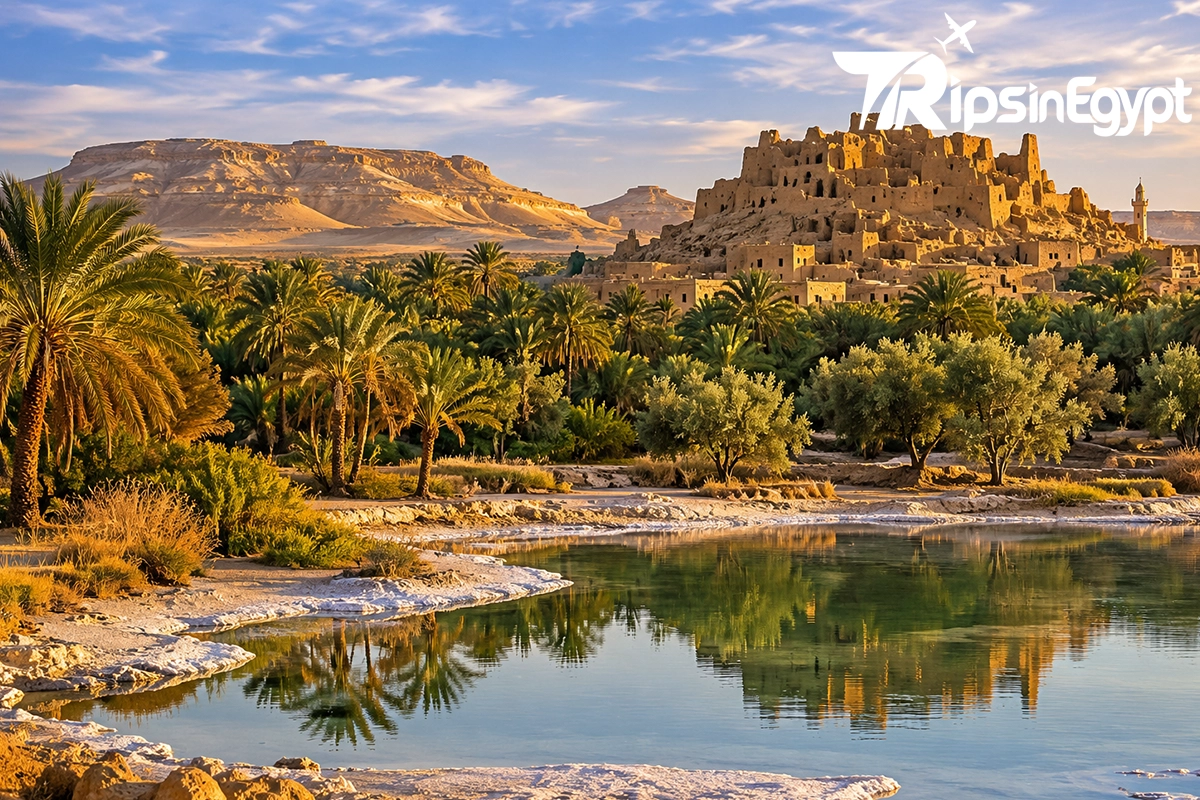
Siwa Oasis is the most isolated of the five and, for many travelers, the most beautiful. It lies about 50 km from the Libyan border, in a depression about 80 km long that sits up to 18 m below sea level. Salt lakes, olive and date groves and more than 200 springs fill its floor.
The usual road runs west along the Mediterranean coast from Alexandria to Marsa Matruh, then about 300 km south across the desert, so the drive from Cairo takes about 8 to 9 hours in total. Many travelers break the trip in Alexandria or Marsa Matruh.
Siwa's main sights sit within a few kilometers of the town:
- Shali, the old fortress town built of salt and mud-brick kershef, now partly ruined but lit beautifully at sunset.
- The Temple of the Oracle of Amun at Aghurmi, which Alexander the Great visited in 331 BC.
- Gebel el-Mawta, the "Mountain of the Dead," with painted rock tombs.
- Cleopatra's Spring, a round natural pool popular for swimming.
- The salt lakes, where you can float in water saltier than the sea.
South of the oasis begins the Great Sand Sea, one of the largest dune fields on earth, where 4x4 safaris take visitors to hot and cold springs among the dunes. The people of Siwa speak Siwi, an Amazigh language, and keep traditions quite different from those of the Nile Valley.
Bahariya and Farafra: The Northern Oases and Two Deserts
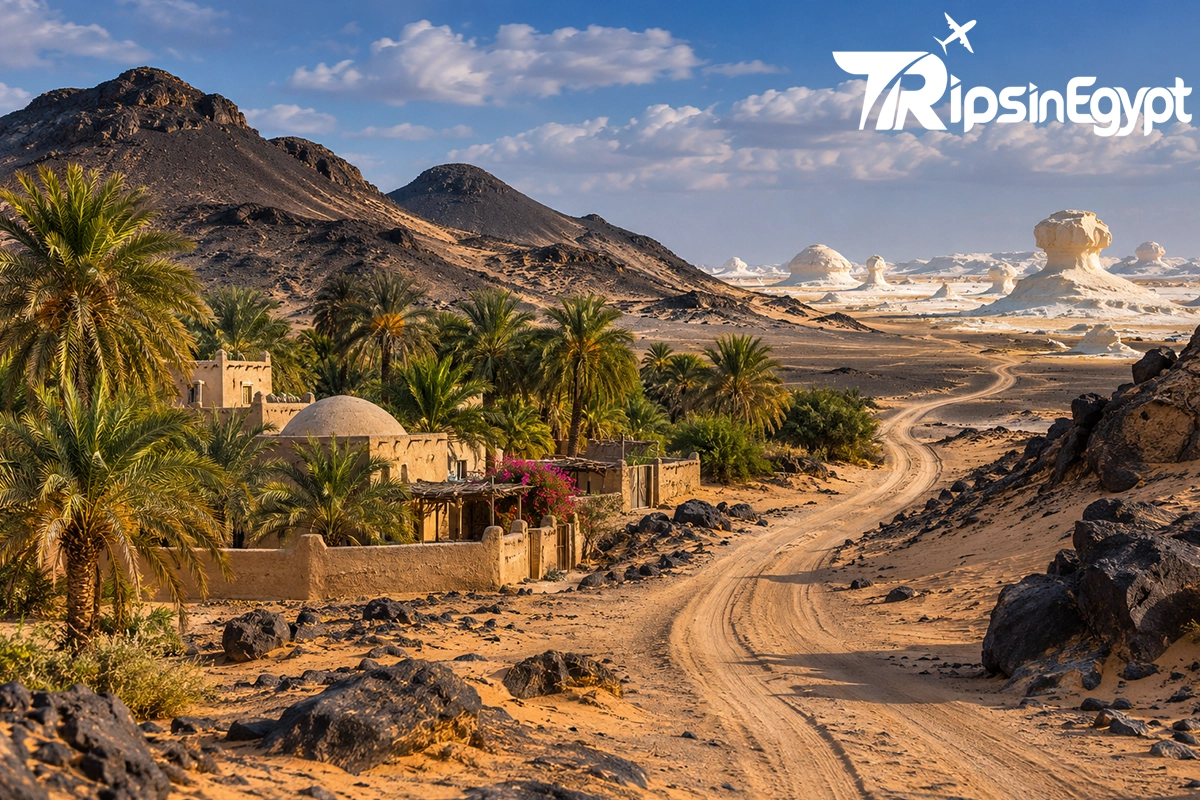
The northern half of the loop is the most visited part of the Western Desert, because it combines two oases with two of Egypt's most famous landscapes.
Bahariya Oasis is the closest to Cairo, about 370 km southwest, or four to five hours by road. Its main town, Bawiti, is the base for most desert safaris. Bahariya is home to the Valley of the Golden Mummies, found in 1996, a highlight for anyone interested in ancient Egyptian mummification, the 26th Dynasty tombs of Banentiu and Djed-Amun-iuf-ankh, and many hot and cold springs among the palm groves.
About 50 km south of Bawiti, the road crosses the Black Desert, where volcanic stones cover the tops of orange hills. Further on, Crystal Mountain is a small ridge of quartz crystals beside the road, and the Agabat valley offers dramatic views of limestone peaks and sand.
Farafra Oasis lies about 180 km south of Bahariya. It is the least populated of the five, centered on the small town of Qasr el-Farafra, with a mud-brick old quarter, the Badr Museum of local art and the hot spring known as Bir Sitta.
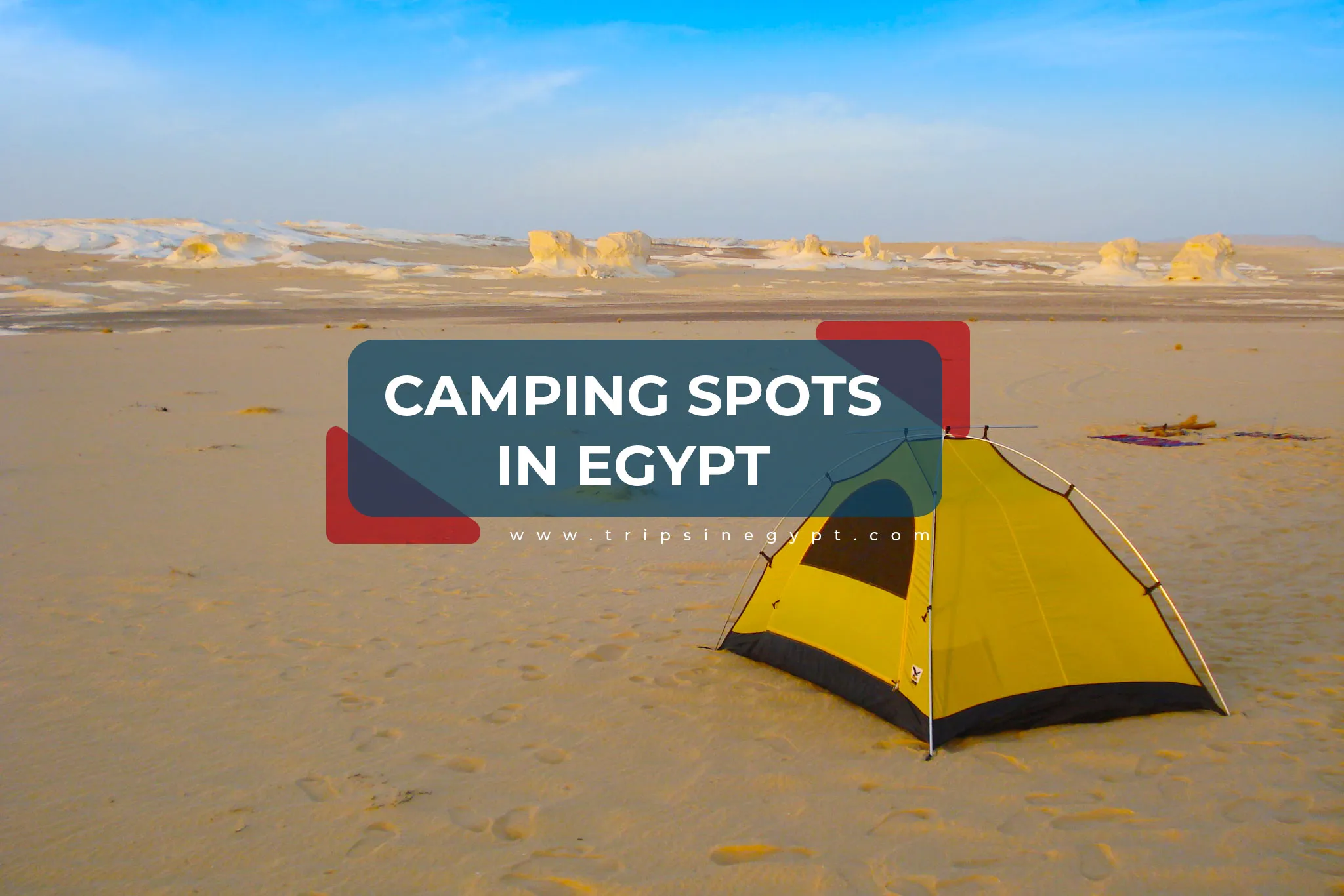
Between the two oases, about 45 km north of Farafra, lies the White Desert National Park, protected since 2002. Here, wind has carved white chalk into towers, mushrooms and shapes that glow at sunrise and sunset. Most visitors camp here for at least one night, and our overnight safari to Bahariya and the White Desert from USD 195 is the easiest way to see both. Our guides to camping spots in Egypt and stargazing in Egypt explain why the desert sky is so memorable.
Dakhla and Kharga: The Southern Oases
South of Farafra, the road runs for about 300 km across open desert before reaching the green fields of Dakhla, the start of the southern oases.
Dakhla Oasis is a string of villages, fields and orchards spread along a depression about 80 km long, with its main town at Mut. It is often called the most picturesque of the oases. Its highlights include:
- Al-Qasr, a medieval mud-brick town of narrow covered lanes, carved wooden lintels and a tall mosque minaret.
- Deir el-Hagar, a Roman-era sandstone temple dedicated to Amun, Mut and Khonsu.
- Qaret el-Muzawwaqa, two painted Roman tombs on a small hill.
- Balat, an Islamic-era village beside Old Kingdom governors' tombs.
Kharga Oasis lies about 190 km east of Dakhla, and its city of El Kharga is the capital of the New Valley Governorate. It has the richest concentration of ancient Egyptian temples and tombs in the Western Desert:
- The Temple of Hibis, a temple of Amun completed under the Persian king Darius I.
- The Bagawat Necropolis, with more than 200 mud-brick Christian chapels, one of the oldest Coptic sites in Egypt.
- Qasr el-Ghueita and Qasr el-Zayyan, small hilltop temples.
- Qasr Dush, a Roman fortress and temple near the village of Baris, about 90 km to the south.
From Kharga, roads lead northeast to Asyut, about 230 km away, and east to Luxor, which makes it possible to finish a desert journey on the Nile.
Driving the Oasis Map: Routes, Distances and Itineraries
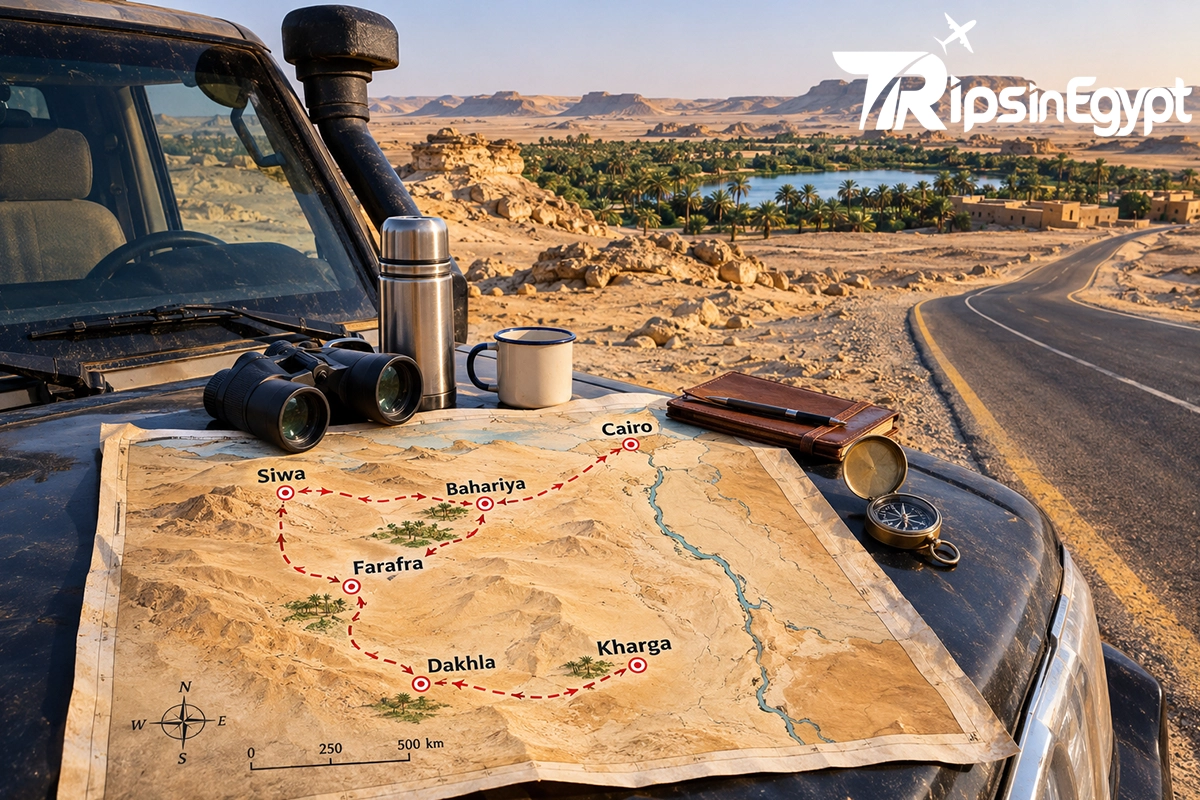
The four southern oases are linked by a paved road that forms a giant loop through the desert. Distances are long and fuel stations are few, so most travelers go with a driver.
| Route | Approximate distance | Driving time |
|---|---|---|
| Cairo to Bahariya | 370 km | 4 to 5 hours |
| Bahariya to Farafra | 180 km | 2.5 to 3 hours |
| Farafra to Dakhla | 300 km | 4 hours |
| Dakhla to Kharga | 190 km | 2.5 hours |
| Kharga to Asyut | 230 km | 3 hours |
| Asyut to Cairo | 375 km | 4.5 to 5 hours |
| Cairo to Siwa, via Marsa Matruh | About 750 km | 8 to 9 hours |
The full loop from Cairo through Bahariya, Farafra, Dakhla and Kharga and back via Asyut covers roughly 1,600 km. A desert track also links Siwa with Bahariya directly, about 400 km across open desert, but it needs a 4x4, an experienced guide and military permits.
Two to three days: Cairo to Bahariya, a night in the White Desert and back. This is the classic short trip, and our 6-day Bahariya trip from USD 500 combines it with Cairo's highlights.
Five to seven days: The full loop from Bahariya to Kharga, ending in Luxor or returning to Cairo. Our 14-day Egypt desert tour from USD 1,700 covers the oases along with the Nile Valley.
Three to four days in Siwa: A separate trip via Alexandria and the coast. Our 8-day Cairo, Alexandria and Siwa tour from USD 820 includes it. See all our Egypt desert tours for more combinations.
When to Go and Practical Tips
The oases are best visited from October to April, when days are warm, around 20 to 30°C, and nights are cool. Desert nights in December and January can fall close to freezing, especially in the White Desert, so bring warm layers and a good sleeping bag. From May to September, midday temperatures often pass 40°C, and spring can bring sandstorms. Our guide to the best time to visit Egypt compares the seasons.
Guides and permits. You can drive the paved roads between the oases, but trips into the open desert, such as the White Desert, the Great Sand Sea or the Siwa to Bahariya track, require a licensed guide and, in some areas, permits arranged in advance. Police checkpoints along the oasis road may ask for passports, so keep yours with you.
Fuel, money and phones. Fill up at every town, carry cash in Egyptian pounds, as ATMs exist only in the main towns, and expect weak phone signal between oases. Download offline maps before you leave Cairo.
Where to stay. Each oasis has a few simple hotels and ecolodges, and Siwa and Bahariya have the widest choice. Many travelers also spend at least one night camping in the desert.
Explore Egypt's Oases With Trips In Egypt
From the salt lakes of Siwa to the temples of Kharga, Egypt's oases show a side of the country that few visitors ever see. Under the eternal desert sky, every stop on the map becomes a story of water, stone and survival. Shed light on our Egypt tour packages to add the oases to your journey, or let us plan a tailor-made tour across the Western Desert.

5 Days Cairo And Hurghada Trip
Amazing 4 Nights Cairo and Hurghada Trip Itinerary 5 Days Cairo and Hurghada trip wil...
- Duration 5 Days / 4 Nights
- Location Cairo & Hurghada
- Type Historical & Recreational Tour
From$690/per person
View Tour
6 Days Cairo, Alexandria & Faiyum Tour
Unforgettable Cairo, Alexandria & Faiyum Adventure in Six Days 6 Days Cairo, Alex...
- Duration 6 Days / 5 Nights
- Location Cairo - Alexandria - Fayum
- Type Historical Tour
From$720/per person
View Tour
10 Days Cairo, Faiyum & Nile Cruise Holiday
Breathtaking 10 Days Journey of A Lifetime in Egypt 10 Days Cairo, Faiyum & Nile...
- Duration 10 Days / 9 Nights
- Location Cairo, Luxor, Aswan & Faiyum
- Type Classic Tour
From$1350/per person
View Tour SOLD OUT
Ultimate 7-Day Egypt Solar Eclipse Experience with Hurghada 2027
Enjoy a 7-Day Egypt Solar Eclipse Tour with Hurghada 2027 6 Nights Egypt Solar Ecli...
- Duration 7 Days / 6 Nights
- Location Cairo / Giza / Luxor / Hurghada
- Type Astronomical Tour
Sold Out
View Details